
You reach for your coffee and your fingers buzz with pins and needles. Or you wake up and your hand is half-numb, your forearm tingling, and there's that familiar ache running from your neck into your shoulder. The combination is unsettling — the back or neck pain you can live with, but the tingling traveling down your arm feels like a signal you shouldn't ignore.
You're right that it's a signal. Back pain with arm tingling almost always means a nerve is involved, not just a sore muscle. The good news is that in most non-traumatic cases, the nerve isn't damaged — it's irritated or slightly compressed, usually where it exits the neck. Once you understand the link between your neck and your hand, the pattern stops feeling random and starts pointing toward what to do.
How a neck problem reaches your hand
The nerves that run all the way down each arm and into your fingers don't start in your arm. They start in your neck. They branch off the spinal cord, exit between the bones of your cervical spine, then travel down through your shoulder and arm to your hand.
That's the whole link. When one of those nerve roots gets irritated or compressed where it leaves the neck — by a tight, inflamed joint, swollen tissue, or a disc pressing on it — the nerve sends faulty signals along its entire length. Your brain can't always tell where the irritation is. It just receives "trouble on this nerve," and you feel it wherever that nerve goes: tingling in the forearm, numbness in specific fingers, a buzzing palm. The ache stays in your neck and shoulder; the tingling shows up in your hand. Same nerve, two ends.
Which fingers tingle is actually a clue. Different nerve roots supply different parts of the hand, so a clinician can often guess which level of the neck is involved just from where the numbness lands. You don't need to map that yourself — the point is that the hand symptom is reporting on the neck.
Why posture is so often behind it
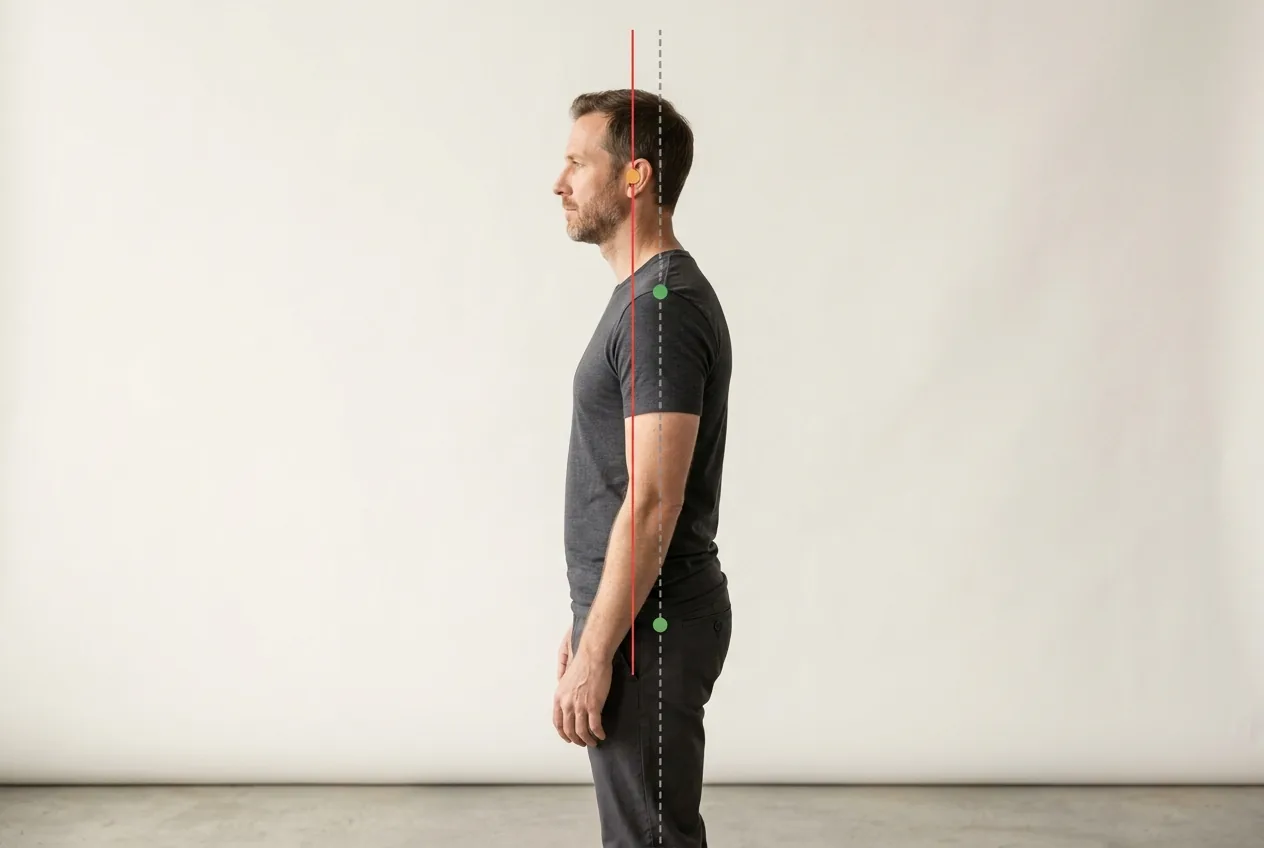
The most common reason a neck nerve gets irritated without any injury is sustained forward-head posture. When your head lives out in front of your shoulders — over a screen, a phone, a steering wheel — the joints at the back of your neck compress and the spaces where the nerves exit narrow. Hold that for years and the tissue around those exits gets cranky. A nerve that had room now gets nudged.
The same posture that compresses the neck also rounds the shoulders forward, and that can pinch nerves further down their path, through the shoulder. So the tingling can have more than one chokepoint along the route, all driven by the same collapsed-forward posture. This is the territory of a pinched nerve in the neck, and recognising the signs early is what keeps it from settling in.
The hand is where you feel it. The neck is usually where it starts.
What helps a posture-driven nerve calm down
The aim is to give the nerve more room and stop re-irritating it. Gentle and consistent wins here — aggressive stretching can flare an irritated nerve.
- Chin tucks. Sit tall, draw your chin straight back without tipping your head, hold five seconds, release. Ten reps, several times a day. This decompresses the back of the neck and opens the exits where the nerve travels.
- Open the chest, gently. Clasp your hands behind your back, draw your shoulder blades together, lift your chest. This counters the rounded-shoulder posture that narrows the nerve's path through the shoulder.
- Nerve glides, light. Extend the affected arm out to the side, palm up, and slowly tilt your head toward the opposite shoulder, then back. This eases the nerve along its track. Stop well before any sharp increase in symptoms — gliding, not stretching.
- Fix the screen. Raise your monitor so the top is at eye level and pull it close enough that you're not craning. Most forward-head posture is built at a badly set-up desk.
What to stop: don't crank your neck into deep stretches or yank it during a "crack," and don't power through long static hours. Recognising the broader signs of nerve entrapment helps you tell ordinary tension from a nerve that needs attention.
When to see a doctor
This is the article where the red flags matter most, so read this part carefully. Sudden weakness in your arm or hand, loss of coordination, or a dropping/clumsy grip means you should see a doctor promptly — that's beyond simple irritation. Also seek prompt care if tingling or numbness is spreading or worsening, if it follows a fall or accident, if it affects both arms or your legs as well, or if you have any loss of bladder or bowel control. Fever with neck pain, or pain that's severe and steadily worsening, also warrants a professional look. Mild, intermittent tingling that eases when you change posture is far more reassuring — but if it's escalating, don't wait it out.
Finding your own pattern
Chin tucks and chest openers help most posture-driven nerve irritation because forward-head posture is so common. But the exact pattern — how far forward your head sits, which shoulder rounds more, where along the route the nerve is getting nudged — is individual. A move that opens space for one person's nerve can be neutral or aggravating for another's.
Generic advice gets you started. Lasting relief tends to come from knowing your own posture and training the specific deviations behind it. A short posture assessment measures where your head and shoulders actually sit and builds a daily routine around that, so you're giving your particular nerve the room it needs rather than guessing.
Common questions
Why do my fingers tingle when my neck hurts?
Because the nerves that reach your fingers begin in your neck. When a nerve root is irritated or compressed where it exits the cervical spine, it sends faulty signals along its whole length — so you feel the ache in your neck and the tingling out in your hand, even though it's the same nerve.
Is arm tingling with neck pain dangerous?
Usually it's irritation rather than damage, especially if it comes and goes and eases when you change position. It becomes urgent if you develop weakness, a clumsy or dropping grip, loss of coordination, spreading numbness, or any bladder or bowel changes — those signs mean see a doctor promptly rather than waiting.
Can bad posture cause tingling in my hands?
Yes. Sustained forward-head and rounded-shoulder posture narrows the spaces where neck nerves exit and travel, which can irritate them enough to produce tingling and numbness in the hand. Correcting the posture that's compressing the nerve is often what settles the symptom.
How long does posture-related arm tingling take to settle?
When it's mild and posture-driven, many people notice improvement within a couple of weeks of decompressing the neck and fixing their setup. Nerve irritation can be slow, though, and symptoms that aren't improving after a few weeks — or that are worsening — should be assessed by a clinician.