
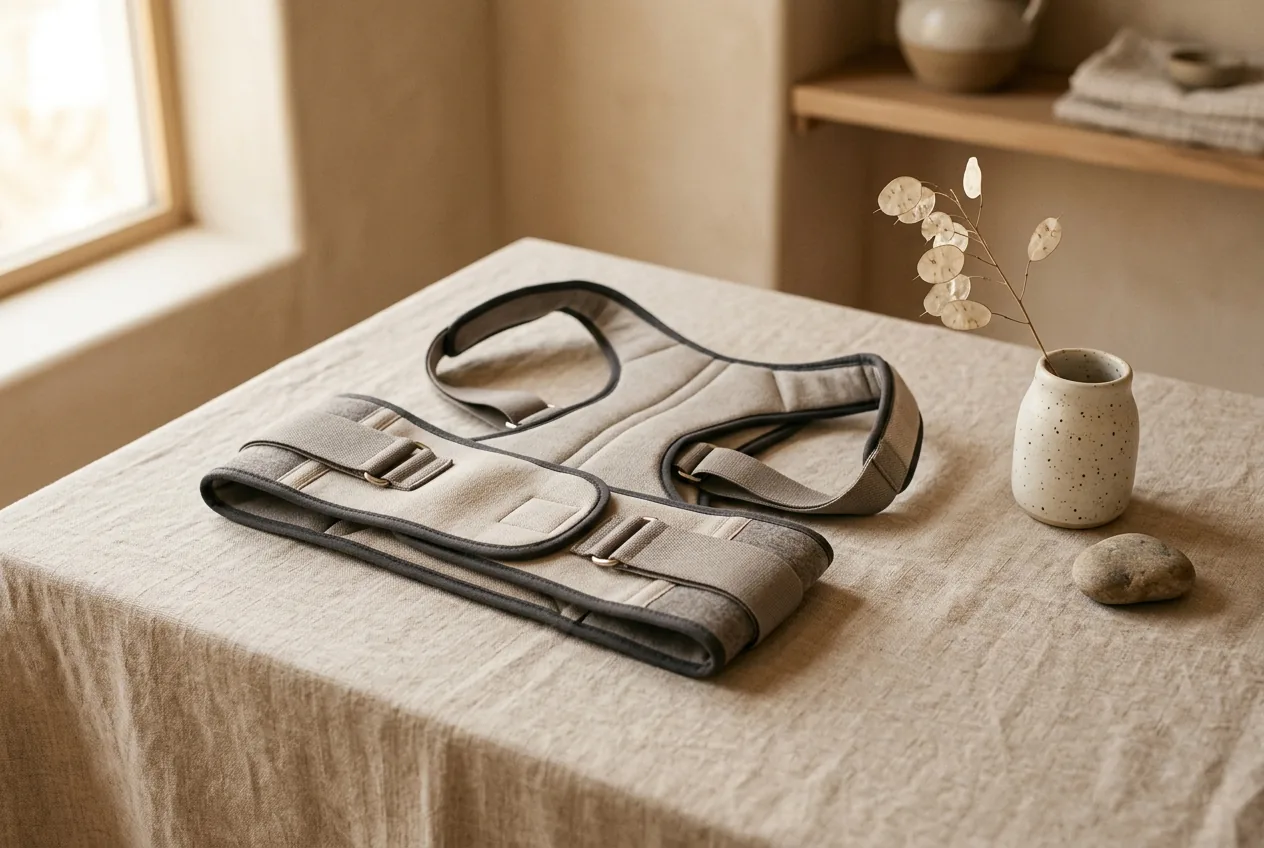
You ordered the brace after catching your reflection in a window — shoulders rolled forward, head jutting toward the screen, looking a decade older than you are. It arrived, you strapped it on, and for the first hour you sat up straighter. Then your shoulders ached, you loosened it, and by week two it was in a drawer.
So do posture correctors work? The honest answer is: a little, for a short time, in a narrow way. They are not useless. They are also not the fix the packaging implies. Knowing the difference saves you money and, more importantly, saves you from chasing the wrong solution for another year.
What a posture corrector actually does
A posture corrector is a strap or brace that pulls your shoulders back and reminds your upper body where "upright" is. Most work by gently retracting your shoulder blades and discouraging the forward slump. That's the entire mechanism. It's a physical cue, like a string tied around your finger, except the string is across your chest.
When you wear one, you do stand straighter. That part is real and you'll feel it. The problem is what's holding you up: the brace, not your muscles. The device does the work your own back is supposed to do.
A corrector holds you in a better shape. It doesn't teach your body how to hold itself.
This matters because posture isn't a position you snap into. It's the resting result of which muscles are strong and switched on versus which have gone weak and quiet. A slumped upper back usually means tight chest muscles pulling you forward and weak mid-back muscles failing to pull you back. A strap overrides that tug-of-war from the outside without changing either side of it.
The case for wearing one (it's not zero)
Correctors aren't a scam, and dismissing them entirely misses where they genuinely help.
- As an awareness tool. If you have no idea what neutral posture even feels like, a brace can give you a reference point for a couple of weeks. Many people honestly don't know they're slumping until something stops them.
- For short, specific stints. Wearing one for 20–30 minutes during a task where you always collapse — a long drive, a stretch of focused desk work — can interrupt the habit without your body becoming dependent on it.
- As a pain interrupt. If forward slump is feeding upper-back or neck tension, a brief reset can take the edge off while you do the real work elsewhere.
Used like this, a corrector is a training wheel. The trouble starts when people treat it as the bicycle.
The case against relying on one
Here's what the marketing leaves out.
Wear a brace all day, every day, and two things tend to happen. First, the muscles that should be holding you upright get even lazier, because the strap is doing their job. You can end up slightly weaker than when you started. Second, the constant pull can create new tension across the shoulders and chest, which is why so many people find the thing uncomfortable after the first hour.
There's also the simple fact that a strap only addresses your shoulders. It does nothing for the pelvis, the hips, or the lower back — and upper-body slump is very often downstream of what's happening below. If your pelvis is tilted and your hip flexors are tight from sitting, your upper back rounds to compensate. Pull the shoulders back with a strap and you've treated the smoke, not the fire. This is the same reason posture and back pain are so tightly linked: the body works as a chain, and a brace clamps one link.
What actually changes posture
Posture changes when the muscles change. There's no shortcut around that, but it's more doable than it sounds, because you're retraining a habit, not lifting heavy.
- Loosen what's tight. For a forward-rounded upper body, that usually means the chest and the front of the shoulders. A doorway pec stretch — forearms on the frame, step through gently, hold 30 seconds — directly counters the pull a brace tries to override.
- Wake up what's weak. Wall angels (back against a wall, arms sliding up and down keeping contact) and simple rows train the mid-back muscles to do the holding themselves. A few minutes daily beats a long session once a week.
- Address the base. If you sit all day, stretch your hip flexors and activate your glutes, because slumped shoulders often start at a tilted pelvis.
- Move more often. No posture is good for hours straight. The best correction is changing position regularly, not holding one rigid pose.
Do this for a few weeks and you build the thing a corrector can only fake: a back that holds itself without being told.
When to see a doctor
Posture work is safe for most people, but pain has limits as a thing to self-manage. See a clinician promptly if you have numbness, tingling, or weakness spreading into your arms or legs, any loss of bladder or bowel control, back pain that follows a fall or accident, fever alongside back pain, unexplained weight loss, or pain that's severe or steadily getting worse. A brace won't fix any of those, and they deserve a real assessment.
The piece a brace can't give you
Here's the gap. A corrector assumes everyone's posture problem is the same — shoulders forward, pull them back. But the slump you see in the mirror is the visible end of a specific chain of tight and weak muscles, and that chain is different from the next person's. A move or device that helps one pattern can do nothing, or worse, for another. That's why generic fixes — including straps — work for some people and quietly fail others.
Lasting change comes from knowing your own pattern: where you're actually tight, where you've gone weak, how your whole alignment sits, not just your shoulders. That's the idea behind a posture-based method that measures your real deviations and builds the routine around them. If you've tried correctors and stretches without it sticking, that missing step — matching the work to your body — is usually the reason. For a wider view of the non-drug options people reach for, our piece on alternative approaches to back pain is worth a read too.
A posture corrector can remind you where upright is. It can't build the back that gets you there and keeps you there. Use it as a nudge if you like — then do the work that makes it unnecessary.
Common questions
How many hours a day should I wear a posture corrector?
Short stints work better than all-day wear. Twenty to thirty minutes during a task where you tend to collapse is plenty, and wearing one constantly can let the muscles that should hold you up get lazier.
Can a posture corrector make my posture worse?
Worn all day, every day, it can. The strap does the work your back muscles are supposed to do, so over time they can switch off rather than strengthen, and you may end up relying on it.
Do posture correctors help with back pain?
They can take the edge off upper-back or neck tension that comes from slumping, but only while you wear one. They don't change the muscle balance underneath, so any relief tends to fade once it's off.
Are posture correctors worth buying?
As a short-term awareness tool to learn what upright feels like, they can be useful. As a standalone fix for posture or pain, they fall short, because lasting change comes from retraining the muscles themselves.