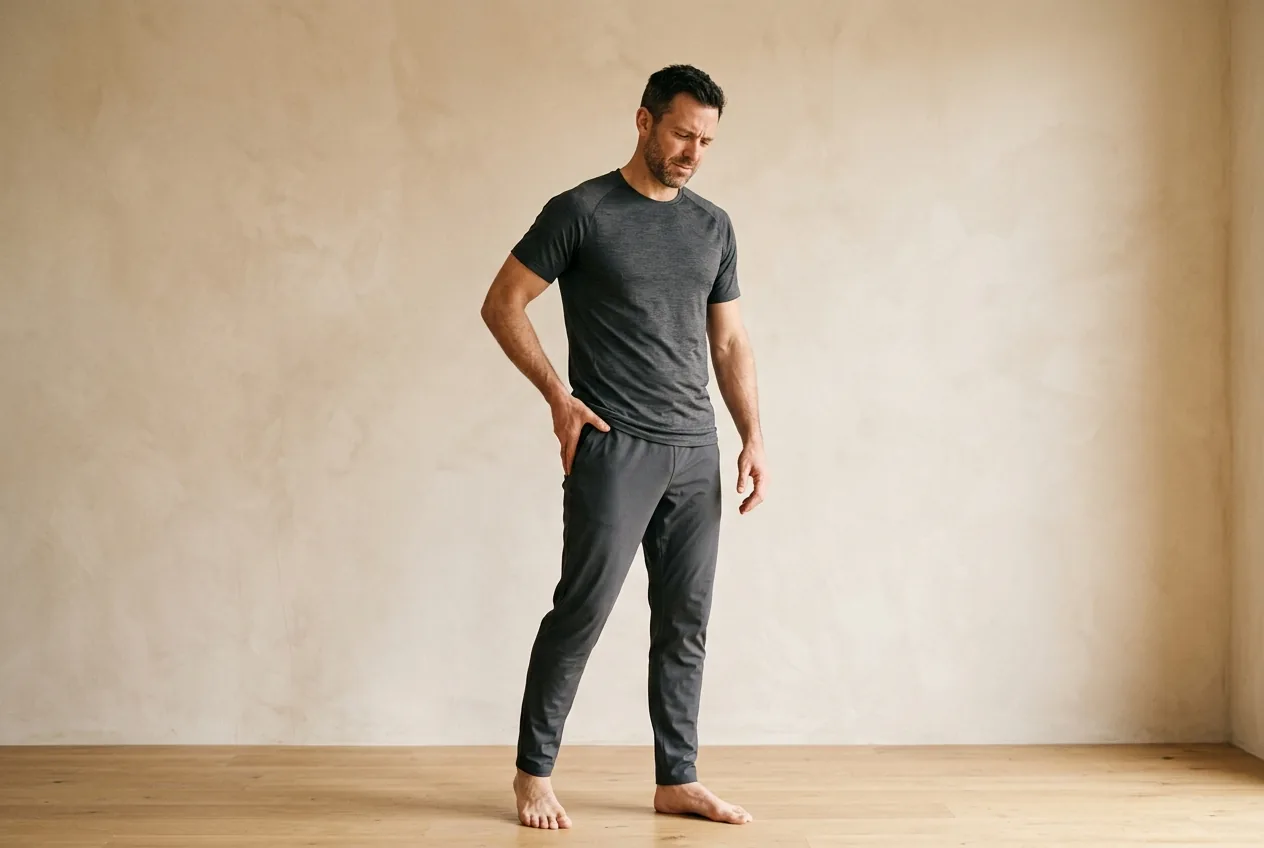

You reached for a sprint, a fast first step, or you bent to grab something off the floor, and the back of your thigh grabbed back — a sudden catch, maybe a small tearing feel, and then a deep ache that you notice on every stride and every time you sit down hard. If that's the moment that brought you here, you've almost certainly got a hamstring strain.
First, the terminology, because it trips people up. A "pulled hamstring" and a "hamstring strain" are the same thing. "Pulled" is the everyday word; "strain" is the clinical one. Both describe muscle fibres in the back of the thigh being stretched past what they could take, so some of them tear. Nothing was actually pulled out of place. The fibres overloaded and gave.
What a hamstring strain actually is
The hamstrings are three muscles running down the back of your thigh, from your sitting bones to just below the knee. They bend the knee and extend the hip, and they work hardest in the split second your leg is out in front of you and decelerating — the exact moment of a sprint stride or a hard reach. That's when most strains happen: the muscle is lengthening and contracting at the same time, and a few fibres can't hold the load.
Strains are graded by how much tore. A grade 1 is a mild overstretch with a few torn fibres — sore and tight, but you can walk. A grade 2 is a partial tear — clear pain, often bruising, a limp. A grade 3 is a full rupture — sudden severe pain, major weakness, sometimes a visible gap. Most everyday strains are grade 1 or 2 and heal with patience.
Signs of a hamstring strain
The signature is sudden pain in the back of the thigh during a powerful or fast movement. After that, the usual signs are:
- Tenderness along the back of the thigh, sometimes up near the sitting bone.
- Pain on stretching — bending forward or straightening the knee with the leg raised pulls on it.
- Pain on contracting — bending the knee against resistance, or pushing off to walk.
- Bruising that may appear over the next day or two, sometimes tracking down toward the knee.
- A limp or a guarded, shortened stride in the worse cases.
One thing worth flagging: not every ache in the back of the thigh is a torn muscle. Pain that builds gradually, runs lower toward the knee, or comes with tingling or numbness can be referred from the lower back or the sciatic nerve rather than a true strain. The difference matters because the fix is completely different — more on that in pain in the back of the thigh.
A strain announces itself in a moment. A nerve referral creeps in and travels. If you can't name the moment it happened, question whether it's really the muscle.
How long recovery takes
This is the question everyone asks, and the honest answer is that it depends on the grade.
A mild grade 1 strain usually settles in a few days to a couple of weeks. A grade 2 partial tear is more often three to six weeks, sometimes longer before you trust it at full speed. A grade 3 rupture is months and sometimes needs a surgeon's opinion. Those are rough ranges, not promises — your own timeline depends on how much tore and how well you load it back up.
The single biggest mistake is rushing back. Hamstrings are the most re-injured muscle in the body, mostly because people return to sprinting or fast bending while the repaired tissue is still weak. The scar tissue laid down during healing is less elastic than the original, so a half-healed hamstring snapped back into a sprint tends to tear again, often worse.
What to do, week by week
The first few days. Calm it down. Relative rest — stop the thing that hurts, but keep walking gently if you can. Ice the sore area for 10 to 15 minutes a few times a day in the first 48 hours. Avoid hard stretching early; yanking on torn fibres slows healing.
Once the sharp pain eases. Start gentle, pain-free movement. Easy walking, then light range-of-motion work — slow knee bends and small hamstring stretches taken only to mild tension, never sharp pain.
The rebuild. This is the part people skip, and it's the part that prevents re-injury. The hamstring needs to be loaded while it lengthens, because that's how it failed in the first place. Slow, controlled strengthening — bridges progressing to single-leg work, and eventually controlled eccentric exercises where the muscle works as it lengthens — rebuilds capacity. Add speed and stretch back gradually, last of all.
The test before returning. You should be able to contract and stretch the muscle without pain, and the injured side should feel close to as strong as the other before you sprint.
The back-of-the-leg piece most people miss
Here's what catches a lot of people out. Chronically tight, easily strained hamstrings are often not a hamstring problem at all — they're a posture problem. When the pelvis tips forward and the glutes go quiet from years of sitting, the hamstrings get held long and asked to do the glutes' job of extending the hip. A muscle that's already working at a stretch all day has very little margin left, so it strains more readily and feels permanently tight no matter how much you stretch it.
That's the link between hamstring tightness and back pain: the same pelvic tilt that overworks your hamstrings also loads your lower back. Stretch the hamstring all you like — if the pelvis stays tipped and the glutes stay weak, the tightness returns within hours.
When to see a doctor
This is posture and recovery education, not medical advice. See a clinician promptly if you heard or felt a pop with sudden severe weakness, if there's a visible gap or large lump in the muscle, if you can't bear weight, or if the pain came with numbness, tingling, or weakness spreading down the leg, which points to a nerve rather than a strain. Pain near the sitting bone that lingers for weeks, or any back pain with loss of bladder or bowel control, fever, or unexplained weight loss, should be checked without delay.
Why your own pattern decides the outcome
You can rehab a strain by the book and still tear it again if the reason it strained — a tipped pelvis, quiet glutes, a back that's not sharing the load — never changes. Generic hamstring stretches treat the symptom and miss the setup. A posture assessment that measures your own deviations shows whether your hamstrings are tight because they're genuinely short or because they're being held long by a forward-tipped pelvis, and that's what decides whether you should be stretching them or strengthening what quit.
Common questions
Is a pulled hamstring the same as a hamstring strain?
Yes. They're two names for the same injury — muscle fibres in the back of the thigh stretched past their limit so some tore. "Pulled" is the casual term and "strain" is the clinical one. Neither means anything moved out of place; the fibres simply overloaded.
How long does a hamstring strain take to heal?
A mild strain often settles in a few days to two weeks, a partial tear takes roughly three to six weeks, and a full rupture can take months and may need a surgeon. Returning too soon is the main reason hamstrings re-tear, so let strength and pain-free stretch return before you sprint or load it hard.
How do I know if it's my hamstring or my sciatic nerve?
A true strain happens in a sudden moment during a fast or powerful movement and stays in the back of the thigh. Pain that creeps in gradually, travels down toward the calf or foot, or comes with tingling and numbness is more likely referred from the lower back or sciatic nerve, and it needs a different approach.
Should I stretch a strained hamstring?
Not hard, and not early. In the first days, aggressive stretching pulls on torn fibres and slows healing. Once the sharp pain eases, gentle stretching to mild tension is fine, but controlled strengthening as the muscle lengthens does more to prevent re-injury than stretching alone.