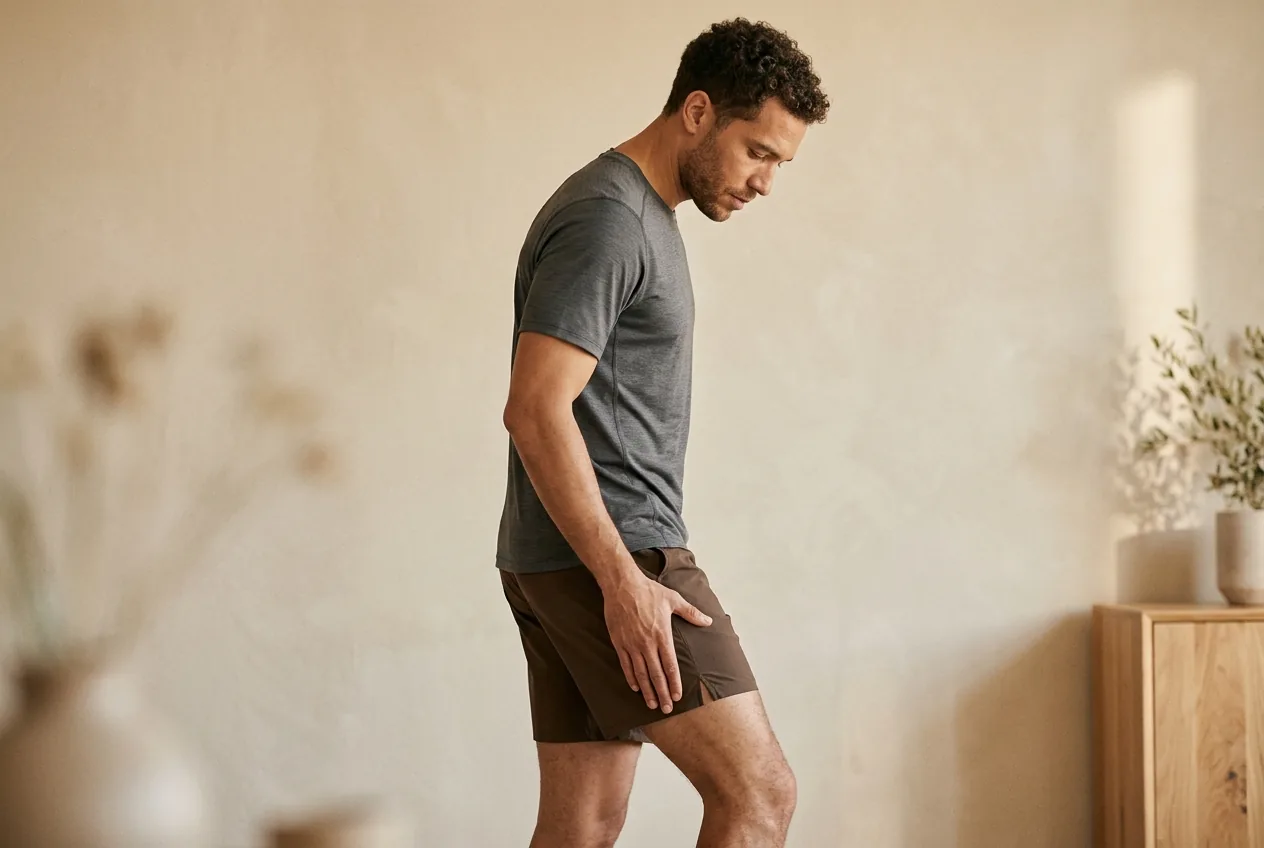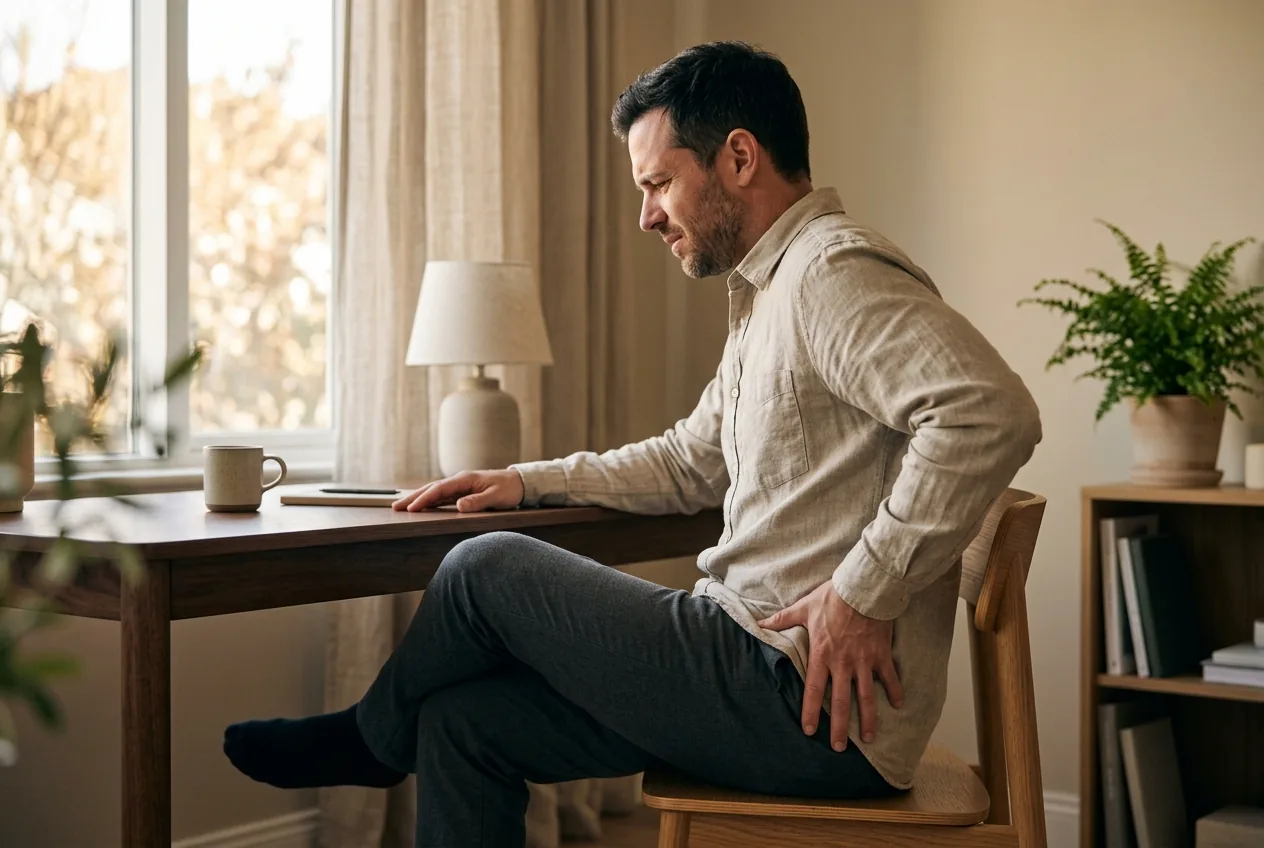

The run felt fine. It's the hours after that get you — a deep ache settling into the side or front of the hip once you've cooled down, a stiffness climbing the stairs that evening, and a first-thing-tomorrow soreness that makes you wonder whether you should run again at all. If your hips are quiet until a few hours after you stop, and then they let you know, that's the pattern this is about.
Running is honest. It takes whatever small imbalance you carry around all day and multiplies it by every footstrike, of which there are thousands in a single run. So hip pain after running is rarely a running injury in the pure sense. It's usually a posture pattern that you'd never feel walking, exposed and amplified by load.
Why running flares the hip
Each running stride lands your full body weight, and more, on one leg at a time. In that instant, the muscles on the outside of that hip — the side glutes — have to fire hard to keep your pelvis from dropping toward the other side. Walking asks the same thing gently. Running asks it violently, thousands of times.
If those side glutes are strong and switched on, your pelvis stays level and the load spreads. If they're weak or quiet — which they often are after years of sitting — the pelvis drops a little on each landing. Multiply that small drop by a few thousand strides and you get an outer hip that's been grinding all run, plus a band of tissue down the side that's been snapping over the bone the whole way. You don't feel it during the run because you're warm and distracted. You feel it after, when it stiffens and swells. The mechanism overlaps closely with runner's knee and hips, because the same dropping pelvis that grinds the hip also drags the kneecap off track.
Running doesn't create the imbalance. It finds the one you already had and runs it a few thousand times.
The common causes
Weak side glutes letting the pelvis drop
The big one. When the side glutes can't hold the pelvis level under load, the outer hip takes the strain stride after stride. This shows up as outer-hip ache and is the most common route into an inflamed bursa in runners.
Tight hip flexors from sitting all day
If you sit at a desk and then run, your hip flexors are short and tight before you start. Running asks the hip to extend fully behind you on every push-off, and a tight flexor fights that extension, so the front of the hip aches and the glutes work at a disadvantage.
Overstriding and heavy heel landing
Reaching the foot far out in front lands you on a braking leg with the knee straight and the impact travelling up into the hip. It also puts the side glutes in a poor position to stabilise. A shorter, quicker stride with the foot landing under your body changes that.
Ramping up too fast
Adding distance, hills, or speed faster than the tissues can adapt overloads the hip with no deeper imbalance needed. This is the most preventable cause and the one runners most often ignore.
How to prevent it
Build the side glutes
This is the highest-value work for runner hip pain. A pelvis that stays level under load protects everything downstream.
- Side-lying leg raises — on your side, top leg straight and slightly behind you, lift under control, leading with the heel. 8 to 10 reps a side.
- Single-leg glute bridges — bridge up off one foot, which forces the side glute to hold the pelvis square. Build to 8 to 10 a side.
- Side planks — even a short hold trains the whole side-hip system to keep the pelvis level.
Loosen what sitting tightened
Open the front of the hip so it can extend on push-off. A gentle hip-flexor stretch — half-kneeling, tuck the pelvis under, ease forward until you feel a stretch across the front of the back hip — taken daily rather than only before a run. This is where desk-bound runners get the most return.
Fix the stride
Shorten it slightly and lift your cadence so your foot lands under you rather than way out front. This single change unloads both the hip and the knee. The broader mechanics are in proper running form.
Progress sensibly
Add distance or intensity gradually, keep most runs easy, and don't stack a hill session onto a long week your hips haven't earned yet. Warm up with a few minutes of easy movement so the glutes are awake before the first hard stride.
When to see a doctor
This is posture and training education, not medical advice. See a clinician promptly if the hip pain came on sharply during a run with a pop or sudden weakness, if you can't bear weight, if the area is red, hot, and swollen or you have a fever, if there's numbness, tingling, or weakness spreading down the leg, or if deep groin pain worsens steadily with weight-bearing. Pain that's severe, steadily worsening, or paired with unexplained weight loss should always be assessed. Persistent bone-deep front-of-hip pain in a runner who has recently ramped up mileage is worth getting checked rather than running through.
Why your own pattern decides whether it comes back
You can ice and rest a flare quiet, but if you go back to running on the same dropping pelvis and tight flexors, the next long run lights it up again. Generic glute exercises help if weak side glutes are your issue — but if your problem is a tipped pelvis or a rotation that throws your whole stride off, they won't reach the cause.
A posture assessment that measures your own deviations reads how your pelvis sits and which muscles are failing under load, so the prep work targets why your hip can't hold up to the miles. Fix the imbalance off the road, and running stops finding it.
Common questions
Why do my hips hurt after running but not during?
Because you're warm, distracted, and the tissues are still tolerating the load while you run. The damage — an outer hip ground by a dropping pelvis, an overworked band of tissue — shows itself afterward, when everything cools, stiffens, and inflames. That's why the ache and stiffness arrive hours later or the next morning.
What causes hip pain in runners?
Most often weak side glutes that let the pelvis drop on each stride, tight hip flexors from sitting that fight full extension on push-off, overstriding that loads the hip on a braking leg, and ramping up distance or intensity too fast. Usually it's a posture imbalance amplified by thousands of footstrikes rather than a single injury.
Should I keep running with hip pain?
Ease off while it's flared — shorten runs, cut the hills and speed, and let an angry outer hip settle. Don't run through sharp, point-tender, or worsening pain. Use the downtime to build the side glutes and loosen the hip flexors so that when you return, the pelvis holds level and the flare doesn't repeat.
How do I prevent sore hips after running?
Strengthen the side glutes so the pelvis stays level under load, stretch the hip flexors daily to undo desk-sitting, shorten your stride slightly so the foot lands under you, and build mileage gradually with a proper warm-up. Addressing the underlying posture imbalance is what keeps the soreness from returning.