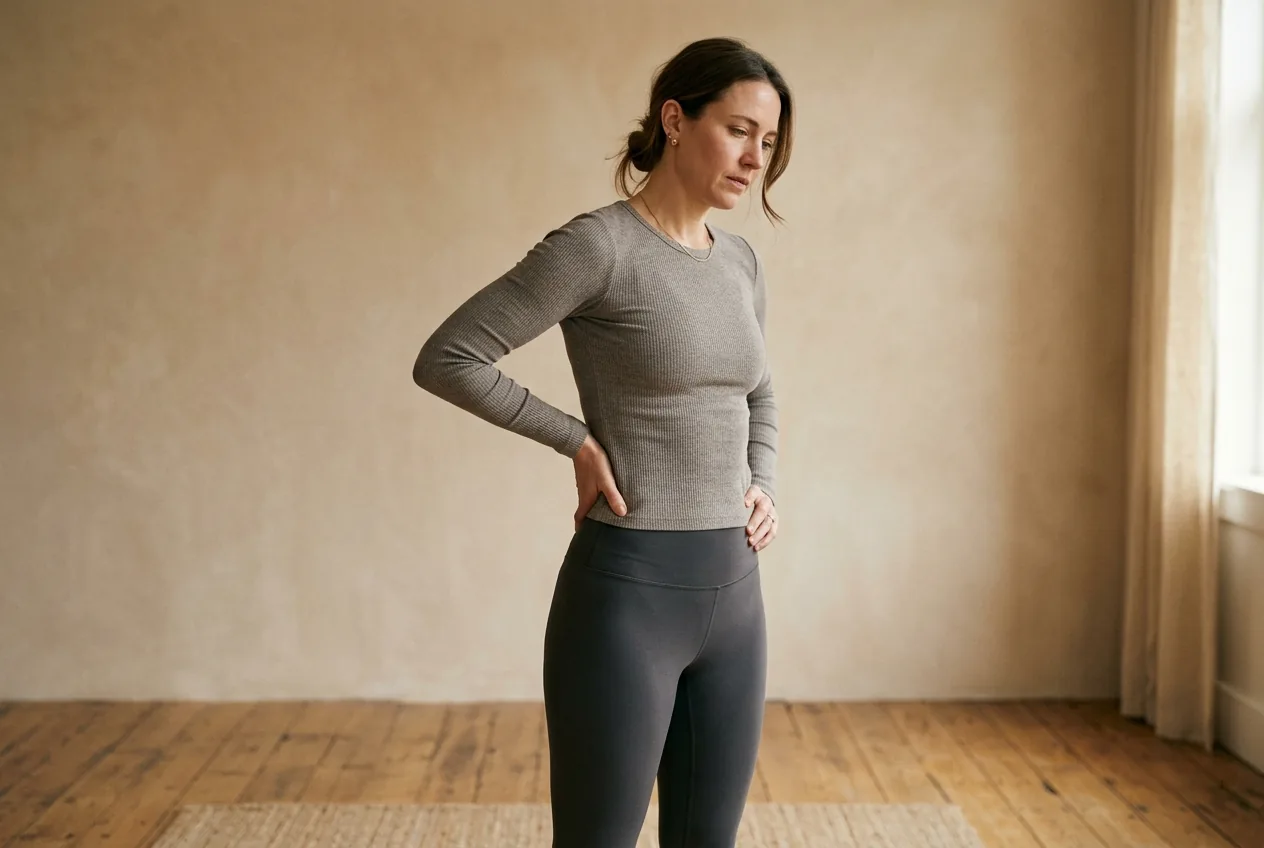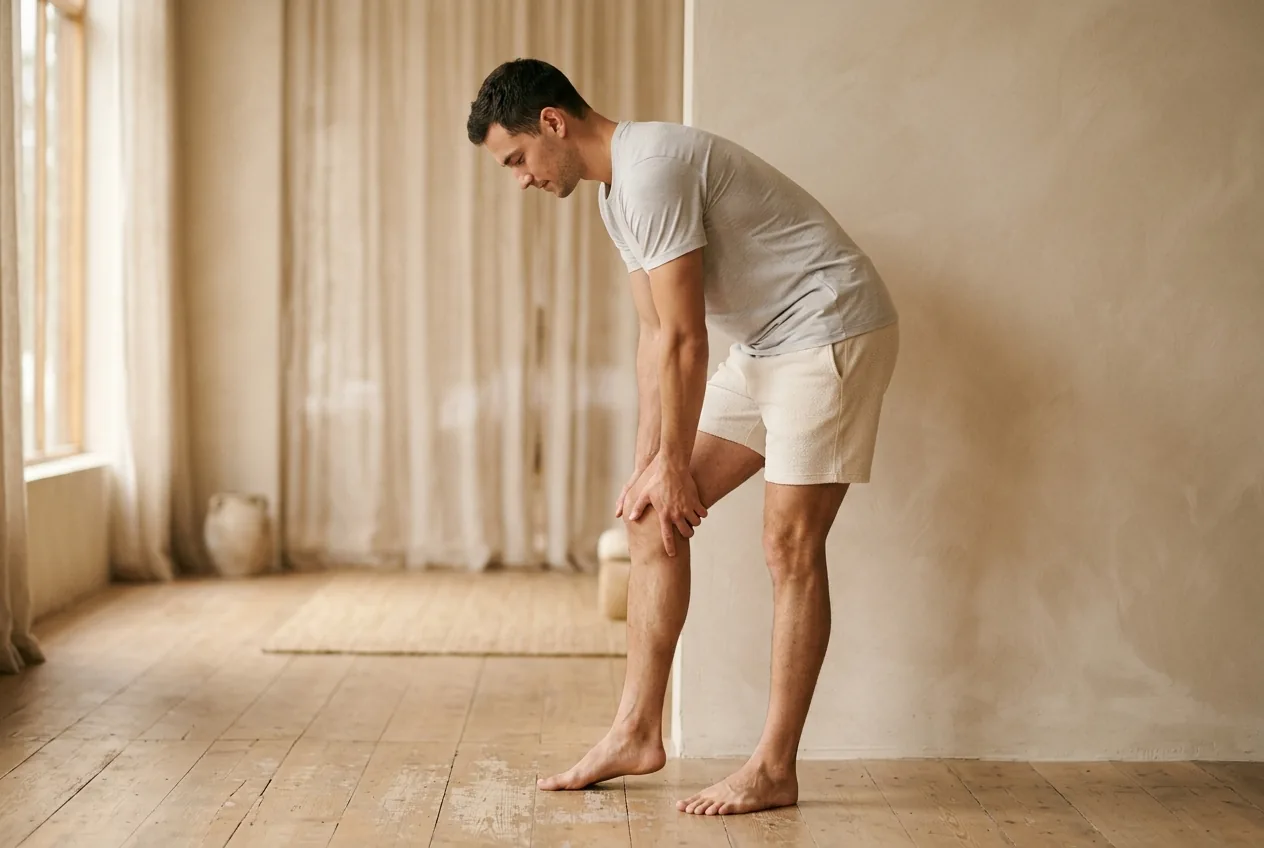
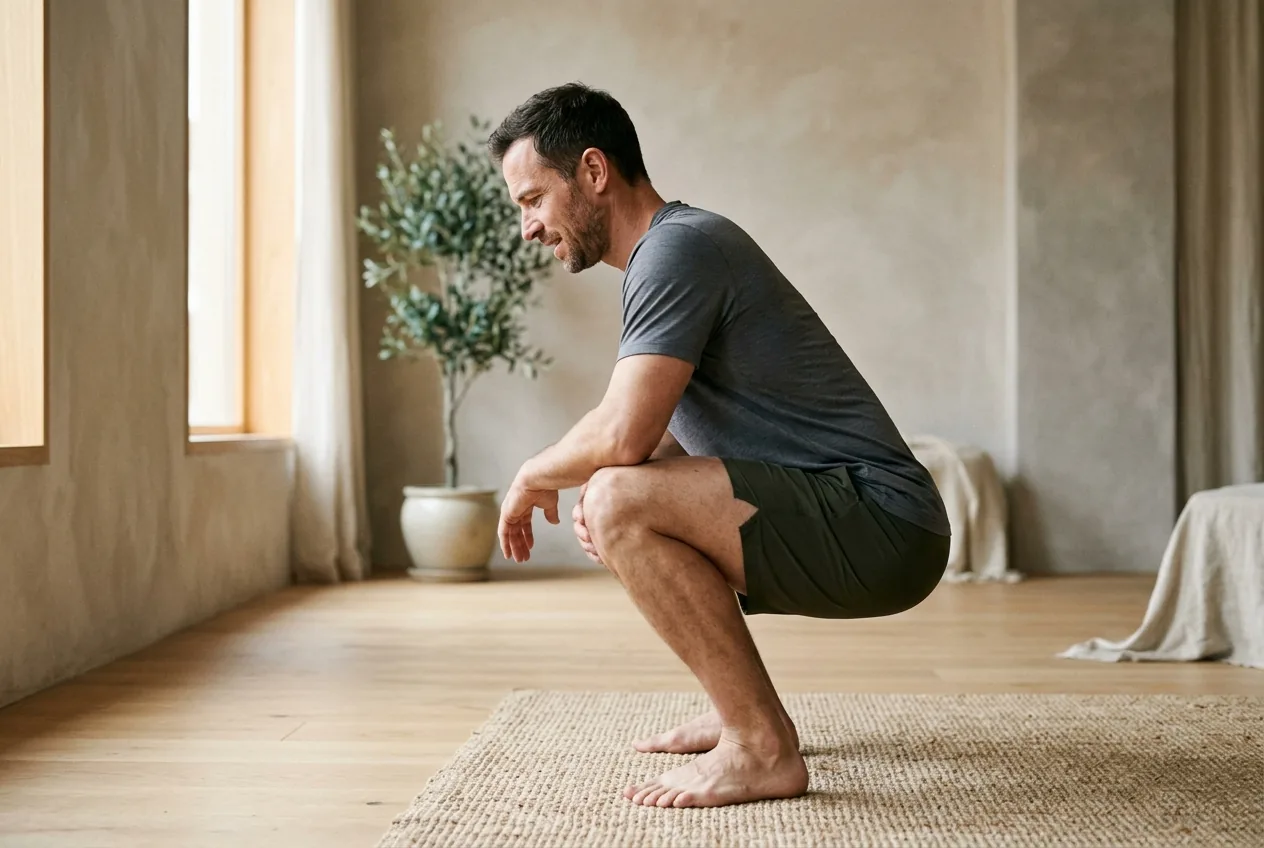
You go to pick something off the floor, lower into a chair, or load the dishwasher, and somewhere on the way down your knee bites. Maybe it's a sharp catch under the kneecap, maybe a dull ache on the inside. Either way, the thing you used to do without a thought now comes with a wince, and you've started bracing against the counter on the way back up.
Here's the part that surprises people. When your knee hurts going down into a squat, the knee is usually the victim, not the cause. It's stuck taking the load that your hips and ankles were supposed to share. Fix where the movement starts and the knee often goes quiet.
What's actually happening when you squat
A squat is a hip movement first. Done well, your hips travel back and down like you're reaching your backside toward a low stool, your shins stay relatively upright, and your knees track in line with your feet. The big muscles of the hips and glutes do most of the work, and the knee just bends along for the ride.
When the hips don't lead, everything shifts forward. Your knees slide far past your toes, your weight rolls onto the balls of your feet, and the pressure behind the kneecap climbs sharply. That's the burn a lot of people feel. The joint isn't damaged — it's overloaded because the bigger players upstream aren't doing their share.
Two posture patterns set this up. If your pelvis tips forward and your lower back over-arches, your weight rides toward your toes before you even move, so the squat starts in the wrong place. And if your glutes have switched off from years of sitting, the knees and quads get drafted to cover the gap.
When the hips stop leading the squat, the knee inherits a job it was never built to do.
The form fixes that change the most
Most squatting knee pain eases once the movement starts at the hips instead of the knees. Work through these in order.
Sit back, not down. Before you bend your knees, push your hips backward as if there's a chair behind you. This loads the glutes and keeps the shins more upright, which drops the pressure behind the kneecap. It's the single biggest change for most people.
Keep your feet planted. Spread your weight across the whole foot — heel, outer edge, base of the big toe — and grip the floor lightly with your toes. If your heels lift or your weight rolls to the inside, the knee gets dragged inward.
Track knees over toes, not past them. Your knees should point the same direction as your feet and shouldn't cave inward as you descend. Try pointing your toes out slightly, around 15 to 20 degrees, and "spreading the floor" by pushing your knees gently outward.
Only go as deep as you stay clean. Stop at the depth where your form holds and your heels stay down. Forcing depth your hips and ankles can't reach is what tips you onto your toes.
The hips and ankles do the real work
Knees rarely fail on their own. They get squeezed by stiffness above and below.
Tight hip flexors from sitting all day pull your pelvis into a forward tilt, so you're already weight-forward when you start. Loosening them changes your squat before you've trained anything — a daily hip flexor stretch for back pain is a sensible start. Weak glutes are the other half: if they don't fire, the knees take over. Building them with a glute bridge for back pain gives the hips something to contribute again.
Don't ignore the ankles. If your ankle can't bend enough to let your shin angle forward over a planted foot, your body finds the range somewhere else — usually by collapsing the knee inward or lifting the heel. A few sets of slow heel-raised-against-a-wall ankle rocks, driving the knee toward the wall while the heel stays down, opens that range over a couple of weeks.
What to stop doing
- Don't strap on a brace and grind through deep squats. Pain on the way down is a signal your mechanics are off, not something to override.
- Don't drop straight down with knees shooting forward. That's the toe-loaded pattern that lights up the kneecap.
- Don't only stretch the painful spot. The knee is usually fine; the hips and ankles are where the change happens.
- Don't chase depth. A clean half-squat beats a sloppy deep one every time.
If your knee pain shows up most while running rather than squatting, the same hip-driven logic applies — see running form to protect your knees and back.
When to see a doctor
This is posture education, not medical advice. See a clinician promptly if your knee locks, catches, or gives way, if it swelled up quickly after the pain started, if you can't bear weight, if there's redness and heat over the joint, if you have a fever with the pain, or if the knee hurt after a fall or twist. Numbness or weakness spreading down the leg, and pain that's severe or steadily worsening despite resting and cleaning up your form, also deserve a proper look.
Why a matched routine beats generic squat advice
The form cues above help almost everyone. But the reason your hips weren't leading in the first place — a tipped pelvis, a flat back, one hip sitting higher, weak glutes on one side — is specific to you, and the wrong emphasis can stall your progress for months.
That's the case for a real posture assessment rather than guessing: measure your actual alignment, then train the muscles that quit so the hips lead the squat and the knee stops paying for it.
Common questions
Why do my knees hurt when I squat down but not when I walk?
Squatting bends the knee deeply under load and demands real range from your hips and ankles. If those are stiff or weak, the knee absorbs the difference and the pressure behind the kneecap climbs. Walking asks far less of the joint, so it stays quiet.
Should I stop squatting if it hurts?
Not necessarily. Pain usually means your mechanics need cleaning up, not that the movement is off-limits. Cut the depth to where it's pain-free, lead with your hips, and keep your heels down. If it still hurts at any depth, ease off and have it checked.
Why does my knee hurt on the inside when I squat?
Inner-knee pain in a squat often comes from the knee caving inward as you descend, usually because the glutes aren't holding the hip steady or the foot is rolling in. Keep your weight across the whole foot and push your knees gently outward to track over your toes.
Are deep squats bad for your knees?
A deep squat with clean form spreads load well and isn't inherently harmful for most people. The trouble starts when you force depth your hips and ankles can't reach, which tips your weight forward and overloads the kneecap. Build the mobility first, then the depth follows safely.