
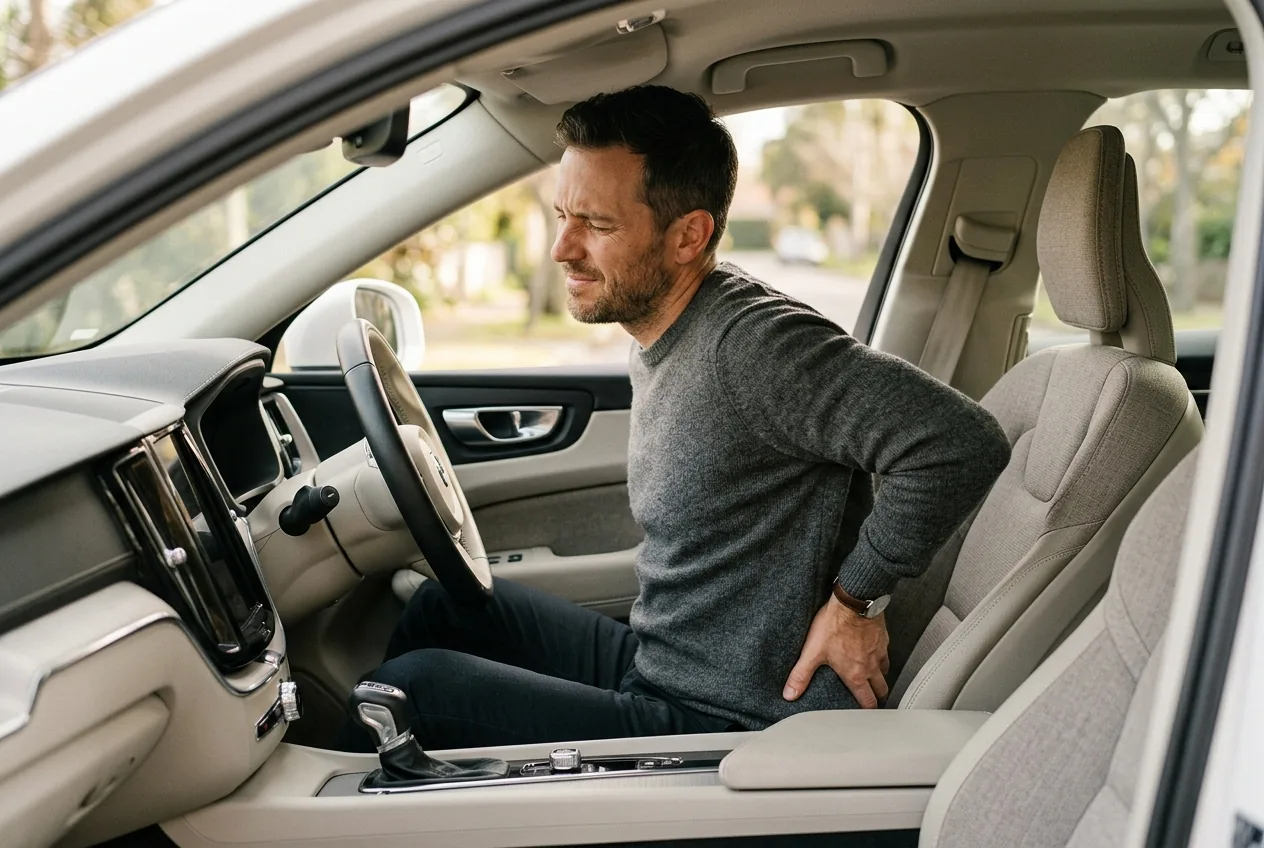
Twenty minutes into the commute and your lower back starts to nag. By the time you pull into the car park it's a deep ache, and getting out of the car is a slow, careful unfolding. Long drives are worse — a road trip leaves you walking like you aged a decade. Lower back pain when driving is its own particular misery because you can't get up and move, and the position is more or less fixed.
The car seat is doing something specific to your spine, and once you see it, the fixes are straightforward.
Why a car seat is harder than a desk chair
A car seat combines almost every load your back dislikes into one position you can't escape.
The seat base usually tips your hips lower than your knees, which rolls your pelvis backward and flattens the natural curve of your lower back into a slump. The seat back is often reclined just enough to push your head forward to see the road. Your right leg works the pedals, so the pelvis is slightly twisted. And then the whole thing vibrates — road buzz adds a constant low-level load that fatigues the discs over time.
Hold that slumped, twisted, vibrating position for a 40-minute commute and the structures at the back of your lower spine take the strain. It's the same loaded slump that makes sitting at a desk hurt, with the extras a car adds.
The vibration deserves more attention than it gets. Steady low-frequency vibration from the road is a known load on the spine — it keeps the discs under a constant, jiggling pressure that fatigues them over time, even when your posture is fine. You can't feel it working, which is exactly why long drives leave your back tired in a way that an equivalent stretch of sitting still at a desk doesn't. Add the twist from working the pedals with one leg and you've got an asymmetric, vibrating, slumped load — three things your back dislikes, all at once, for the length of the drive.
Set the seat up properly
Five minutes once, and every drive is better.
- Raise the seat base so your hips are at least level with your knees, ideally a touch higher. This stops the pelvis rolling backward into a slump.
- Add lumbar support. Use the car's built-in support if it has one, or a small cushion or rolled towel in the curve of your lower back. This is the single biggest change for most people.
- Bring the seat closer. Sit close enough that your knees stay slightly bent and you can reach the pedals without stretching your leg straight, which pulls the pelvis flat.
- Set the backrest near upright — around 100–110 degrees, not laid back. A reclined seat forces your head and neck forward.
- Adjust mirrors to this taller posture. Then if you start slumping later, you'll notice because the mirrors are off.
For seat support specifics, car seat back support goes deeper, and the general principles match how to sit with lower back pain.
Break up the time
The setup buys you time; movement is the real fix.
On long drives, stop every hour or so. Get out, stand tall, do a few of these:
Standing back extension. Hands on your lower back, gently lean back to reverse the hours of slumping. Five easy reps.
Standing hip flexor stretch. Step into a short lunge, tuck the tailbone, squeeze the back glute, hold 30 seconds each side. Driving keeps the hips bent for hours, so this resets the front of the hip.
At red lights, you can also do a quiet pelvic tilt — gently arch and flatten your lower back against the seat a few times to keep things moving. A few slow shoulder rolls and a gentle press of the lower back into the lumbar support do the same job: they interrupt the held position before it sets.
For the daily commute where stopping isn't realistic, the move that matters is the one at each end. Before you set off, take ten seconds to set the seat and sit tall rather than dropping in and slumping. When you arrive, don't fold straight up out of the seat — turn to face the door, plant both feet, and stand as one piece. Bookending the drive with a clean start and a clean exit spares your back the two moments it's most likely to tweak.
The damage isn't the drive. It's holding one slumped position with no movement for the length of the drive.
What to stop doing
- Stop reclining the seat to "relax." It feels easier and quietly pushes your head forward and your back into a slump.
- Stop sitting on a fat wallet in your back pocket. It tilts your pelvis and twists your lower back for the whole drive.
- Stop hauling yourself straight out of the car with a twist. Turn your whole body to face the door, plant both feet, then stand.
When to see a doctor
Driving pain that's a position-related ache, easing once you're out and moving, is usually mechanical. See a clinician promptly if driving brings on numbness, tingling, or weakness down a leg or into the foot; if you have any loss of bladder or bowel control; back pain after a car accident or other trauma; fever with the pain; unexplained weight loss; or pain that's severe or steadily getting worse no matter how you sit.
Why the cushion isn't the whole answer
A lumbar roll and hourly breaks help almost every driver. But why a car seat wrecks your back depends on the pattern you bring to it — an over-arched back, a flat one, a one-sided tightness from working the pedals. The right corrective work differs, and the wrong stretch can deepen the imbalance. A posture assessment measures your actual deviations so the daily routine fits, rather than relying on a one-size cushion. That's the thinking behind this posture therapy method.
If you spend a lot of hours behind the wheel — long commute, work driving, frequent road trips — treat the car the way a desk worker should treat the desk: as a place you have to actively manage rather than just endure. Set the seat once and properly. Keep a small lumbar roll in the car so it's always there. Plan a stop on the long drives instead of pushing through. None of it is dramatic, and all of it adds up over the thousands of hours most drivers log in a year.
The goal is plain: finish the commute, step out of the car, and get on with your day instead of nursing your back into the office.
Common questions
Why does my lower back hurt more in the car than at a desk?
A car seat usually tips your hips below your knees, which rolls your pelvis back into a slump, while the reclined backrest pushes your head forward and working the pedals twists your pelvis. On top of that, road vibration keeps the discs under a constant, jiggling load that fatigues them over time.
How should I set up my car seat to avoid back pain?
Raise the seat base so your hips are at least level with your knees, add lumbar support in the curve of your lower back, sit close enough to keep your knees slightly bent, and set the backrest near upright rather than reclined. Five minutes once makes every drive better.
Why does my back hurt getting out of the car?
After holding one slumped position for the whole drive, folding straight up out of the seat with a twist loads a stiff back at a vulnerable moment. Turn your whole body to face the door, plant both feet, and stand as one piece instead.
Does road vibration really affect my back?
Steady low-frequency vibration is a known load on the spine — it keeps the discs under constant pressure even when your posture is fine. You can't feel it working, which is why a long drive leaves your back tired in a way an equivalent stretch of desk sitting doesn't.