If your lower back aches by mid-afternoon and you've been told to "engage your core" but have no idea what that's supposed to feel like, the pelvic tilt is where to start. The pelvic tilt exercise is the most beginner-friendly way to wake up the deep muscles that brace and protect your lower back. You lie down, learn to rock your pelvis a tiny amount using your core rather than your legs, and in doing so you rediscover a control most people lose after years of sitting. It looks like almost nothing is happening — and that's the point. The skill is subtle, and once you have it, it underpins almost every other back exercise.
This single-move guide covers the step-by-step, what it should feel like, the common mistakes, sets and reps, and who benefits most from starting here.
What the pelvic tilt actually teaches
Your pelvis can rock forward and back like a bowl tipping. Years of sitting tend to lock it into one position and switch off the deep abdominal and gluteal muscles that control it, leaving the lower back to pick up the slack. That's a recipe for the dull, fatigued ache so many desk workers feel by the afternoon.
The pelvic tilt re-teaches that control. By gently flattening your lower back into the floor — a posterior tilt — you fire the deep core and glutes and feel, often for the first time in years, what it means to brace your trunk without clenching everything. It's small, it's quiet, and it's the foundation. Once you can find and hold a neutral, controlled pelvis, harder moves like the glute bridge and the bird dog become far easier to do well.
"Engage your core" finally makes sense the moment you feel your pelvis move under your own control instead of your legs doing it for you.
How to do the pelvic tilt, step by step
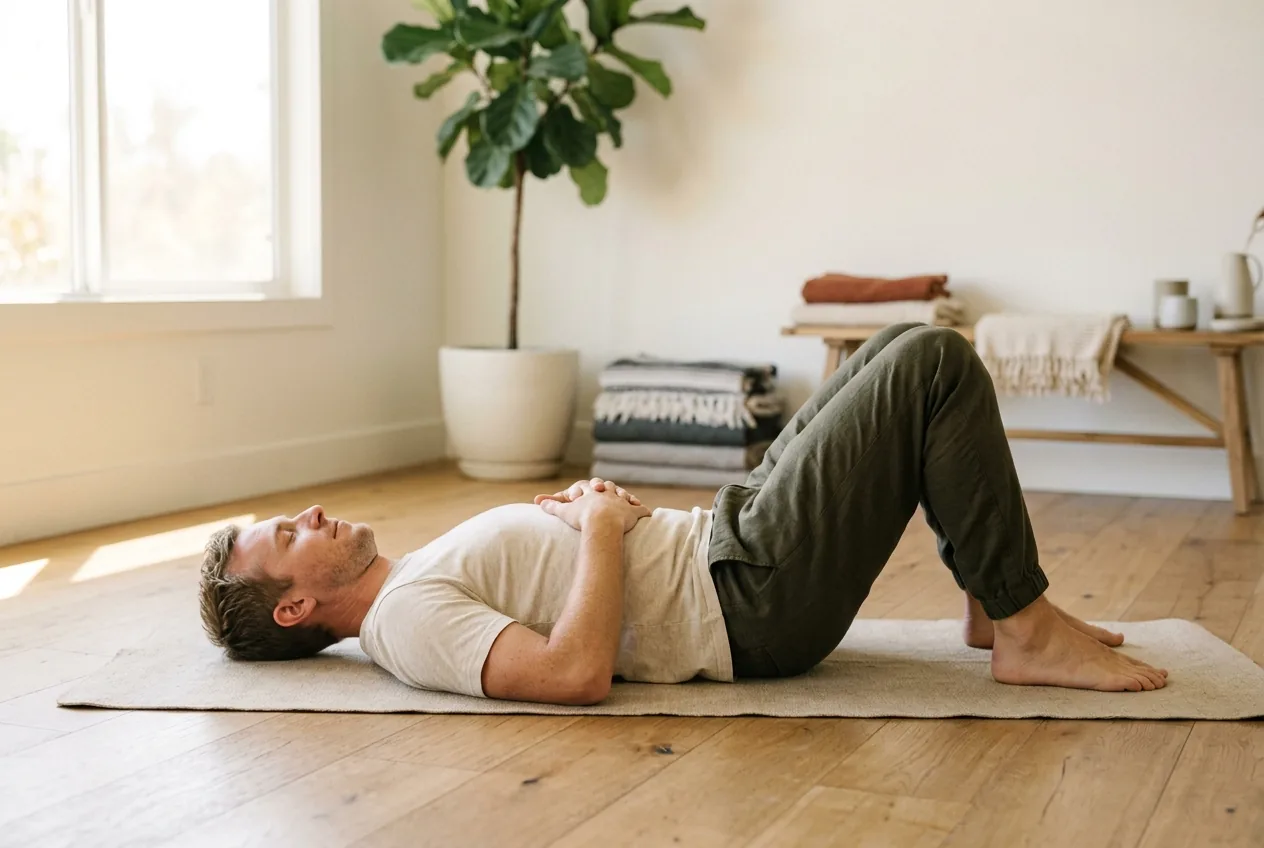
- Lie on your back, knees bent, feet flat on the floor about hip-width apart, arms relaxed by your sides.
- Notice the natural gap under your lower back — there's usually a small arch there to begin with.
- Without pushing through your feet, gently tighten your lower abdominals and tilt your pelvis so your lower back presses flat into the floor. Imagine drawing your belt buckle up toward your ribs.
- Hold the flattened position for three to five seconds, breathing the whole time.
- Slowly release back to the natural, neutral position. That's one rep.
What you want to feel: the movement coming from your abdominals and glutes, gently flattening the small of your back. What you don't want: your feet pushing hard into the floor, your buttocks clenching like a vice, or your breath stopping.
A good check: rest a hand under the small of your back. As you tilt, you should feel your back press lightly against your hand. As you release, the small gap returns.
The mistakes that turn it into the wrong move
Pushing through your feet. Many people lift their hips slightly by driving through their heels, which makes it a mini-bridge instead of a pelvic tilt. Keep your hips on the floor — only the small of your back moves.
Holding your breath. People clench everything and freeze. The brace should be gentle enough that you can breathe and talk through it. If you can't breathe, you're over-gripping.
Squeezing the glutes hard. A little glute involvement is fine, but a vice-grip squeeze takes over from the deep core you're trying to find. Aim for a soft, controlled tilt led by the lower abdominals.
Rushing. Done fast, the subtle control never registers. Move slowly enough to actually feel the pelvis rock and the back flatten.
Forcing a big movement. This is a small move. If you're cranking hard to flatten your back, you've lost the quiet control that makes it work.
Sets, reps, and how to build on it
Start with 2 sets of 8 to 10 slow tilts, holding each for three to five seconds, once a day. Because it's gentle and low-load, you can do it daily and even fit a set in during the workday on the floor or, in a modified way, in a chair.
Once the lying tilt feels easy and controlled, build on it:
- Add a hold and a breath. Tilt, hold the brace, take two slow breaths without losing it, then release. This teaches you to brace while breathing — the version you actually use in life.
- Seated and standing tilts. Find the same small pelvic rock sitting tall in a chair, then standing. This transfers the control into real-world positions, which is where it helps your back most.
- Use it as a setup cue. Before harder core or back moves, find your neutral pelvis with a gentle tilt first. It's also a useful reset to pair with the McGill big 3.
Who should start here
The pelvic tilt is one of the safest back moves there is, which makes it a good first step for almost anyone — especially:
- People brand new to core work who don't yet know what "engage your core" feels like.
- Older adults and anyone easing back into movement after a flare, since it's low-load and floor-based. It fits well into gentle back exercises for seniors.
- Anyone with an anterior pelvic tilt, where the pelvis sits tipped forward and the deep core has switched off — learning the controlled posterior tilt is a direct first step toward restoring balance.
- New parents and postpartum recovery, where deep core control often needs rebuilding gently (clear it with your clinician first).
When to see a doctor
The pelvic tilt is very gentle, but symptoms still have limits worth respecting. See a clinician promptly if you have numbness, tingling, or weakness spreading down a leg, any loss of bladder or bowel control, back pain after a fall or accident, fever with back pain, unexplained weight loss, or pain that's severe or steadily worsening. Stop if the move produces sharp or shooting pain rather than gentle muscular effort, and check with your clinician after recent abdominal or spinal surgery.
Why finding the move is only the start
The pelvic tilt rebuilds a genuinely useful skill, and re-waking the deep core helps almost any back. But the reason your pelvis got stuck and your core switched off in the first place is a postural pattern — and learning the tilt doesn't, on its own, change that pattern.
The exercise gives you the control. Knowing *where* your pelvis and spine actually sit is what tells you how to use it — whether your priority is learning the posterior tilt because your pelvis tips forward, or something else entirely. A generic instruction to "do pelvic tilts" can't see that. A posture assessment measures your actual deviations and builds the routine around them, so this foundational skill gets pointed at the right target. If you want to spot your own pattern first, you can check your posture at home.
Learn the pelvic tilt slowly and well — it's the floor under everything else. Then aim it at the pattern your body actually has.
Common questions
What does the pelvic tilt exercise do?
It re-teaches control of the deep core and glute muscles that brace your lower back. By gently rocking your pelvis to flatten the small of your back, you wake up muscles that years of sitting tend to switch off — the foundation for harder back and core moves.
How many pelvic tilts should I do?
Start with 2 sets of 8 to 10 slow tilts, holding each three to five seconds, once a day. It's gentle enough to do daily, and you can add seated and standing versions once the lying tilt feels controlled.
Is the pelvic tilt good for lower back pain?
For many people, yes — it's one of the safest starting points. It wakes up the deep core that protects the lower back and teaches what "engaging your core" actually feels like. Stop if it produces sharp or shooting pain rather than gentle effort.
Why can't I feel anything during a pelvic tilt?
The movement is meant to be small and subtle. Rest a hand under the small of your back so you can feel it press down as you tilt. Make sure the movement comes from your abdominals, not from pushing through your feet, and slow it right down.