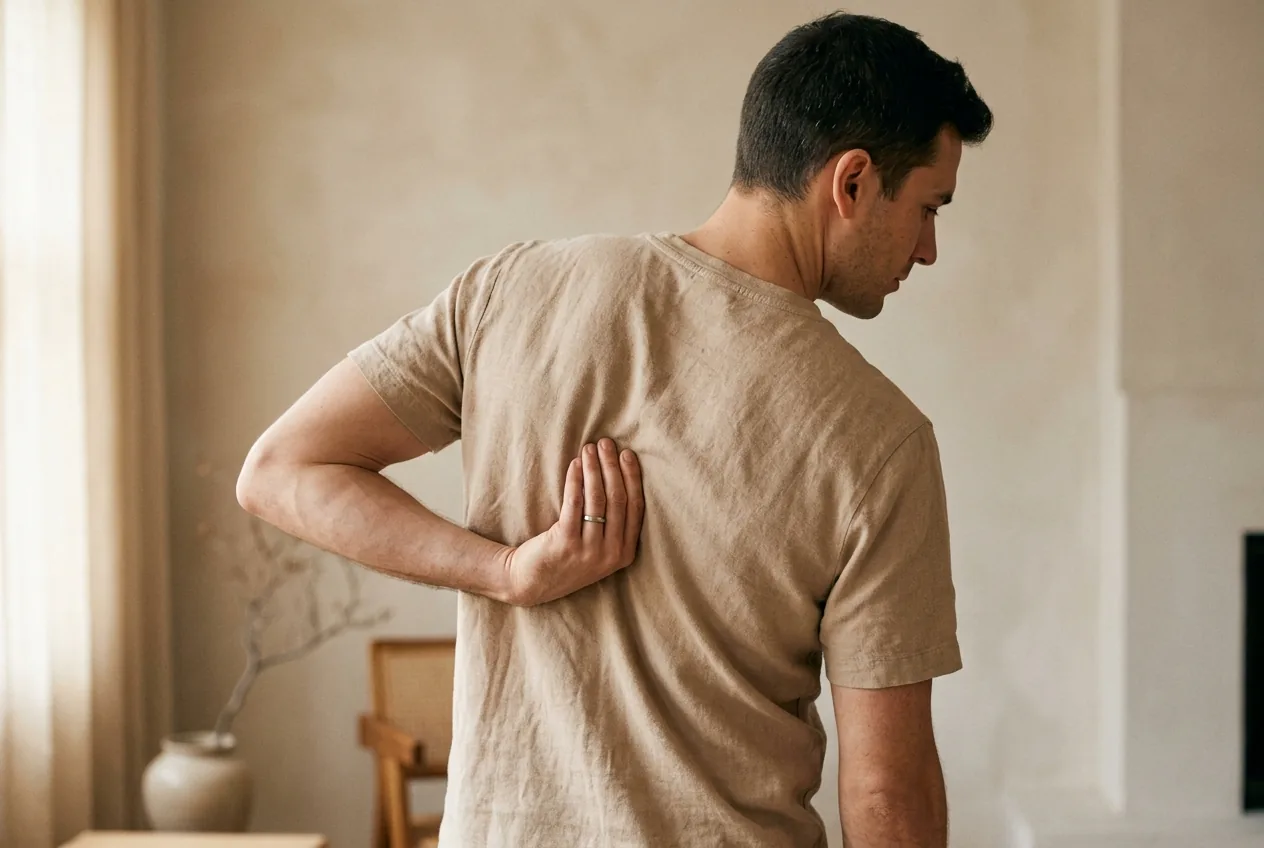

You take a deeper breath than usual, or twist to reach the seatbelt, and a sharp catch flares along your ribs or off to one side of your chest. It's unsettling — rib pain makes people think of the heart or the lungs first. But often the cause is far more ordinary: a slumped posture and a habit of breathing shallowly into the top of your chest.
Rib pain from posture is more common than people expect. The rib cage isn't a rigid box. It's a set of joints that are supposed to move every time you breathe. When posture locks the chest down and breathing gets shallow, those joints and the muscles between the ribs get stiff, strained, and sore.
How posture and breathing irritate the ribs
Each rib connects to your spine at the back and, for most ribs, to the breastbone at the front, through small joints. When you breathe well, the rib cage expands and lifts, and all those joints glide a little. That motion keeps them healthy.
Now picture the typical desk posture: shoulders rounded, upper back hunched, chest collapsed inward. In that position the rib cage is compressed and can't expand fully. So breathing shifts up into the chest and neck — short, shallow breaths that barely move the ribs. The joints stop gliding, the muscles between the ribs stay tight, and over time the whole cage gets stiff. Then one deeper breath or one twist asks a stiff joint to move suddenly, and it catches sharply.
Shallow chest breathing also keeps the neck and upper-back muscles working overtime, because they get recruited to lift the chest with each breath. That ties rib pain to the same posture pattern behind mid back pain and forward head posture.
A rib cage that never gets to expand becomes a rib cage that catches when you finally ask it to.
What it feels like, and what it isn't
Postural rib pain tends to be:
- Sharp and positional — it catches with a breath, a twist, or a stretch, then eases.
- Reproducible — pressing on the sore spot or moving a certain way brings it back.
- Often along the side of the ribs or near where ribs meet the breastbone.
- Worse after long slumped sits and better when you move and breathe fully.
That's different from pain that comes with breathlessness, a racing heart, or pain spreading to the arm or jaw, which needs urgent attention regardless of posture.
How to ease rib pain from posture
The plan: open the chest, get the rib joints moving again, and retrain full, low breathing.
Open and mobilize
- Doorway chest opener. Stand in a doorway, forearms on the frame, and step gently through to stretch across the chest. Hold 20–30 seconds. This counters the collapsed-chest position that compresses the ribs.
- Seated thoracic rotations. Sitting tall, arms crossed over your chest, slowly rotate to each side. 8–10 per side. Gentle rotation restores glide to the rib-and-spine joints.
- Side bend with a breath. Reach one arm overhead and lean gently to the opposite side, then breathe into the stretched ribs. Feel the cage expand on that side. Hold a couple of slow breaths each side.
Retrain the breath
- Diaphragmatic breathing. Lie on your back, one hand on your chest, one on your belly. Breathe slowly so the belly hand rises and the chest hand stays mostly still. Aim for a longer, fuller breath that expands the lower ribs sideways. Two or three minutes, a few times a day. This is the move that changes the pattern, because it gets the rib cage moving again with every breath.
Change the inputs
- Sit and stand taller, chest lifted, so the rib cage isn't compressed.
- Take a few slow, full breaths every time you reset your posture at the desk.
- If you're stressed and breathing high in the chest, a couple of slow exhales bring the breath back down — stress and shallow breathing feed each other.
What to stop doing
A few habits keep the rib cage locked down, and easing off them helps as much as the mobility work.
- Hunching over a phone or laptop for long stretches. It folds the chest closed and squeezes the rib joints. Prop the screen higher and sit taller so the cage can expand.
- Holding your breath when you concentrate. Many people unconsciously freeze their breathing while focused at a screen, which lets the ribs stiffen. Notice it and let the breath flow.
- Bracing your stomach all day. A constantly clenched belly forces the breath up into the chest. Let the lower ribs and belly move with each breath instead.
- Pushing through a sharp catch. If a movement reliably reproduces the pain, don't force it repeatedly. Work the gentle mobility drills first and let the joint settle before testing the range again.
These small changes give the rib cage room to move through the day, not just during your few minutes of stretching. That's usually what stops the catches from returning.
When to see a doctor
Most postural rib pain is mechanical and eases as the chest opens and breathing deepens. But rib and chest pain deserve care when certain signs are present.
Seek urgent care for chest pressure or pain spreading to the arm, jaw, or back with shortness of breath, sweating, or a racing heart — that can signal a heart problem and shouldn't wait. See a doctor promptly for pain after a fall or impact that could have cracked a rib, pain with a cough, fever, or breathlessness, pain that's worse at night or doesn't change with movement, or unexplained weight loss. One more flag: one-sided pain set lower and toward the back near your flank, especially with burning urination, blood in the urine, or fever, can be kidney-related rather than a rib problem. When in doubt about chest or rib pain, get it checked — posture is the likely cause, not the certain one.
Why it keeps catching
If your ribs keep catching, it's usually because the posture and breathing pattern haven't changed. The cage stays compressed, the breath stays shallow and high, and the joints stay stiff — so the next deep breath or twist finds the same catch. A stretch helps for a while, but you settle back into the slump and the shallow breath the moment you stop thinking about it.
Lasting relief comes from changing the posture that compresses the chest in the first place, and that depends on your own pattern — how rounded your upper back is, how far your head sits forward, what's tight and what's weak. The right work for one posture can be wrong for another, which is why generic routines fall short. A posture assessment measures your real deviations and builds the routine around them. If your ribs keep catching despite stretching, see how a posture-based method addresses chronic back pain by starting from your actual alignment.
Open the chest, breathe low and full, and the rib cage goes back to moving the way it's supposed to — quietly.
Common questions
Can bad posture really cause rib pain?
Yes. The rib cage is a set of joints meant to move with every breath. A slumped, collapsed-chest posture compresses the cage and keeps those joints from gliding, so they stiffen — and one deeper breath or twist asks a stiff joint to move suddenly and it catches.
How can I tell postural rib pain from something serious?
Postural rib pain is usually sharp, positional, and reproducible — it catches with a breath or twist and eases, and pressing the spot brings it back. Pain with breathlessness, a racing heart, sweating, or spreading to the arm or jaw needs urgent care regardless of posture.
Does shallow breathing make rib pain worse?
It can. Breathing high in the chest barely moves the lower ribs, so the joints stop gliding and stiffen. Slow diaphragmatic breathing that expands the lower ribs sideways gets the cage moving again and is often the move that changes the pattern.
When should rib or side pain be checked by a doctor?
Seek urgent care for chest pressure or pain spreading to the arm, jaw, or back with shortness of breath or sweating. See a doctor for pain after a fall, pain with a cough or fever, pain worse at night, or one-sided pain low near your flank with burning urination, which can be kidney-related. When in doubt about chest or rib pain, get it checked.