You stand up after a long stretch at your desk and the front of your hips feels jammed, like a hinge that's seized halfway. Your lower back arches a little more than it should, and standing tall feels like work. If that's familiar, you've probably got tight hip flexors from sitting — one of the most common and most overlooked side effects of a desk-bound life, and a quiet driver of back ache.
Your hip flexors are the muscles at the front of your hip that lift your knee. The biggest, the psoas, runs from your thigh up through your pelvis and attaches to your lower spine. When you sit, these muscles are bunched up short. Spend most of your waking hours that way and they adapt to the shortened length — and then they don't fully let go when you stand. That lingering tightness is what tugs on your pelvis and lower back hour after hour.
How sitting creates the problem
Muscles adapt to the positions you hold most. Sit eight hours a day and your hip flexors learn that "short" is their new normal. Stand up, and instead of returning to full length, they stay tight and pull your pelvis into a forward tip. That tip drags your lower back into an exaggerated arch, and the back muscles clench to cope.
Meanwhile the muscles on the other side — your glutes — spend all that sitting time switched off and stretched. So you end up with a classic imbalance: tight, overactive hip flexors at the front and weak, sleepy glutes at the back. The pelvis tips, the lower back arches, and the ache sets in. The downstream effect on your spine is exactly what drives the hip flexor and back pain connection.
Signs your hip flexors are tight
You don't need a clinic to spot this. Check for these:
- Lower back ache that's worse after sitting and eases a little once you've moved around.
- A pinch or jam at the front of the hip when you stand up or take a long stride.
- Standing with a pronounced lower-back arch, belly forward, butt sticking out a little — the forward-tipped pelvis look.
- Discomfort lying flat on your back with legs straight, easing when you bend your knees.
- A tight, restricted feeling when you try to extend your leg behind you.
A simple at-home check: lie on your back at the edge of a bed and hug one knee to your chest. Let the other leg hang off the edge. If that hanging thigh floats up rather than dropping level, or you feel a strong pull at the front of the hip, that side's hip flexor is likely tight.
Sitting doesn't just feel like nothing's happening. Your hips are quietly learning a shorter setting every hour you stay down.
Releases that actually help
Tightness from sitting responds well to two things: regular movement breaks during the day, and a focused stretch.
Break up the sitting
The single best thing is simply not staying down for hours at a stretch. Stand up every 30–45 minutes, even for 30 seconds. Take a short walk after lunch. Each break interrupts the adaptation before it sets in. If you can, alternate sitting and standing through the day.
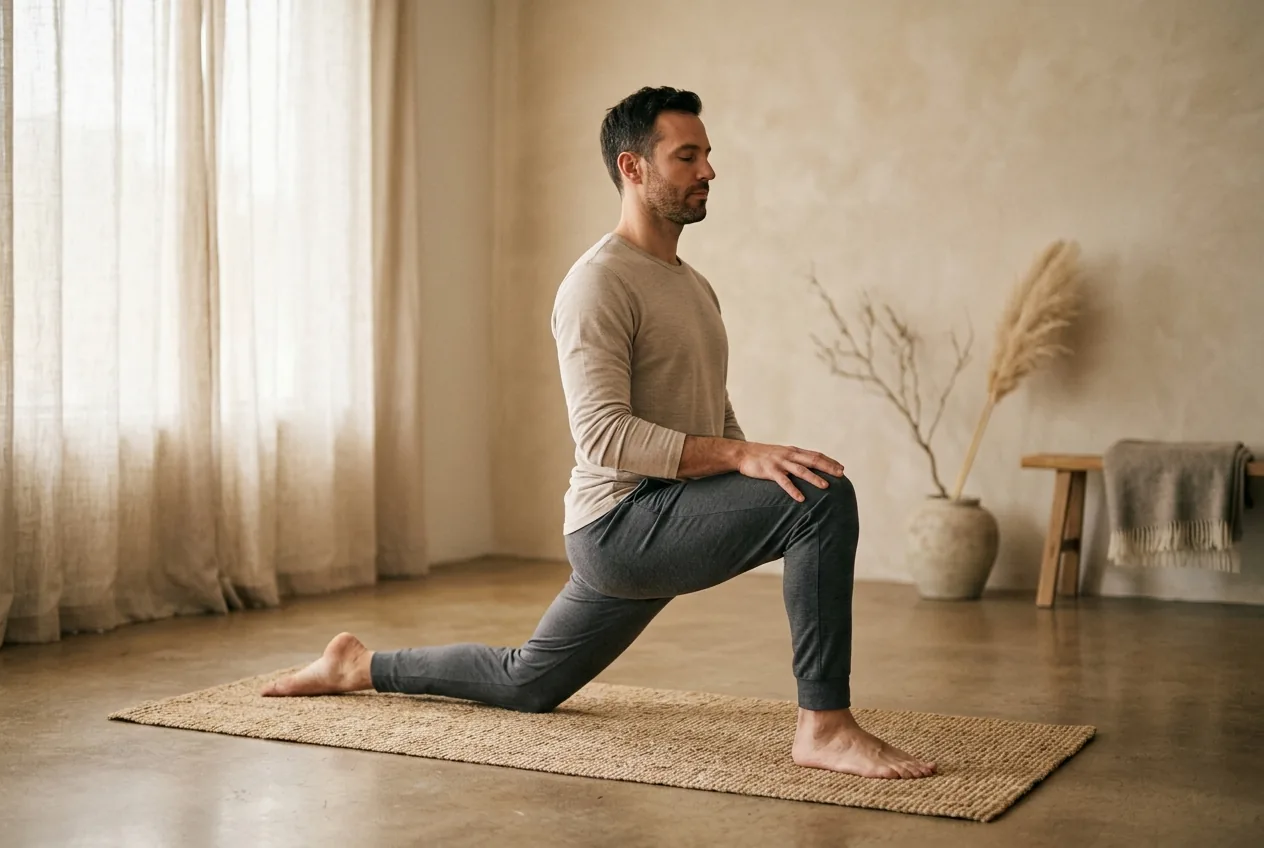
The half-kneeling hip flexor stretch
This is the most effective release:
- Kneel on one knee, the other foot flat in front, both at right angles.
- Squeeze the glute on the kneeling side to tuck your tailbone under and flatten your lower back. Don't skip this.
- Keeping your torso tall, ease your hips forward an inch or two until you feel the stretch at the front of the kneeling hip.
- Hold 30 seconds. Two or three rounds each side, once or twice a day.
The tailbone tuck is what makes it work. Without it, people arch their back to chase the stretch and end up loading the lower back instead of lengthening the hip.
Wake the glutes back up
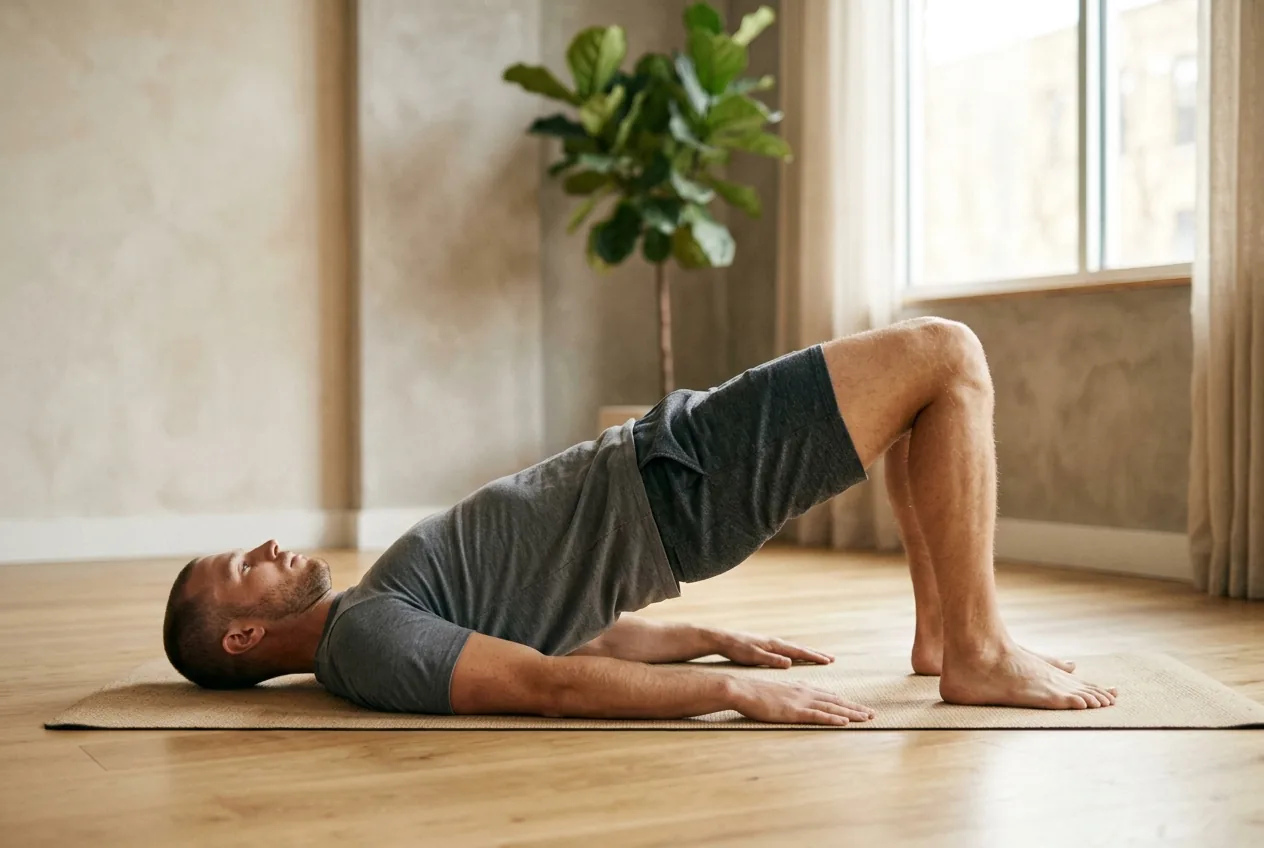
Stretching alone is half the job. Switch the glutes back on with bridges so they can hold the pelvis in place once the hip flexors release. A few of those moves live in core exercises for lower back pain. Stretch the tight side, strengthen the weak side — that's the combination that holds.
A gentle version of the stretch also makes a good addition to a before-bed routine, since the day's sitting leaves the hips at their tightest by evening.
Set up your day so sitting hurts less
You can't always avoid long sitting, but you can blunt its effect. Keep your hips slightly higher than your knees in your chair, which reduces how far the hip flexors fold. If you have a standing desk, alternate rather than standing rigidly for hours. And when you do take a break, don't just stand — take a few steps and gently extend one leg behind you, which moves the hip flexor through the range it's been denied.
The aim isn't to eliminate sitting. It's to stop your body treating "folded at the hip" as its only setting. A few interruptions an hour and a daily stretch are usually enough to keep the tightness from cementing into a fixed forward tilt.
When to see a doctor
This is for ordinary tightness from sitting. See a clinician promptly if you have numbness, tingling, or weakness in a leg, any loss of bladder or bowel control, pain after a fall or accident, fever with back or hip pain, unexplained weight loss, or pain that's severe or steadily worsening. Deep groin or hip pain that doesn't ease with stretching, or a hip that catches and locks, is also worth getting assessed.
Why a generic stretch isn't the full fix
Stretching tight hip flexors helps most desk workers, because most desk workers genuinely have them. But the right balance of stretching versus strengthening — and how much your hips are really driving your back pain — depends on your specific pattern. Someone whose pelvis tips forward needs the stretch-and-strengthen combo above. Someone whose pelvis tucks under needs almost the opposite emphasis, and aggressive hip-flexor stretching could nudge them the wrong way.
That's the gap between general advice and your own situation. Most chronic back pain comes from a particular imbalance — specific muscles switched off, others overworking — and the routine that fixes it has to match your deviations, not the average office worker's. A posture-based approach to chronic back pain measures what your hips and spine are actually doing first, then builds the releases and strengthening around that. It tells you whether tight hip flexors are really your problem, or just the symptom you happened to notice.
Start by breaking up your sitting and doing the half-kneeling stretch twice a day this week, plus a set of bridges. If standing tall gets easier and your back eases after work, your hips were part of the story — and now you know which lever to keep pulling.
Common questions
How do I know if my hip flexors are tight from sitting?
Common signs are a lower back ache that's worse after sitting, a pinch at the front of the hip when you stand or stride, standing with a pronounced lower-back arch, and discomfort lying flat with your legs straight that eases when you bend your knees.
How long does it take to loosen tight hip flexors?
With daily stretching and regular movement breaks, many people notice standing tall gets easier within a week or two. Reversing years of sitting takes longer and depends on staying consistent rather than stretching hard once.
Will standing more fix tight hip flexors?
It helps, but standing rigidly for hours isn't the answer. The real fix is variety — alternating sitting and standing and taking a short walk every 30 to 45 minutes so your hips don't stay folded for long stretches.
Do I need to strengthen as well as stretch?
Yes. Sitting tightens the hip flexors and switches off the glutes, so stretching alone lets the pelvis tip forward again. Stretch the tight side and wake the glutes up with bridges — that combination is what holds.