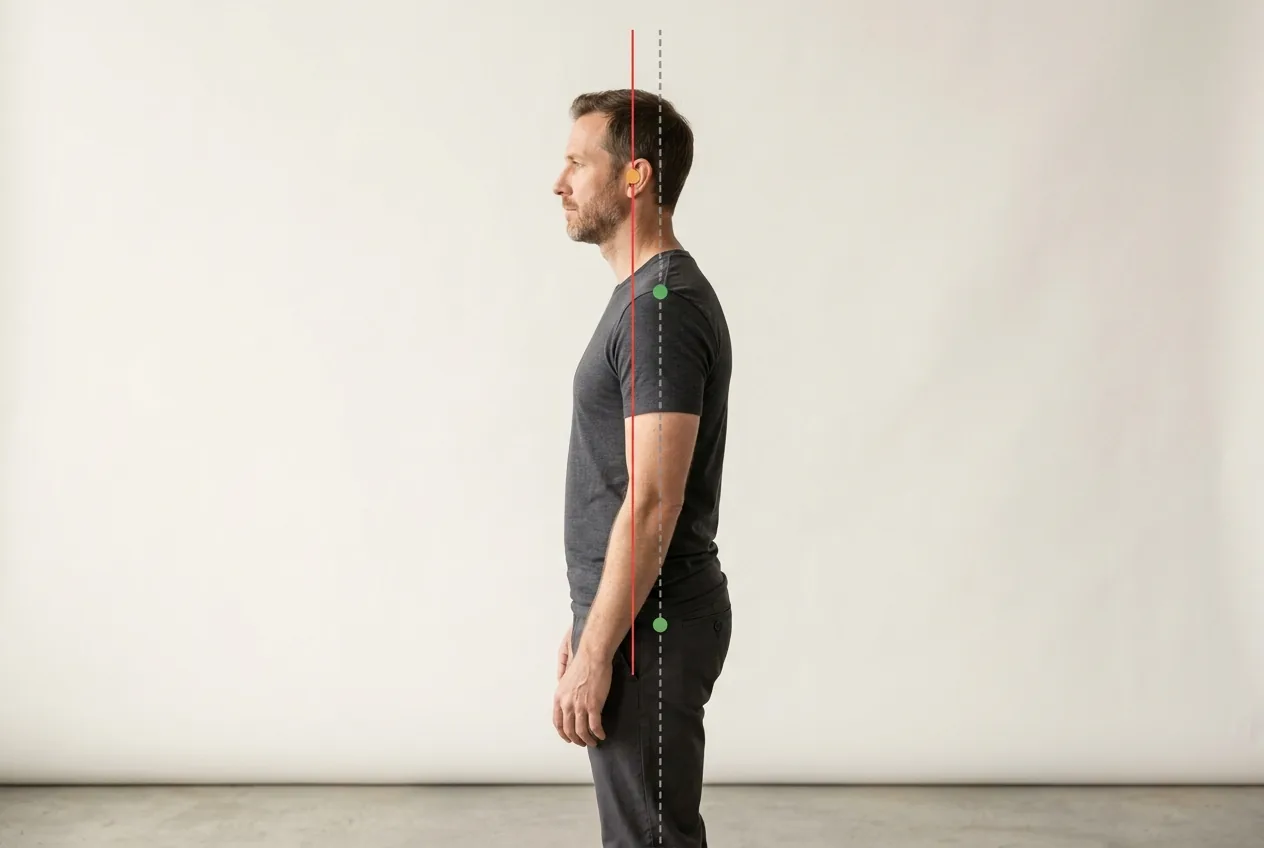

It's a strange, two-sided feeling: a deep ache between the shoulder blades and, at the same time, a tightness across the front of the chest, like a band that won't let you take a full breath. It tends to build over a long day at the desk and ease a little when you stand up and roll your shoulders back. You've started to wonder whether something's wrong inside, or whether it really is "just" your posture.
Upper back and chest pain that show up together are often two ends of the same problem — a collapsed, rounded posture squeezing the cage of joints and muscles that wraps your torso. That's the common cause, and it's mechanical and treatable. But chest pain is the one symptom that earns a safety check before anything else, because a heart problem can feel similar. The red-flag section comes first here on purpose. Read it before you assume your chest tightness is postural.
Chest pain that's an emergency — read this first
Call emergency services right away if chest pain comes with any of these: pressure, squeezing, or a heavy weight on the chest; pain spreading to the arm, jaw, neck, or back; shortness of breath; sweating, nausea, or lightheadedness; or a racing or irregular heartbeat. Together, these can signal a heart attack, and they do not wait for you to finish reading — regardless of your age or how good your posture is.
Also get urgent care for sudden sharp chest pain with breathlessness, chest pain after an injury, or pain with coughing up blood or a high fever. If you can't be sure your chest pain is mechanical, treat it as serious and get it checked. Posture is a likely cause for many people; it is never the certain one. Nothing below applies until a clinician has ruled out the dangerous causes. The fuller breakdown of how to tell the two apart is in can bad posture cause chest pain.
How posture squeezes both front and back
Your rib cage isn't a fixed shell. Each rib joins the spine at the back and most join the breastbone at the front, through small joints meant to glide a little every time you breathe. Muscles run between and across all of it.
A long desk slump — shoulders rounded, upper back hunched, chest collapsed — compresses the whole cage. At the back, the upper-spine muscles get held long and strained as they fight to stop you folding forward, which produces the ache between the shoulder blades. At the front, the chest muscles shorten and tighten, the rib joints near the breastbone stop gliding, and breathing goes high and shallow. So one posture creates pain at both ends: a strained, overstretched back and a tight, compressed front.
That tight chest pulls the shoulders even further forward, which loads the upper back more. The front and back feed each other, which is why they so often hurt at the same time. It's the same forward-slump pattern behind a tight upper back, just felt from both sides at once.
When the front and the back hurt together, it's usually not two problems. It's one collapsed posture squeezing the whole cage.
What posture-related chest and upper-back pain tends to feel like
Mechanical pain of this kind has a recognizable signature — a pattern, not a diagnosis, and never a reason to skip the safety check:
- Positional. It builds with slumped sitting and eases when you stand tall and breathe fully.
- Reproducible with movement. A twist, a reach, or a deeper breath can sharpen it; resting eases it.
- Tender to the touch at the back between the shoulder blades, or near the breastbone at the front.
- Sharp or achy and tied to position, rather than a heavy, crushing pressure that comes on at rest.
Heart-related pain tends to be the reverse: a pressure or heaviness, often unrelated to how you move, frequently with breathlessness or sweating. If your pain looks like that, the first section applies, not this one.
What helps the mechanical kind
Once you've been cleared, the aim is to open the collapsed cage, get the rib joints gliding, and restore full, low breathing. Go gently and stop anything that sharpens the pain.
- Doorway chest stretch. Forearm on the door frame, elbow at shoulder height, step gently through. Hold 20–30 seconds each side. This opens the tight front that's compressing the cage.
- Thoracic extension over a chair or roller. Hands behind your head, gently arch your upper back over the backrest or a foam roller. A few slow reps restore the upper-back extension the slump takes away — easing the back ache and opening the front together.
- Diaphragmatic breathing. Lie down, one hand on chest, one on belly. Breathe slowly so the belly rises and the lower ribs expand sideways while the chest stays mostly still. Two or three minutes, a few times a day. This gets the rib cage moving with each breath, which is what breaks the stiffening pattern.
- Reset through the day. Sit and stand taller, chest lifted, and take a few full breaths each time. Notice if you hold your breath while concentrating at a screen — many people do, and it lets the ribs stiffen.
What to stop: long hours collapsed over a laptop, shallow chest-only breathing, and forcing a painful twist to "test" the spot.
When to see a doctor
Beyond the emergency signs above, see a clinician promptly if the pain wraps around the ribs and doesn't ease with position; if it comes with numbness, tingling, or weakness in an arm; if you've had a fall or injury; or if it comes with fever, unexplained weight loss, or pain that's severe and steadily worsening. And to repeat the one rule that matters most: with chest pain, get it checked first and attribute it to posture second — never the other way round.
Why it keeps coming back
If the ache and tightness keep returning, it's because the posture compressing the cage hasn't changed. The chest stays collapsed, the back stays strained, the breath stays shallow — so the next long day finds the same two-sided pain. A stretch helps for a while, then the slump pulls it all back.
Lasting relief comes from changing the posture that collapses the cage, and the right changes depend on your own pattern — how rounded your upper back is, how far your head sits forward, what's tight at the front and switched off at the back. The work that frees one posture can be wrong for another. A posture assessment measures your actual deviations and builds the routine around them. Once a clinician has cleared your chest pain as mechanical, it's worth seeing how a posture-based method works from your real alignment.
Open the front, free the back, breathe low and full — and the cage goes back to moving the way it should. But only after you've made sure it's the cage, and not the heart, doing the talking.
Common questions
Can posture cause both upper back and chest pain at once?
Yes. A rounded, collapsed posture compresses the whole rib cage — straining the upper-back muscles that fight to hold you up while tightening the chest muscles and stiffening the rib joints at the front. That's why the ache between the shoulder blades and the tightness across the chest so often appear together. It should only be assumed mechanical after serious causes are ruled out.
How do I know if my chest pain is posture or my heart?
Posture-related chest pain is usually positional, reproducible with movement or breathing, and tender to the touch. Heart-related pain tends to be a pressure or heaviness, often unrelated to movement, sometimes with breathlessness, sweating, or pain spreading to the arm or jaw. If you have any doubt, treat it as serious and get emergency care.
Why does my chest feel tight when I take a deep breath?
A collapsed posture stiffens the rib joints that are meant to glide when you breathe. A deeper breath suddenly asks a stiff joint to move and it catches, feeling tight or sharp. Once serious causes are excluded, opening the chest and retraining slow, full breathing usually settles it.
What helps posture-related chest and upper-back pain?
After a clinician has cleared serious causes, the most effective moves are a doorway chest stretch to open the front, gentle thoracic extension to free the upper back, and diaphragmatic breathing to get the rib cage moving again. Frequent posture resets through the day stop the cage from staying compressed for hours.