By the third flight of stairs your thighs are burning, or you stand up after a long sit and your knees feel stiff and uncertain for the first few steps. That tells you the muscles around your knees and hips have lost endurance — they can produce a quick effort but not hold one. The wall sit exercise trains exactly that: the ability to hold a position under load without quitting. It's one move, no equipment, and it works the legs and posture together.
A wall sit looks almost lazy — you're leaning against a wall, not moving. But hold the position and your thighs will tell you within twenty seconds that nothing about it is restful.
What a wall sit actually trains
When you sink into a wall sit, your knees bend and your thighs take the load while your back stays flat against the wall. The quadriceps on the front of your thighs do most of the work, with the glutes and hamstrings helping and the deep core holding your spine against the wall. Because you hold the position rather than moving through it, you're training endurance — the muscles' ability to keep firing under steady load.
That endurance matters more than it sounds. Strong, enduring thigh muscles support the knee joint and take load off it, which is why this kind of work helps people with cranky knees. The same endurance is what lets you stand tall through a long task instead of sagging, and the flat-back-against-the-wall part quietly trains the posture muscles to hold a neutral spine.
For knees that ache from sitting or stairs, building this kind of supporting strength is a core part of knee arthritis exercises and a sensible answer to the question behind weak knees.
A wall sit isn't a rest. It's an endurance test your thighs lose within half a minute when they're out of practice.
How to do a wall sit with good form
Setup is most of the battle. Get the position right and the muscles work; get it wrong and your knees or back take strain they shouldn't.
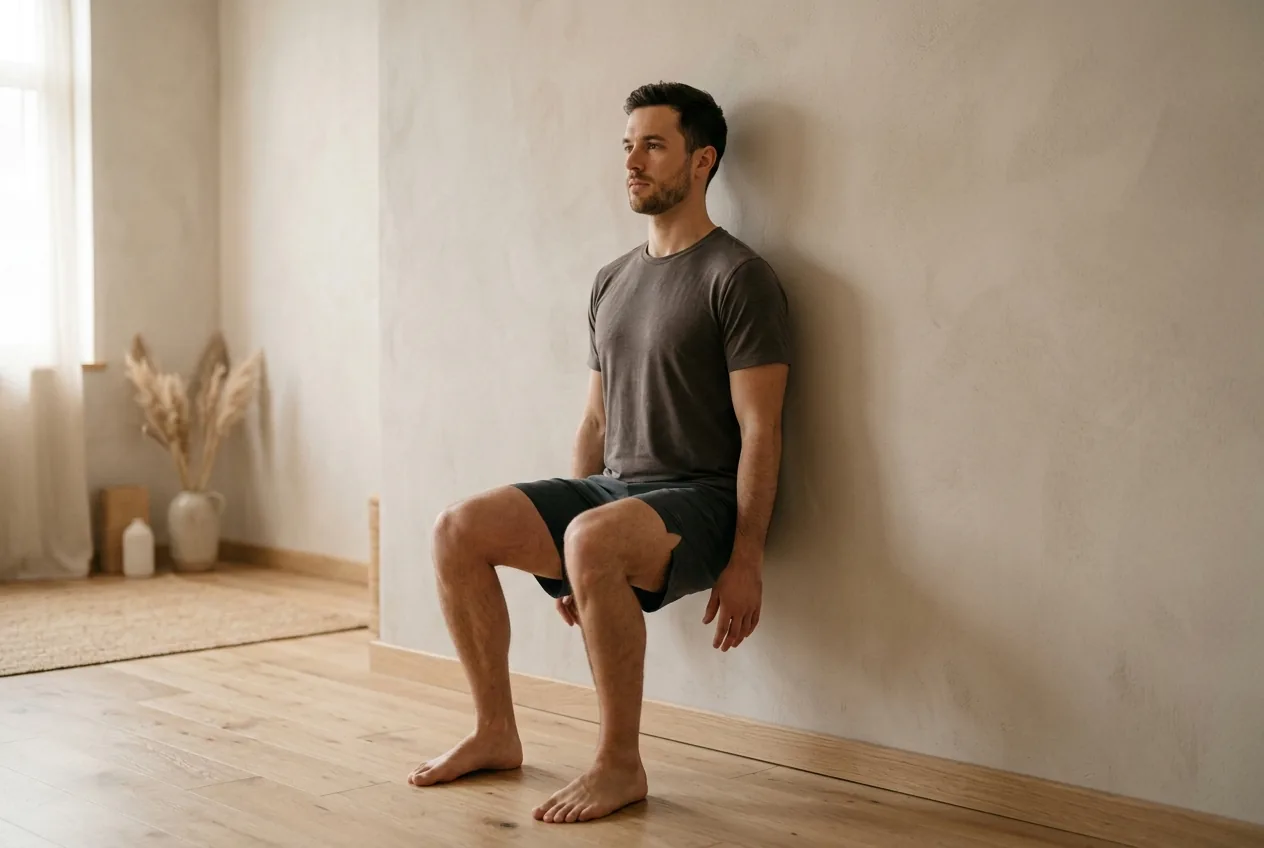
- Stand with your back against a smooth wall, feet about shoulder-width apart and a step or two out from the wall.
- Slide down the wall by bending your knees, walking your feet out as needed, until your thighs are as close to parallel with the floor as you can manage comfortably.
- Check your knees. They should be stacked directly over your ankles, bent at roughly ninety degrees — not pushed out past your toes. If your knees are ahead of your feet, walk your feet further out.
- Press your whole back flat against the wall, including your lower back. Don't let it arch away.
- Keep your weight in your heels, your shins close to vertical, and your hands off your thighs.
- Hold and breathe. Don't hold your breath. Feel the work in your thighs.
Start with what you can manage — even fifteen or twenty seconds is a real effort if you're new to it. Rest, then repeat. Three holds is a solid session.
Reps and sets
Think in time, not reps. A common progression: three holds of twenty to thirty seconds, resting a minute between, two or three times a week. As it gets easier, add five or ten seconds to each hold rather than adding more rounds. Working up to three holds of around a minute is a strong endurance base. If a full-depth wall sit bothers your knees, do a higher, shallower version with less knee bend and lower yourself over the weeks.
The benefits, plainly
- Knee support without impact. It builds the thigh strength that protects the knee, with no jumping, running, or joint pounding.
- Posture endurance. Holding a flat back against the wall trains the muscles that keep you upright through a long day.
- No equipment, anywhere. A wall is all you need, which makes it easy to keep up.
- A clear progress marker. Because you measure it in seconds, you can see yourself improve week to week, which keeps people doing it.
Common mistakes
- Knees past the toes. The most common form error. It loads the knee joint instead of the thigh muscles. Walk your feet further from the wall so your shins stay vertical.
- Not going low enough — or going too low. A stand-up half-squat barely works the legs; a too-deep sit can strain the knees. Aim for thighs near parallel, and back off the depth if your knees complain.
- Lower back arching off the wall. Let the lower back arch away and the wall sit stops training your core and starts straining your spine. Press the whole back flat.
- Holding the breath. Bracing and holding your breath spikes effort and tension. Breathe steadily through the hold.
- Resting hands on the thighs. Pushing on your legs offloads the muscles you're trying to train. Keep your hands at your sides or across your chest.
When to see a doctor
The wall sit is exercise, not medical treatment. Stop and see a clinician promptly if it brings on sharp knee pain, knee swelling, locking, or giving way, or if you get numbness, tingling, or weakness down a leg, or back pain that's severe or steadily worsening. New or significant knee pain is worth assessing before you load the joint repeatedly.
Why a single move isn't the whole answer
A wall sit is genuinely useful, but it's one piece. It builds endurance in a fixed position, and a knee or a back that hurts usually hurts because of how the whole chain — feet, hips, pelvis, spine — is loaded, not just because one muscle is weak. The wall sit that helps one person's knees can do little for another whose problem starts at the hip or the pelvis. It's a fair starting point. The version that lasts is matched to where your load is actually going wrong, which is what a posture assessment built around your own alignment is for, rather than guessing from a single exercise.
Common questions
How long should I hold a wall sit?
Start with whatever you can manage cleanly — fifteen to thirty seconds is plenty when you're new. Do three holds with a minute of rest between, two or three times a week, and add a few seconds each hold as it gets easier. Working up toward a minute per hold is a strong endurance goal.
What muscles does the wall sit work?
Mostly the quadriceps on the front of your thighs, with the glutes and hamstrings assisting and the deep core holding your spine flat against the wall. Because you hold the position rather than move through it, it trains muscular endurance rather than explosive strength.
Is the wall sit good for bad knees?
For many people, yes — it builds the thigh strength that supports and offloads the knee without impact. Keep your knees stacked over your ankles and not past your toes, and use a shallower, higher version if a full-depth wall sit hurts. Stop for sharp pain, swelling, or locking, and get those checked.
Why do my knees go past my toes in a wall sit?
Your feet are too close to the wall. Walk them further out so your shins stay vertical and your knees sit directly above your ankles. Knees drifting past the toes loads the joint instead of the muscles and is the most common wall sit form mistake.