Someone says "good posture" and you picture a soldier — chest puffed, shoulders yanked back, chin up, the whole thing held by sheer effort until your back gives out two minutes later. If that's the image you've been chasing and failing to hold, no wonder. That's not what good posture looks like. It's a pose, and poses don't last.
Real good posture is almost the opposite. It's relaxed. It's the position where your bones stack up and your muscles get to do the least work, not the most. Knowing what good posture looks like — and what it feels like — matters because it's the target everything else aims at. Aim at the soldier and you'll always miss.
The core idea: stacked, not held
Picture a stack of children's blocks. Stacked dead-center, they hold themselves up — gravity runs straight down through the middle and nothing has to strain. Nudge the top block forward and now you have to brace the whole tower to stop it toppling. That bracing is what tired, aching muscles feel like.
Your body is the same. When your head sits over your shoulders, your shoulders over your hips, and your hips over your ankles, the load runs down through your bones and your muscles can mostly relax. When a segment drifts out of line — the head pokes forward, the pelvis tips — other muscles have to work overtime to keep you upright, and that overwork is the ache.
So good posture isn't a shape you hold. It's an alignment where you don't have to hold much at all.
Good posture is the position where your skeleton carries you and your muscles get a break. If holding it is exhausting, it isn't it.
What it looks like from the side
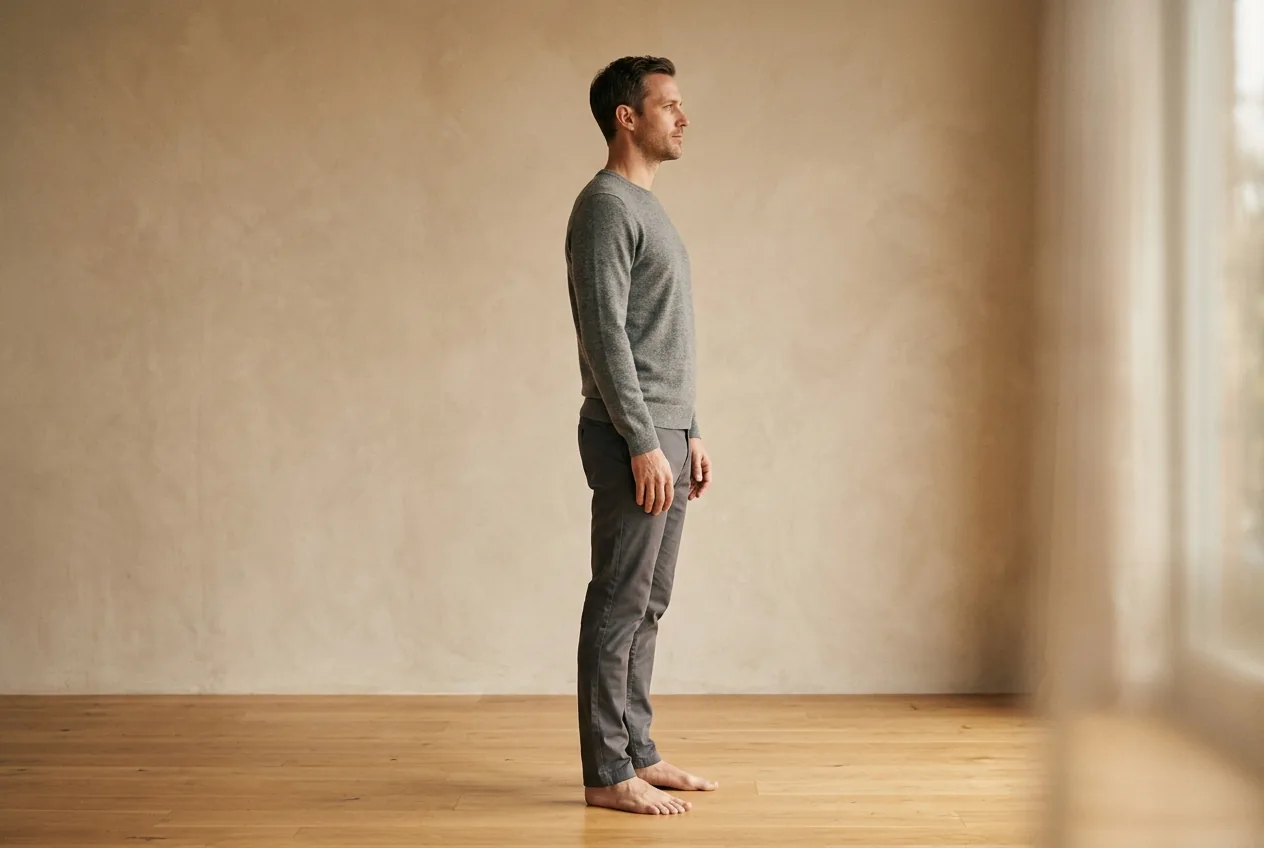
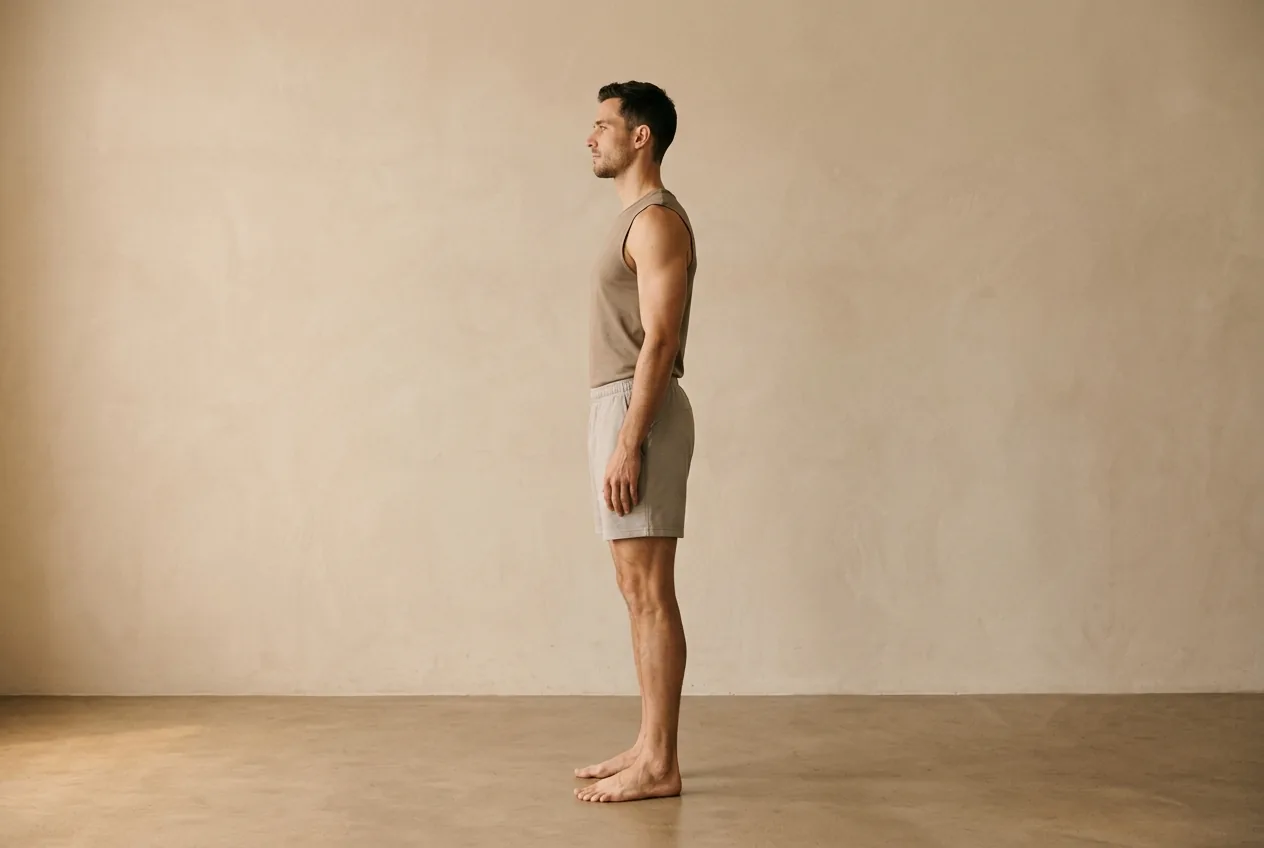
The side view is where posture really shows, because most common problems are front-to-back. Imagine a plumb line — a string with a weight — dropping straight down from the ceiling next to you. In good standing posture it passes, roughly, through these points stacked over each other:
- The ear (not in front of the shoulder)
- The middle of the shoulder
- The middle of the hip
- Just in front of the ankle
Your spine keeps its natural, gentle curves: a slight inward curve at the neck, a slight outward curve at the upper back, a slight inward curve at the lower back. These curves are meant to be there — they're how the spine absorbs load. Good posture isn't a flat, ramrod spine; it's those curves sitting in easy proportion.
The most common place this breaks is the head. If your ear sits forward of your shoulder, that's forward head posture, and because the head is heavy, every inch forward makes your neck work harder all day.
What it looks like from the front
The front view is about symmetry, left to right. In balanced posture:
- Your shoulders sit at about the same height
- Your hips are level
- Your head sits straight, not tilted toward one shoulder
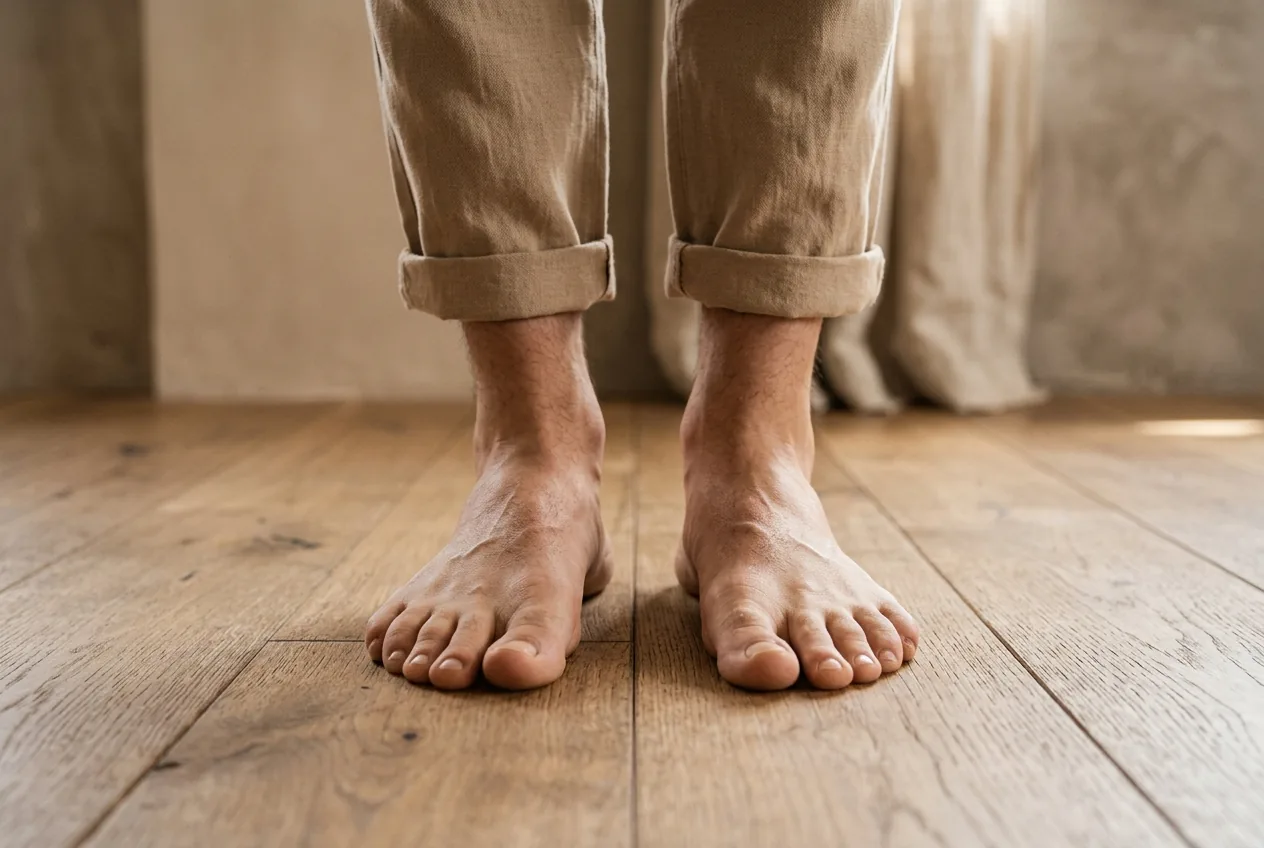
- Your weight feels even between both feet
Small differences are normal — almost nobody is perfectly even, and that's fine. What's worth noticing is a clear, habitual tilt: one shoulder always higher, as in uneven shoulders, or one hip riding up, as in uneven hips. Those usually trace to a foundation tilt that the rest of the body compensates around.
What it feels like (the part nobody mentions)
Here's the test that beats any mirror. Good posture feels easy. You should be able to stand or sit in it and breathe fully, with no single spot screaming for relief. You can hold it without thinking, because you're not holding it — you're balanced over it.
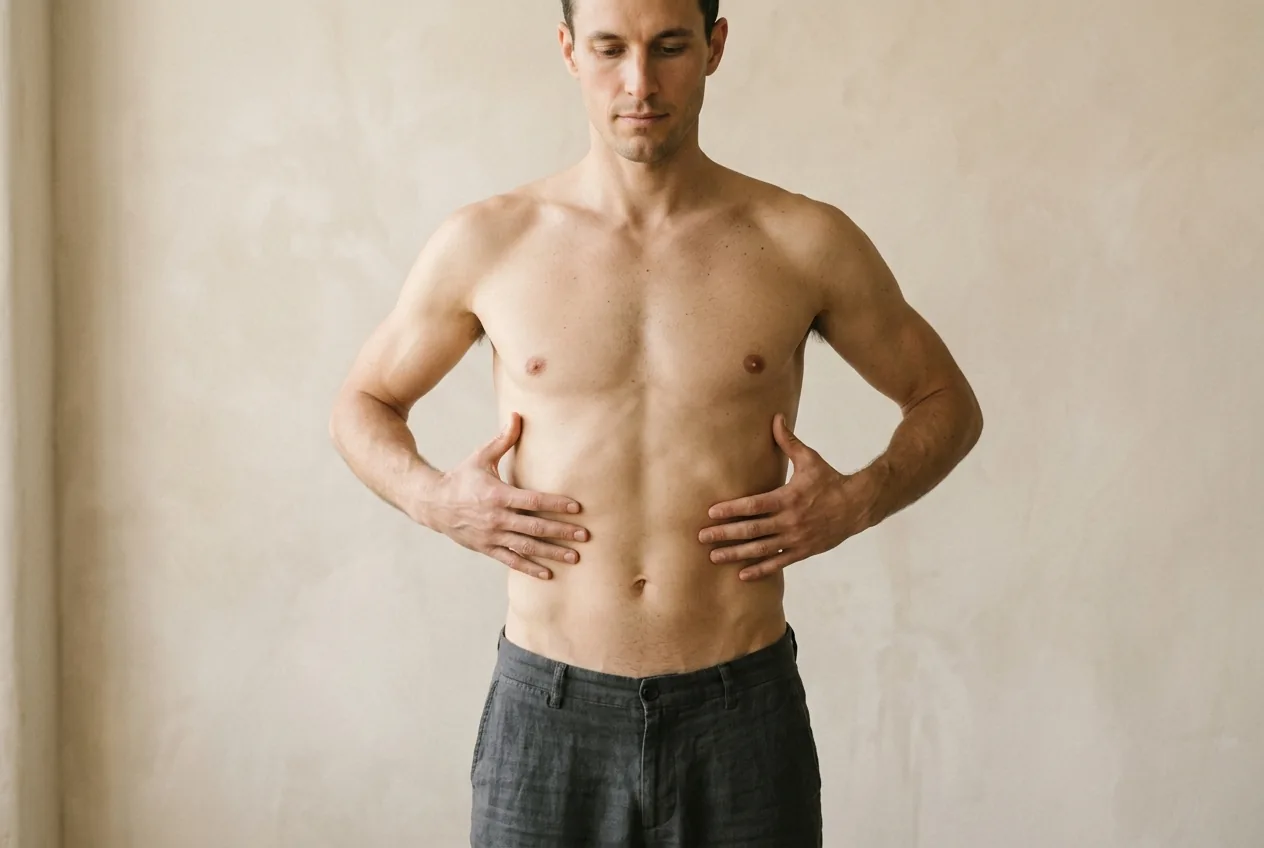
If your "good posture" requires constant clenching, if your chest is jammed up and your breathing goes shallow, you've overcorrected into the soldier pose. Back off. Let your ribs settle down over your pelvis, let your shoulders drop, and find the spot where the effort drains out. That relaxed-but-stacked feeling is the real thing.
Sitting follows the same rule: hips back in the chair, feet supported, screen at eye level, and the same easy stack from hips to head. The goal isn't to sit rigidly upright — it's to sit balanced and to change position often.
A quick self-check
You don't need equipment. Stand side-on to a mirror, or have someone take a side-on photo, and relax into how you normally stand. Look for the head drifting forward, the shoulders rolling in, the lower back arching hard or flattening out. Then check the front view for an obvious tilt. The at-home posture check walks through a wall test and a photo method that make the deviations easier to spot.
What you'll usually find isn't one big fault but a small stack of drifts. That's normal. Most people carry a couple of the common posture types at once.
When to see a doctor
This is posture education, not medical advice. Posture differences are everyday patterns, not disease. See a clinician if you have pain with numbness, tingling, or weakness spreading into a limb, any loss of bladder or bowel control, posture changes after a fall or accident, a curve in the spine that's visibly worsening, fever with back pain, or unexplained weight loss. In children, an uneven back when bending forward should be checked.
Why knowing the target isn't the whole answer
Knowing what good posture looks like gives you the destination. It doesn't tell you the route from where you are now. If your head pokes forward and your pelvis tips, the way back to that easy stack is specific to those deviations — and the same correction that helps one pattern can worsen another.
That's the reasoning behind a real posture assessment: it measures your own deviations and builds the route to neutral around them, in the right order. The mirror shows you the gap; the assessment shows you how to close it.
The target is a relaxed stack, not a held pose. Find the position where the effort disappears, and you've found good posture.
Common questions
What does good posture actually look like?
From the side, your ear, shoulder, hip, and ankle stack roughly in a vertical line, with the spine's natural gentle curves intact. From the front, your shoulders and hips sit about level and your head is straight. The key feature people miss is that it looks and feels relaxed, not stiff or chest-out.
Is standing up straight the same as good posture?
Not quite. "Standing up straight" often means jamming the chest up and bracing, which is tiring and tends to overarch the back. Good posture is a balanced stack where your bones carry the load and your muscles can relax. If staying upright feels like constant effort, you've probably overcorrected.
How can I tell if my posture is bad?
Stand side-on to a mirror or take a side-on photo and look for the head drifting forward of the shoulders, shoulders rolling in, or the lower back arching hard or flattening. From the front, look for an obvious shoulder or hip tilt. An at-home check makes these easier to spot, though it shows the loudest deviation rather than the full picture.
Does good posture have to be held all the time?
No. The best posture is one you can settle into without holding, and the body isn't built to stay in any single position for long anyway. Changing position often and moving through the day matters as much as the alignment itself — a balanced stack you return to beats a rigid pose you force.