You tried a yoga class hoping it would loosen the knot your back has become, and you left feeling great — then woke up the next morning stiffer than before. Or maybe a few poses felt like exactly what your body was asking for, and a few others made something pinch. That mixed result isn't bad luck. It's the most important thing to understand about yoga for posture: the same pose that frees one person's back can load another's the wrong way.
Yoga has real value here. It builds the awareness, mobility, and quiet strength that desk life strips away. But "yoga is good for posture" is too blunt to be useful. What helps is the right poses for your pattern, done with attention to what your spine is actually doing.
What yoga does for posture, and what it doesn't
Sitting hunched all day shortens the front of your body and lets the muscles that hold you upright switch off. Yoga, done well, reverses that: it opens the chest and hips, mobilizes a stiff mid-back, and asks the deep postural muscles to work. Holding a pose with control is strength training in slow motion.
What yoga won't do is undo eight hours of slumping in one weekly class. And it won't help if you pick poses that feed your particular imbalance. A back that's already over-arched doesn't need more backbends; a flat, tucked-under back doesn't need more forward folds. The honest version of yoga for posture is selective, not "more is better."
A pose isn't good or bad for your back. It's right or wrong for the way your back already sits.
Poses that help most desk-bound backs
These tend to help the common slumped, head-forward, tight-hip pattern that office work builds. Move into each slowly and stop short of any sharp pinch.
Cat-cow
The best gentle starting point. On hands and knees, alternate arching and rounding your spine in time with your breath. It mobilizes a stiff mid-back and teaches you to move the spine segment by segment. The full technique is in the cat-cow stretch.
Cobra or sphinx
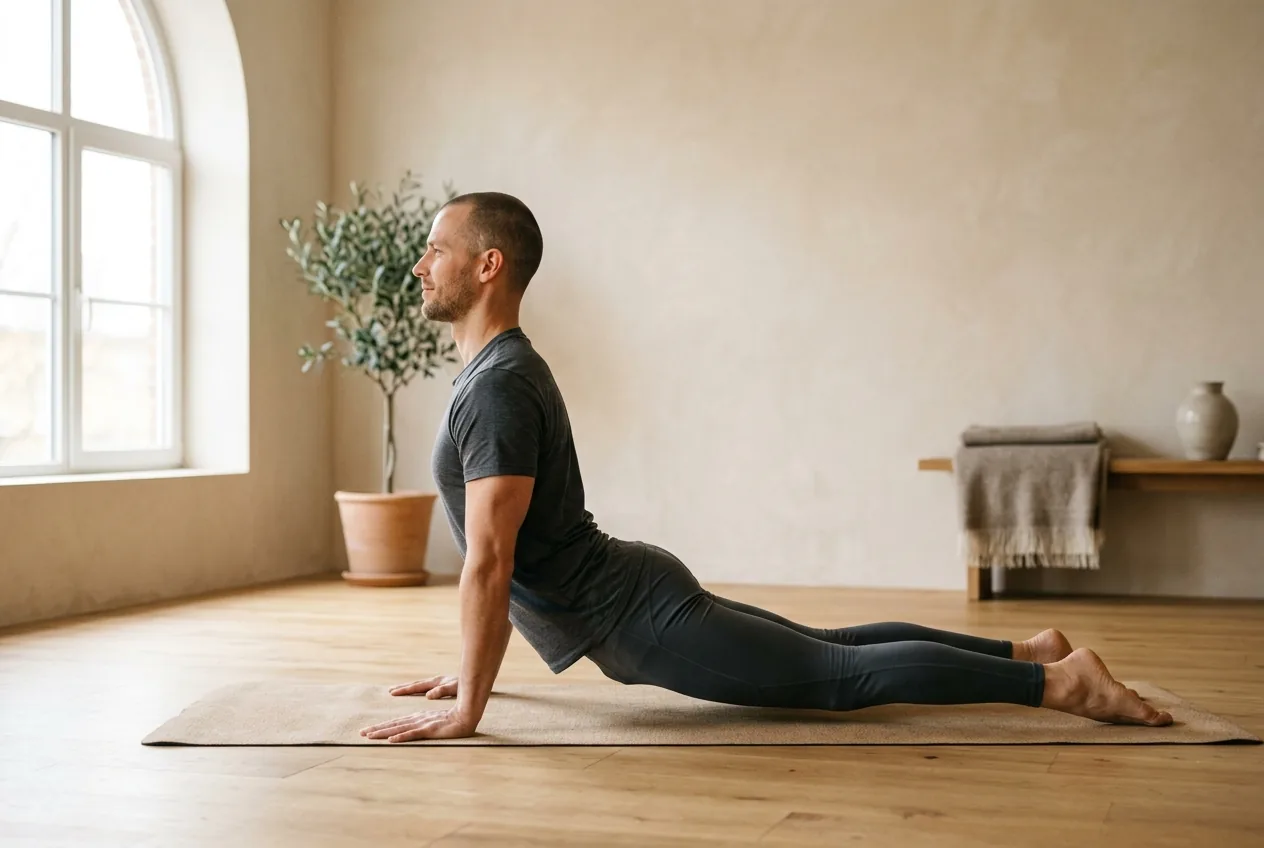
A mild backbend that counters all-day flexion. Lie face down and lift your chest using your back muscles, keeping the lift gentle and your shoulders down away from your ears. Sphinx (propped on the forearms) is the easier version and a good place to start. Skip these — or go very easy — if your lower back already over-arches.
Downward dog
Lengthens the whole back of the body — calves, hamstrings, and the long spinal muscles — while waking the shoulders. Keep a soft bend in the knees and focus on a long spine rather than straight legs. If your hamstrings are tight, bent knees protect your lower back.
Bridge
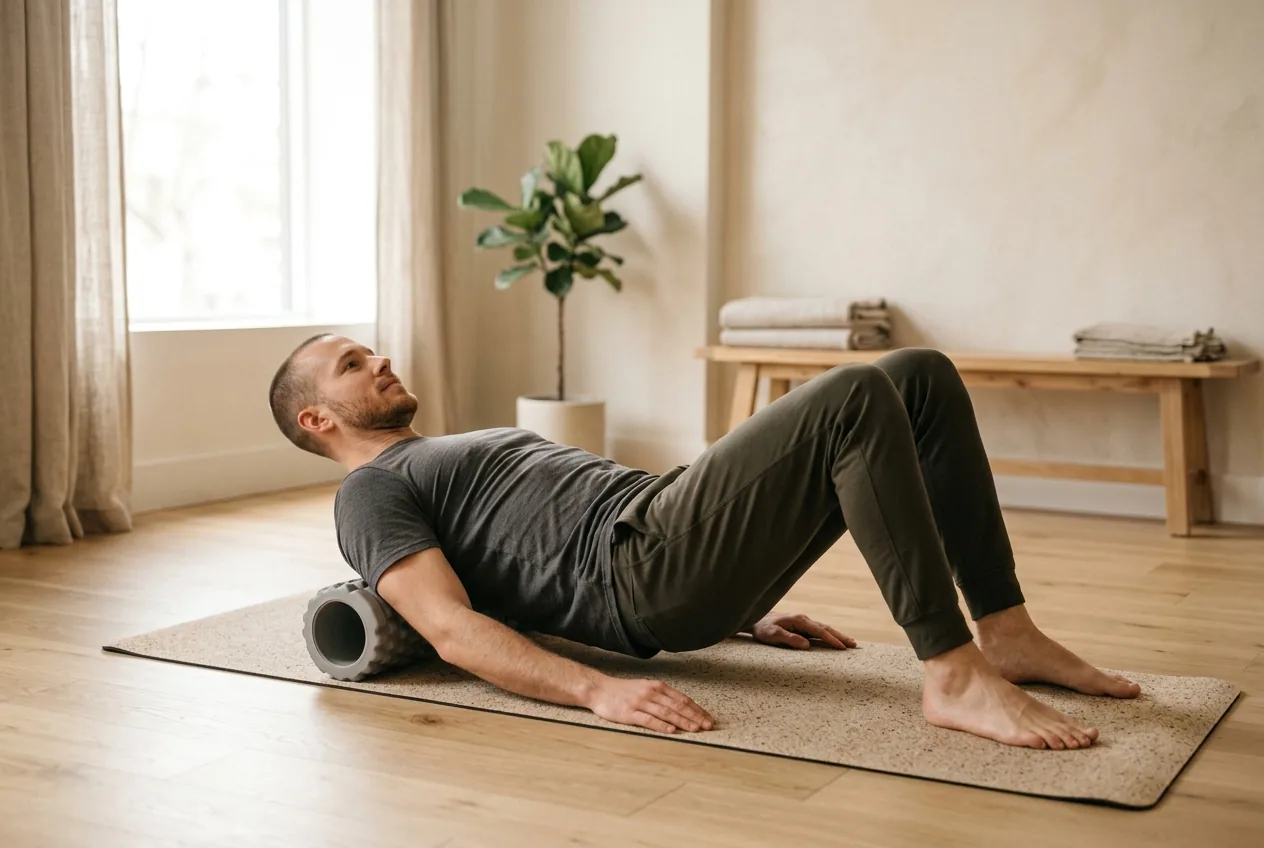
Fires the glutes and opens the front of the hips at the same time — the exact combination most desk workers need. Lie on your back, feet flat, and lift your hips by squeezing your glutes, not by cranking your lower back. It's the same muscle work as the glute bridge for back pain.
Child's pose and a gentle twist
Child's pose releases the lower back and hips. A supine twist — lying on your back, dropping both knees to one side — eases tension along the spine. Both are low-risk and good to finish on.
The one rule that decides what's safe for you
Here's the thread running through all of it. Backbends (cobra, camel, upward dog) extend the spine. Forward folds (seated forward bend, standing forward fold) flex it. If your problem is an over-arched lower back and a forward-tipped pelvis — common with anterior pelvic tilt — deep backbends can make it worse, while gentle folds and core work help. If your back is flat or tucked under, the opposite is true.
This is why a generic flow that throws every pose at everyone gives such mixed results. Half the sequence suits your pattern, half fights it, and you can't tell which did what. Knowing whether your spine needs more extension or more flexion turns yoga from a gamble into a tool.
How to practice it so it sticks
- Short and frequent beats long and occasional. Ten focused minutes most mornings does more for posture than one long weekly class. A few poses you'll actually repeat — like morning stretches for the back — build the habit.
- Hold with control, don't collapse into the stretch. The strength is in keeping the pose organized, not flopping to your end range.
- Breathe. Steady breathing keeps you from forcing past what the tissue is ready for.
- Move the right joint. In forward folds, bend from the hips with a long spine rather than rounding the lower back to reach further.
What to stop doing
- Stop chasing depth. Touching your toes isn't the goal; a long, organized spine is.
- Stop forcing through sharp pain. Stretch tension is fine; pinching, shooting, or numbness is a stop sign.
- Stop loading the neck in poses like shoulder stand or plough if your neck is already cranky — those compress exactly the area you're trying to ease.
When to see a doctor
Yoga suits ordinary postural stiffness and muscular back tension. See a clinician promptly before starting if you have numbness, tingling, or weakness running into an arm or leg, any loss of bladder or bowel control, back pain after a fall or accident, fever with back pain, unexplained weight loss, or pain that's severe or steadily worsening. If a specific pose reliably reproduces sharp pain, drop it and get the area looked at.
Matching the practice to your back
Cat-cow, bridge, and a gentle twist are safe bets for most people. But which backbends or folds belong in your routine — and which ones to leave out — depends on how your spine actually sits. That's the part a class can't tell you and the part that decides whether yoga helps or quietly works against you.
Lasting relief comes from knowing your own pattern: whether your back needs more extension or more flexion, which muscles switched off, which are overworking. A posture-based approach measures your real deviations first, then builds the routine around them — so the poses you practice are the ones your body is actually asking for, not a flow that happens to include both medicine and poison for your particular back.
Common questions
Is yoga good for posture and back pain?
It can be, when the poses fit your pattern. Yoga opens the chest and hips, mobilizes a stiff mid-back, and strengthens the muscles that hold you upright. The catch is that some poses help one type of back and aggravate another, so a selective practice beats throwing every pose at the problem.
Which yoga poses are best for posture?
For the common desk-worker pattern, cat-cow, gentle cobra or sphinx, downward dog with soft knees, bridge, and a supine twist tend to help. Cat-cow and bridge are safe starting points for almost everyone, while deep backbends should be approached carefully if your lower back already over-arches.
Can yoga make back pain worse?
Yes, if you pick poses that feed your imbalance. An over-arched lower back doesn't need deep backbends, and a flat back doesn't need aggressive forward folds. Forcing depth or pushing through sharp pain can also aggravate things. Stay within gentle tension and stop at any pinching or shooting pain.
How often should I do yoga to improve posture?
Short daily practice works better than one long weekly class. Ten focused minutes most mornings competes with the hours of sitting that build poor posture, whereas a single session a week rarely holds against that. Frequency is what changes a habit.