If you finish a set of bridges and feel it in your lower back instead of your backside, you're not lazy and you're not broken — you're just doing the move your body has learned to do. The glute bridge for lower back pain is one of the most recommended exercises on the internet, and one of the most commonly botched. Done well, it teaches your glutes to take over work they've been dodging. Done the usual way, it quietly hands that work right back to the muscles that already ache.
This is a single-move guide. By the end you'll know how to set it up, what the rep should feel like, the three errors that ruin it, and how many to do before it actually changes anything.
What the bridge is supposed to fix
Sit for most of the day and your glutes spend hours switched off and stretched out under you. Meanwhile the muscles along your spine and the front of your hips stay tense to hold you upright in a chair. Over months, your body adopts a quiet division of labour: the back works, the glutes coast.
When you then stand up and bend, lift a kid, or reach into the dryer, the movement that should come from your hips comes from your lumbar spine instead. That's the setup behind a lot of stubborn lower-back ache — not a single injury, but a pattern of the wrong muscles doing the job. It's closely tied to weak glutes and the "dead butt" problem.
The bridge is the simplest way to interrupt that. It puts your hips in a position where the glutes have to fire, with your spine supported on the floor so it can stay out of the way. The point isn't a burning backside. The point is teaching your body which muscle owns the movement.
How to do a glute bridge correctly
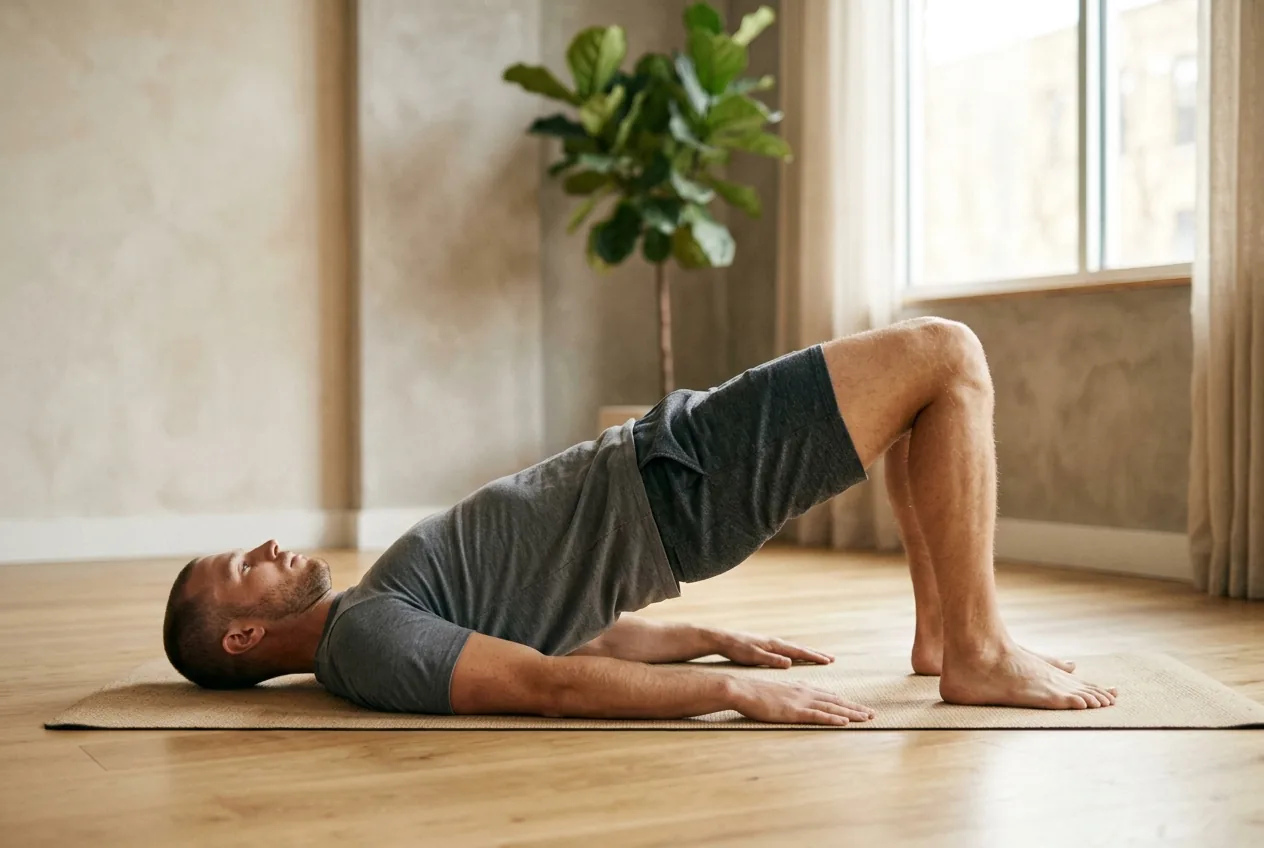
Lie on your back, knees bent, feet flat on the floor about hip-width apart and close enough that your fingertips can graze your heels. Arms rest at your sides, palms down. This is your start position.
- Before you move, flatten your lower back gently toward the floor — a small posterior tilt of the pelvis, like tucking your tailbone under. This is the step most people skip, and it's what keeps the back out of it.
- Squeeze your glutes first, then press through your heels and lift your hips toward the ceiling.
- Stop when your body makes a straight line from shoulders to knees. Higher is not better.
- Hold for two seconds at the top, squeezing your backside like you're trying to crack a walnut.
- Lower slowly — take three or four counts on the way down, don't just drop.
The whole rep should feel like it lives in your glutes and the backs of your thighs. Your lower back should feel like it's resting, not working.
If you can't feel your glutes, lower the height of the lift. A small bridge done right beats a high one done wrong.
The three mistakes that turn it into a back exercise
Arching at the top. The most common error. People chase height and end up hyperextending the lower back, so the lift comes from the spine instead of the hips. Cue: imagine your hips and ribs are connected by a short rope that shouldn't stretch. Lift only until you're straight.
Heels too far out. When your feet drift away from your body, the hamstrings take over and the glutes barely fire — some people even get a hamstring cramp. Walk your heels in until they're under your knees.
Pushing through the toes. Driving through the balls of your feet pulls the work into the front of the thigh. Keep your weight in your heels; you should be able to lift and wiggle your toes at the top.
If you feel the move in your lower back, stop and check these three before you blame the exercise.
Reps, sets, and how to progress
Start with 2 sets of 10 slow reps, once a day. Quality over quantity — ten controlled lifts where you actually feel your glutes beat thirty sloppy ones every time.
Once that feels easy and your back stays quiet, progress in one of these ways:
- Longer holds: pause five seconds at the top of each rep.
- Single-leg bridge: extend one leg straight, lift with the other. Keep your hips level — don't let the lifted-leg side drop.
- Feet elevated: rest your heels on a low step to increase range.
Build slowly. The goal is a pattern your body keeps, not a personal record.
Who this helps, and who should ease in
The bridge tends to help people whose backs ache after sitting, who feel their lower back doing the work when they bend or lift, and who've been told they have a "weak core" but really have switched-off glutes. It pairs naturally with core exercises for lower back pain, which target the deeper stabilisers the bridge doesn't reach.
If you have an anterior pelvic tilt — a forward-tipped pelvis with an exaggerated lower-back curve — the posterior-tilt cue at the start matters even more for you. It's the part that protects your spine.
When to see a doctor
The glute bridge is gentle, but pain has limits worth respecting. See a clinician promptly if you have numbness, tingling, or weakness that spreads down a leg, any loss of bladder or bowel control, back pain after a fall or accident, fever alongside back pain, unexplained weight loss, or pain that's severe or steadily getting worse. Those signs point to something a single exercise won't address.
Why the same move helps one back and not another
Here's the honest part. The bridge is a good general move, but whether it's the right move for *you* depends on the pattern you're carrying. A back that hurts from a forward-tipped pelvis needs a different emphasis than one that hurts from a flattened spine — and the same lift can ease one and aggravate the other.
That's the whole problem with generic exercise advice: it can't see your alignment. Knowing your own pattern is what turns a list of exercises into a routine that holds. A structured posture assessment measures where your body actually deviates and builds the sequence around it, so the work you put in goes where it counts.
Start with the bridge done right. Then match it to your body, and do it daily. That's where the change lives.
Common questions
Why do I feel glute bridges in my lower back instead of my glutes?
Usually one of three things: arching at the top instead of stopping when you're straight, heels too far from your body so the hamstrings take over, or pushing through your toes. Tuck your tailbone first, walk your heels under your knees, and drive through your heels.
Are glute bridges good for lower back pain?
For many people, yes. Sitting switches the glutes off and lets the lower back do their work. The bridge teaches the glutes to fire again with your spine supported on the floor, which takes load off your back.
How many glute bridges should I do for my back?
Start with 2 sets of 10 slow reps once a day, focusing on feeling your glutes rather than lifting high. Ten controlled reps beat thirty sloppy ones. Progress to longer holds or single-leg versions once your back stays quiet.
How high should I lift my hips in a glute bridge?
Only until your body makes a straight line from shoulders to knees. Higher isn't better — chasing height hyperextends the lower back and hands the work back to your spine.