You stand up after a long stretch at the desk and your hips feel locked, like they need a few steps to remember how to move. Crouching to pick something off the floor, getting into a low car, sitting cross-legged on the floor with the kids — your hips don't want to go there anymore. That stiffness isn't age catching up with you. For most desk-bound adults it's the predictable result of hips that sit in one short, folded position for hours a day. Good hip mobility exercises give that range back, and they don't take long.
The aim isn't to bend yourself into a pretzel. It's to restore the normal motion your hips have quietly lost, in every direction, so daily movement stops feeling stiff.
Why hips get stiff in the first place
Sitting is the main culprit. When you sit, the hip is folded — the hip flexors at the front are held short, and the glutes at the back are switched off and lengthened. Hold that for thousands of hours and the body adapts. The front tightens and shortens; the back weakens. The joint itself moves less in every direction because the muscles around it have settled into the sitting shape.
That's why stretching alone often doesn't stick. You loosen the front, then sit for eight hours and it tightens right back up. The hips don't just need to be stretched — they need to be moved through their full range often, and the weak back side needs waking up so it can hold the new range. This is the same mechanism behind tight hip flexors from sitting, and freeing the hips usually eases the lower back too, since a stiff hip makes the back pick up the slack.
Stiff hips from sitting aren't a flexibility failing. They're a body that adapted to the shape you hold it in most. Change the shape often and the range comes back.
A simple hip mobility routine
Do these most days. None should hurt — mobility work lives just at the edge of your comfortable range, not past it. Slow and controlled beats forced and fast.
Kneeling hip-flexor stretch
Kneel on one knee, the other foot flat in front. Tuck your tailbone under and gently push your hips forward until you feel a stretch across the front of the kneeling-side hip. Tucking the tailbone is what makes this work — it stretches the hip flexor instead of cranking the lower back. Hold 20 to 30 seconds each side. This directly counters the sitting shape, and the full cues are in the hip-flexor stretch for back pain.
Hip circles on all fours
On hands and knees, lift one knee and draw slow circles with it, opening the hip out and around. 8 to 10 circles each direction, each leg. This moves the joint through ranges sitting never asks for.
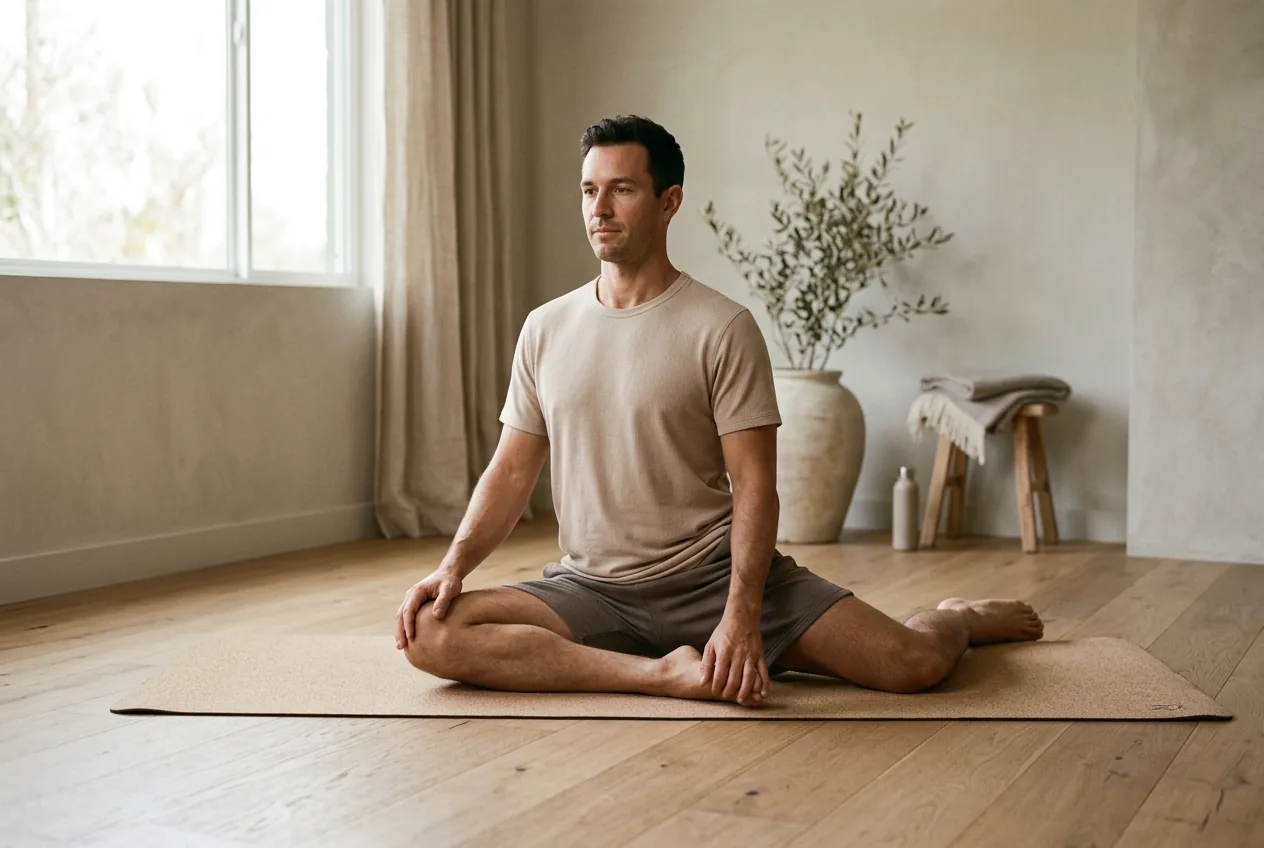
90/90 hip rotations
Sit on the floor with one leg bent in front at 90 degrees and the other bent out to the side at 90 degrees. Slowly rotate both knees over to the other side and back, switching the front and back legs. This frees up the rotation most people lose first. Go gently and don't force the knees down. 6 to 8 slow reps each side.
Deep squat hold
Holding a doorframe or counter for balance, lower into the deepest comfortable squat with your heels down and sit there for 20 to 30 seconds, letting the hips open. This is a position humans used to rest in all day. Easing back into it restores a lot of range. Build up the time slowly.
Glute bridge
Lie on your back, knees bent, feet flat, squeeze the glutes to lift your hips, hold two seconds, lower slowly. Mobility without strength doesn't last — this wakes up the back side of the hip that sitting switched off, so it can hold the range you're opening. 10 to 12 reps. The cues are in the glute bridge for back pain.
How to make it stick
- Little and often beats one long session. Two or three minutes most days does more than a 20-minute session once a week.
- Break up sitting. Stand and take a few steps every half hour. No routine outpaces eight unbroken hours of sitting.
- Stay in the comfortable range. Sharp pain or a pinch deep in the hip means back off. Mobility is gained gently, not forced.
- Pair stretch with strength. Open the front, wake up the back. That's what holds the range.
When to see a doctor
This is posture education, not medical advice. Stiffness that eases as you move is the usual desk-hip pattern. See a clinician if hip stiffness comes with sharp, deep groin pain on weight-bearing, if the joint locks, catches, or gives way, if there's swelling, redness, or fever, if pain or numbness spreads down the leg, or if range is steadily getting worse despite gentle work. Persistent, worsening stiffness that isn't tied to sitting is worth having assessed.
Why your own pattern matters
Generic hip mobility routines assume every hip is stiff in the same way. They aren't. One person's hips are locked from a pelvis tipped forward by tight hip flexors; another's from a pelvis dropped to one side by a weak glute. The moves that free one can do little for the other, and the wrong emphasis can even feed the imbalance.
That's the case for knowing your own setup. A posture assessment measures how your pelvis actually sits — tipped, dropped, rotated — and builds the hip and glute work around that, so you're opening the directions you've actually lost rather than working through a generic list.
Common questions
What are the best exercises for hip mobility?
A short daily mix works best: the kneeling hip-flexor stretch to counter sitting, hip circles and 90/90 rotations to free up movement in every direction, a deep squat hold to restore overall range, and a glute bridge to wake up and hold the new range. Two or three minutes most days beats one long session.
How do I loosen tight hips from sitting?
Counter the sitting shape often. Stretch the hip flexors at the front, move the joint through its full range with circles and rotations, and wake up the glutes at the back that sitting switches off. Just as important, break up sitting itself — stand and move every half hour so the hips don't lock back up.
How long does it take to improve hip mobility?
Most people feel looser within the first week or two of daily work. Lasting change — where the hips stay mobile rather than tightening back up — usually takes several weeks of consistency, plus breaking up long sitting. Pairing stretching with glute strengthening is what makes the gains hold.
Can tight hips cause lower back pain?
Yes, often. When the hips are stiff, the lower back tends to move more to make up for it, and tight hip flexors can tip the pelvis forward and overload the lower back. Freeing the hips and strengthening the glutes frequently eases back pain that stretching the back alone never touched.