
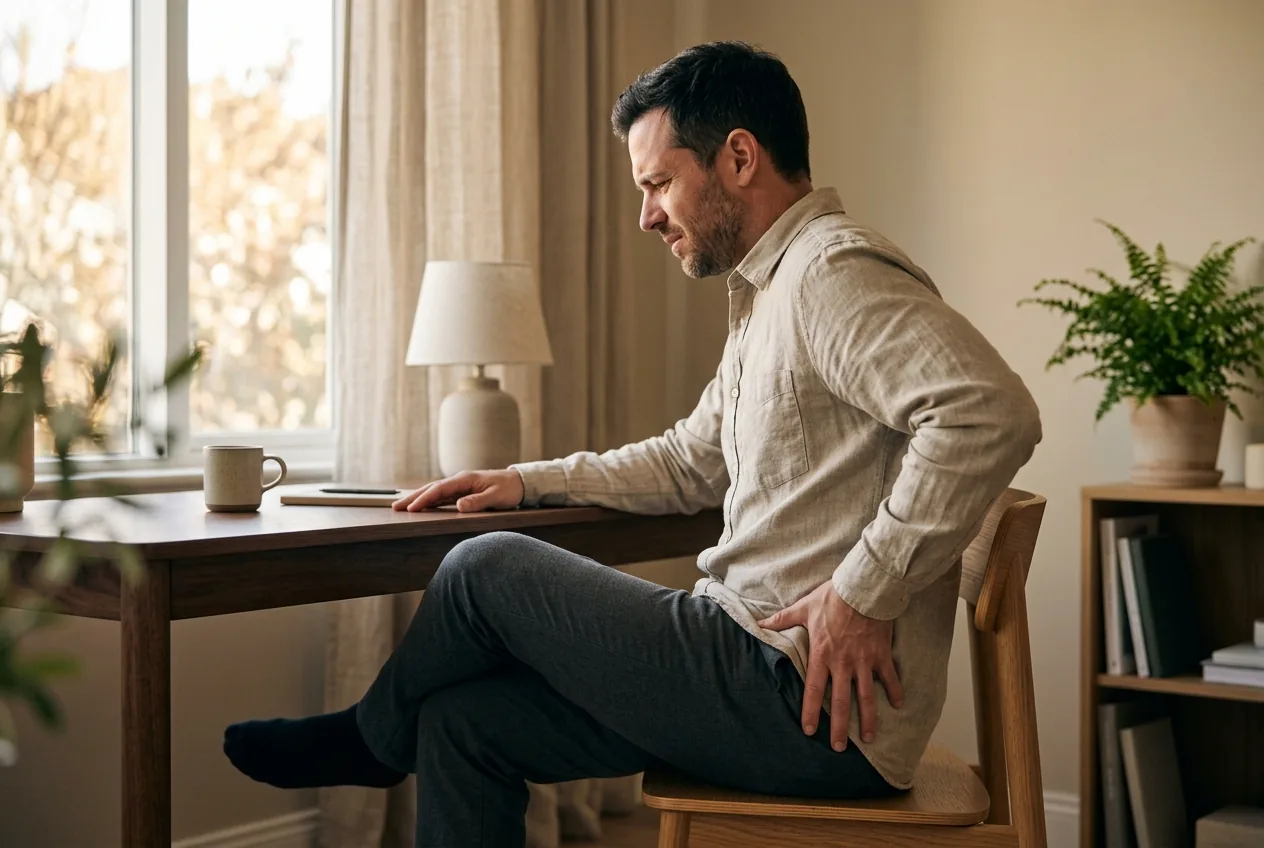
Twenty minutes into a meeting, or an hour into a drive, the same thing happens: a deep ache settles into one hip, sometimes a pinch at the front of the crease, sometimes a dull burn underneath where you're sitting. You shift, cross your legs, lean to one side. It helps for a minute, then it's back. Hip pain when sitting is one of those problems that barely registers when you're up and moving but turns a long meeting or a road trip into a clock-watching exercise.
If your hip hurts when seated but feels fine on a walk, you're not imagining it. Sitting does specific things to the hip that standing doesn't, and once you see them the fixes are straightforward.
What sitting does to the hip
A seated hip is bent to roughly 90 degrees and held there. That position does three things.
It shortens the hip flexors at the front of the hip. Hold a muscle short for an hour and it tightens; do it for years and it stays short. That's the deep front-of-hip pinch some people feel when seated, and it's the same mechanism behind tight hip flexors from sitting.
It switches the glutes off. You're literally sitting on them, and a muscle that's compressed and idle for hours stops firing well. Weak, sleepy glutes let the pelvis drift out of line, which loads the hip joint and the tissue around it unevenly.
It puts pressure on the structures under you. The sit bones, the tissue over them, and a band of muscle deep in the buttock all get compressed. On a hard or poorly shaped seat — including a lot of car seats — that pressure can irritate the piriformis muscle and the nerve that runs near it, which is why the ache sometimes spreads down the leg.
A hip that only hurts when you sit is usually being squeezed and switched off, not worn out.
Why driving is often worse
Driving stacks extra problems on top of plain sitting. The seat reclines, which tips your pelvis backward and rounds your lower back. Your right leg works the pedals while your left sits idle, so the two hips are loaded differently for hours. Bucket seats often dump your weight onto the outer hip. And there's vibration, which steadily irritates already-compressed tissue.
The result is that "hip hurts when driving" frequently shows up on one side — usually the right, the pedal side — and gets worse the longer the trip. The mechanics are close cousins of lower back pain when driving, and the seat fixes overlap.
Fixes for sitting at a desk
You can change a lot without buying anything.
- Get your hips above your knees. Set the chair high enough, or wedge a folded towel under your sit bones at the back, so your hips sit slightly higher than your knees. This opens the hip angle and eases the front-of-hip pinch. The basics of how to sit with lower back pain apply directly.
- Stop sitting on your wallet or one foot. Either one tilts your pelvis and loads one hip for the whole sitting session.
- Don't cross your legs for long stretches. It feels like relief and quietly rotates the pelvis.
- Stand up every 30 to 45 minutes. Even a 30-second stand-and-walk resets the hip flexors and wakes the glutes. This single habit does more than any cushion.
Fixes for the car
- Bring the seat back closer to upright — around 100 to 110 degrees — so you're not reclined into a rounded back.
- Use a small lumbar support or a rolled towel in the curve of your lower back to stop the pelvis from tipping backward.
- On long drives, stop and walk for two minutes every hour. The hip needs motion, not just a better cushion.
- If one side takes the brunt, a thin wedge cushion that levels your pelvis can help. A car seat back support setup is worth getting right if you drive a lot.
Moves that undo the damage
Two short habits counter what sitting does.
Kneeling hip flexor stretch. Once or twice a day, kneel in a lunge, tuck your tailbone under, squeeze the down-side glute, and ease your hips gently forward until you feel a stretch across the front of the back hip. Hold 30 seconds each side. This gives back the length sitting takes.
Glute bridge. Lie on your back, knees bent, feet flat, and lift your hips by squeezing your glutes. Do 10 to 12. This wakes up the muscle you've been sitting on so the pelvis stops drifting. The glute bridge for back pain covers the cues.
When to see a doctor
This is posture education, not medical advice. See a clinician promptly if your hip pain came after a fall or accident, if you have numbness, tingling, or weakness spreading down the leg, any loss of bladder or bowel control, fever with the pain, redness and heat over the joint, unexplained weight loss, or pain that's severe or steadily worsening. Pain that radiates well down the leg and won't settle deserves a proper look — it can involve the nerve rather than the hip itself.
Why the lasting fix is your own pattern
The seat tweaks and stretches help most people quickly. The reason your hip got sensitive to sitting in the first place is more individual — a forward-tipped pelvis, one hip higher than the other, glutes that quit. Generic cushion advice can't account for that, and the wrong stretch can even nudge a one-sided problem the wrong way.
That's the case for a proper posture assessment rather than chasing the ache seat by seat: measure your actual deviations, then retrain the muscles that switched off, so a long meeting or drive stops being a countdown.
Common questions
Why does my hip hurt when I sit but not when I walk?
Sitting bends and holds the hip, shortening the hip flexors, switching off the glutes you're sitting on, and compressing the tissue underneath. Walking moves all of that and loads the hip the way it's built for, so the ache eases.
Why is hip pain worse when driving?
A reclined seat tips your pelvis back and rounds your spine, one leg works the pedals while the other sits idle, bucket seats load the outer hip, and vibration irritates already-compressed tissue. It often shows up on the pedal-side hip.
How should I sit to avoid hip pain?
Set your hips slightly higher than your knees, keep your weight even on both sit bones, skip crossing your legs for long stretches, and stand up every 30 to 45 minutes. The standing breaks matter more than any cushion.
Can sitting cause hip pain that goes down the leg?
It can. Prolonged sitting compresses the piriformis muscle deep in the buttock and the nerve running near it, which can refer pain down the leg. If pain travels well past the buttock or comes with numbness or weakness, have it assessed.