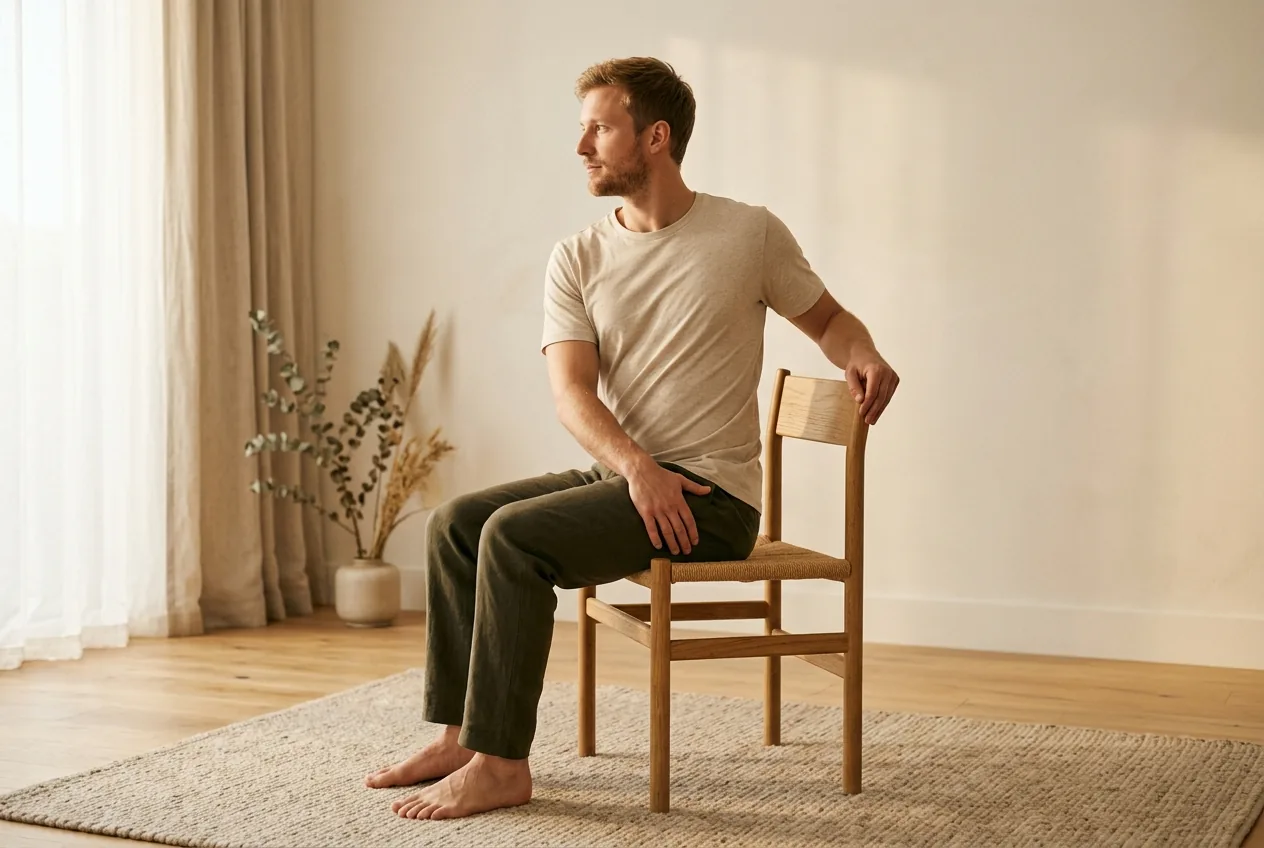
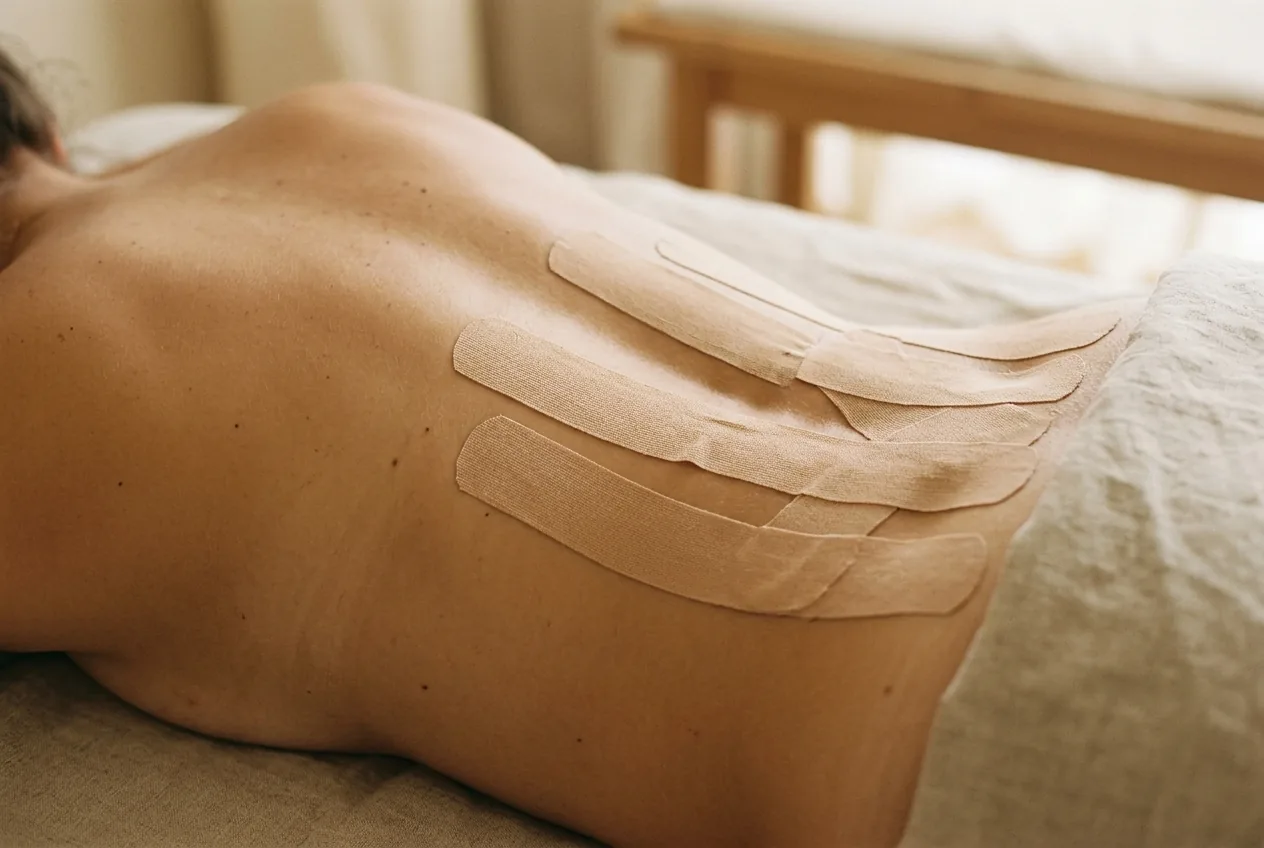
You've seen the bright strips of tape on athletes and physios' clients, and now your aching back has you wondering if a few stripes could quiet things down too. It's a fair question. Kinesiology tape for back pain is everywhere — clinics, gyms, the chemist's shelf — and the marketing makes big promises about support, alignment, and pain relief. The honest answer is more modest than the packaging: the tape can do a couple of useful things, but it doesn't pull your spine into position or fix the reason your posture slumps.
This guide lays out what kinesiology tape actually does, what the evidence broadly supports, where it helps with posture and back pain, and where it quietly oversells.
What kinesiology tape actually does
Kinesiology tape is a thin, stretchy cotton strip with an adhesive backing. Unlike rigid athletic tape, which is built to lock a joint down, kinesiology tape stretches and moves with you. That's the whole design idea — it stays on while you move rather than restricting you.
The main thing it does is sit on your skin and create a constant, gentle sensation. When the tape pulls slightly on the skin as you move, it gives your nervous system a steady stream of feedback from that area. That sensory input is the realistic mechanism behind most of its effects: it makes you more aware of the taped region, which can change how you hold and move it.
What it does not do is mechanically hold your spine, shoulders, or pelvis in place. A strip of stretchy cotton has nowhere near the force needed to overcome the muscles and habits pulling you into a slouch. Anyone selling it as a posture-corrector in the structural sense is overstating it.
Does kinesiology tape help posture?
In a limited, useful way — yes. Here's the realistic version.
When you put tape across the upper back or along the spine, the tug on your skin becomes a reminder. Every time you start to round forward, you feel the tape stretch, and that nudges you to straighten up. It's a tactile cue, similar in spirit to a posture brace but lighter. That cueing effect can genuinely help you slouch less while you're wearing it.
The catch is the same one that limits every passive posture aid: the cue works while it's on, and it builds awareness, but it doesn't build the muscle that holds you upright. Take the tape off and the old pattern is still there. So tape can be a helpful short-term reminder while you do the actual work of releasing tight muscles and strengthening weak ones — much like posture correctors, it's a prompt, not a cure.
Tape reminds your body where upright is. It can't make your body strong enough to stay there.
Does it help back pain?
For some people, modestly and temporarily. The most consistent reasons tape seems to ease back pain:
- Sensory distraction. That steady input from the skin can compete with pain signals, taking the edge off discomfort while it's on.
- More confident movement. Feeling "supported" — even if the support is mostly perceptual — can reduce guarding, so you move more normally, which itself helps a sore back.
- Awareness. The cue can stop you from drifting into the position that aggravates you.
What the broad picture suggests is that kinesiology tape can offer small, short-term pain relief and may help a bit when combined with proper rehab — but on its own it isn't a strong or lasting treatment. Used alongside movement and strengthening, it's a reasonable add-on. Used instead of them, it disappoints.
How to use it sensibly (and how not to)
If you want to try it, treat it as one small tool:
- Get it applied properly. A physio or trained clinician knows the placement and tension for your situation. A badly applied strip does little.
- Use it as a cue, not a crutch. Let the tape remind you to sit tall or move well — then do the strengthening that makes upright posture stick.
- Pair it with real work. Tape plus daily movement beats tape alone every time. Think of it as scaffolding while you build.
- Watch your skin. Remove it if you get itching, redness, or irritation; some people react to the adhesive.
- Don't expect it to hold your spine. If your goal is structural change, the tape isn't the thing doing it.
Where not to lean on it: as a standalone fix for chronic pain, as a substitute for addressing why your posture slumps, or as a reason to skip strengthening. Compared with other passive options, it sits in the same camp as many alternative approaches to back pain — possibly soothing, rarely the root fix.
When to see a doctor
Tape is low-risk, but back pain has limits worth respecting. See a clinician promptly if you have numbness, tingling, or weakness spreading down a leg, any loss of bladder or bowel control, back pain after a fall or accident, fever with back pain, unexplained weight loss, or pain that's severe or steadily worsening. This article is education and posture therapy, not medical advice — and tape should never be used to push through pain that's escalating. If you're weighing professionals, here's how a chiropractor and a physical therapist differ.
Why a strip of tape can't fix the pattern
The reason kinesiology tape can soothe but not solve comes down to what's actually driving most chronic back and neck pain. A slumped posture or a recurring ache usually isn't a skin-level problem — it's a pattern. Some muscles have switched off and others overwork to cover, dragging your spine and pelvis out of position. Tape adds a sensation on top of that pattern. It doesn't change the pattern.
That's why the cue helps in the moment and fades the second you peel it off. A posture assessment measures where your alignment actually deviates and builds a daily routine to retrain the muscles holding you in the slump — the thing tape only reminds you to fight. If you want a first read on your own posture, you can check it at home and start to see why one person's tape job helps and another's does nothing.
Use the tape as a gentle cue if it helps. Just don't mistake the reminder for the repair.
Common questions
Does kinesiology tape actually correct posture?
Not structurally. It's too stretchy and weak to hold your spine in place. What it does do is give a tactile cue — when you slump, the tape tugs your skin and reminds you to straighten — which can reduce slouching while it's on. It builds awareness, not the muscle that holds you upright.
How long can you leave kinesiology tape on?
Most kinesiology tapes are designed to stay on for several days, often three to five, including through showers. Remove it sooner if you notice itching, redness, or skin irritation, and give your skin a break between applications.
Is kinesiology tape better than a posture brace?
They work on the same principle — a cue, not a fix. Tape is lighter and lets you move freely; a brace gives a firmer reminder but can feel restrictive. Neither builds strength, so both work best as short-term prompts alongside actual strengthening.
Can kinesiology tape relieve lower back pain?
It can offer small, short-term relief for some people, mostly through sensory distraction and a sense of support that reduces guarding. It's a reasonable add-on to movement and rehab, but on its own it's not a strong or lasting treatment for back pain.