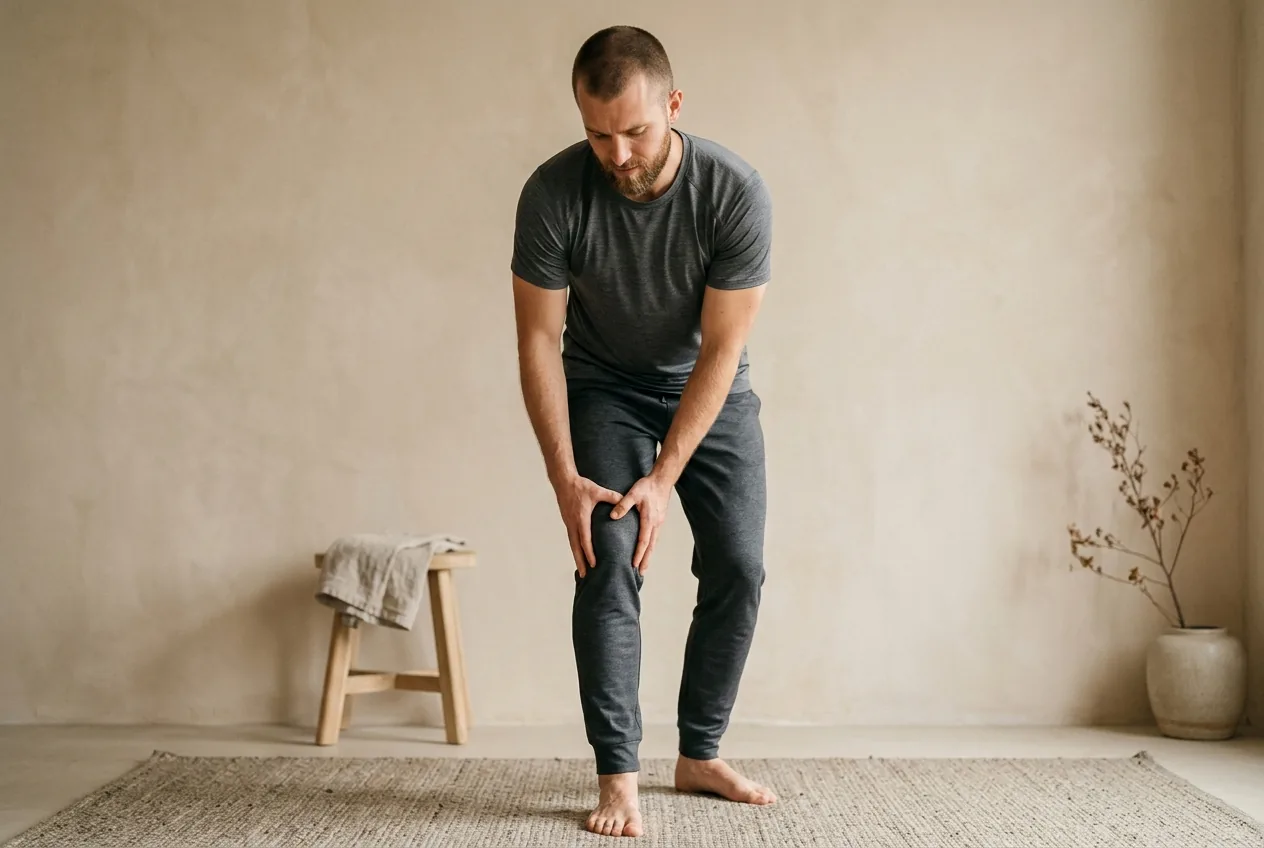
Your knee aches on the stairs, or after a walk, or when you stand up from the floor after playing with your kids. There's no swelling worth mentioning, no moment you can point to where you hurt it. You've stretched the quad, foam-rolled the IT band, maybe bought a knee sleeve. It helps a little, then the ache drifts back. The knee feels like the problem, so the knee is where all your attention goes.
But knee pain and posture are tied together more tightly than most people expect, and the knee is often the joint that pays for trouble somewhere else. It sits in the middle of a chain that runs from your feet up through your hips. When the joints above and below it sit out of line, the knee gets twisted and loaded in ways it wasn't built for — and it's the one that complains, even though it's rarely the one at fault.
The knee is a hinge caught in the middle
Your knee is essentially a hinge. It's good at bending and straightening, and not built to twist much. Above it sits the hip, a ball-and-socket joint that controls which way the thigh bone points. Below it sits the foot and ankle, which decide how your weight lands on the ground. The knee just tracks along between them.
So the knee's alignment isn't really set at the knee. It's set by the hip above and the foot below. If the hip lets the thigh roll inward, the knee gets pulled inward with it. If the foot collapses flat, the lower leg rotates and the knee follows. Either way, the kneecap stops gliding straight in its groove and starts rubbing off to one side. Do that a few thousand times a day, walking and climbing stairs, and the joint gets irritated.
That's the heart of it. The knee hurts where the load piles up, but the load piles up because of how the joints around it are positioned.
The knee is honest. It hurts where the strain lands, even when the strain was created somewhere else.
What's usually happening above the knee
For desk-bound adults, the trouble most often starts at the hip. Sitting for hours shortens the hip flexors at the front of the hip and lets the glutes — the muscles that should control the thigh — switch off. Weak glutes are a recurring theme on this site for a reason; they sit at the center of how the lower body holds itself, which is why weak glutes feed into back pain too.
When the glutes are asleep, nothing stops the thigh from rolling inward as you load the leg. The knee caves toward the midline on every step and every stair. The kneecap tracks off-center, and the ache sets in. You can stretch the knee all day, but if the hip isn't controlling the thigh, the knee keeps getting pulled in.
Tight hip flexors add to it by tilting the pelvis and changing how the whole leg lines up. If you sit most of the day, the pattern in tight hip flexors from sitting is likely part of your knee story.
What's usually happening below the knee
The other end matters just as much. If your foot rolls inward and the arch flattens when you stand or walk, the shin bone rotates in, and the knee turns with it. People with flat-feeling feet often have knee pain on the same side, and it's no coincidence — the collapse at the bottom travels straight up to the knee. The whole chain is why foot posture affects the whole body, knees included.
So before you blame the knee, look at how your foot meets the ground and how your hip controls your thigh. The knee is usually reporting a problem from one or both of those neighbors.
What to work on instead
The plan is to build control at the hip, support from the foot, and stop hammering the knee with poor alignment. Go gently. Nothing here should sharpen the knee pain.
Strengthen the hip
- Glute bridges. Lie on your back, knees bent, feet flat. Push through your heels and lift your hips, squeezing the glutes at the top. Ten to fifteen slow reps. This wakes up the muscles that should be controlling your thigh.
- Side-lying leg lifts. Lie on your side and lift the top leg straight up without letting it drift forward. Ten to fifteen per side. This trains the outer-hip muscles that stop the knee caving inward.
Build from the foot
- Short-foot drill. Standing, gently draw the ball of your foot toward your heel to lift the arch a little, without curling your toes. Hold a few seconds, repeat. This trains the foot to support itself instead of collapsing.
- Single-leg balance. Stand on one foot for 20–30 seconds, keeping the arch lifted and the knee pointing forward, not caving in. This ties the foot and hip together under real load.
Change the daily input
- Get up from sitting often, so the hip flexors don't lock short and shut the glutes down.
- On stairs, watch that your knee tracks over your foot rather than diving inward.
- If your shoes are worn unevenly or offer no support, that's a clue your foot is collapsing — worth addressing.
When to see a doctor
Most posture-related knee aches ease as the hip and foot get back in line. But some knee pain needs a clinician. See one promptly for a knee that's swollen, hot, or red, a knee that locks or gives way, pain after a clear injury or a twist with a pop, an inability to put weight on it, or pain with fever. Posture work is for ordinary mechanical aches, not for a knee that's swollen or unstable. When the pain is sharp, swelling, or follows a specific injury, get it checked first.
Why it keeps coming back
If your knee keeps aching no matter how much you stretch and ice it, it's usually because the joints around it haven't changed. The hip still isn't controlling the thigh, the foot still collapses, and every step keeps twisting the knee the same way. You calm the flare, but the alignment that caused it is unchanged.
Lasting relief comes from correcting the pattern above and below the knee, and that depends on your own setup — how your pelvis sits, which hip muscles are switched off, how your feet load the ground. The right work for one alignment can be wrong for another, which is why a generic knee routine often disappoints. A posture assessment measures your real deviations and builds the routine around them. If your knee keeps complaining despite the exercises, see how a posture-based method addresses chronic pain by starting from your actual alignment, head to foot.
Line up the hip and the foot, and the hinge in the middle usually gets to stop taking the strain.
Common questions
Can posture really cause knee pain?
Yes. The knee tracks between the hip above and the foot below, so when those joints sit out of line, the knee gets twisted and loaded unevenly. The kneecap stops gliding straight and rubs, which is why posture and alignment higher up so often show up as knee pain.
Why does my knee hurt when nothing happened to it?
Posture-related knee pain builds slowly from how you load the joint thousands of times a day, not from a single injury. If the hip lets the thigh roll in or the foot collapses, the knee twists a little on every step until it gets irritated.
Should I strengthen my knee or my hips?
For posture-related knee pain, the hips usually matter more. Weak glutes let the thigh roll inward and pull the knee off track, so strengthening the hip and training foot support often does more than working the knee directly.
When should knee pain be checked by a doctor?
See a clinician for a knee that's swollen, hot, red, locking, or giving way, pain after a clear injury or a twist with a pop, an inability to bear weight, or pain with fever. Those need assessment rather than posture work.