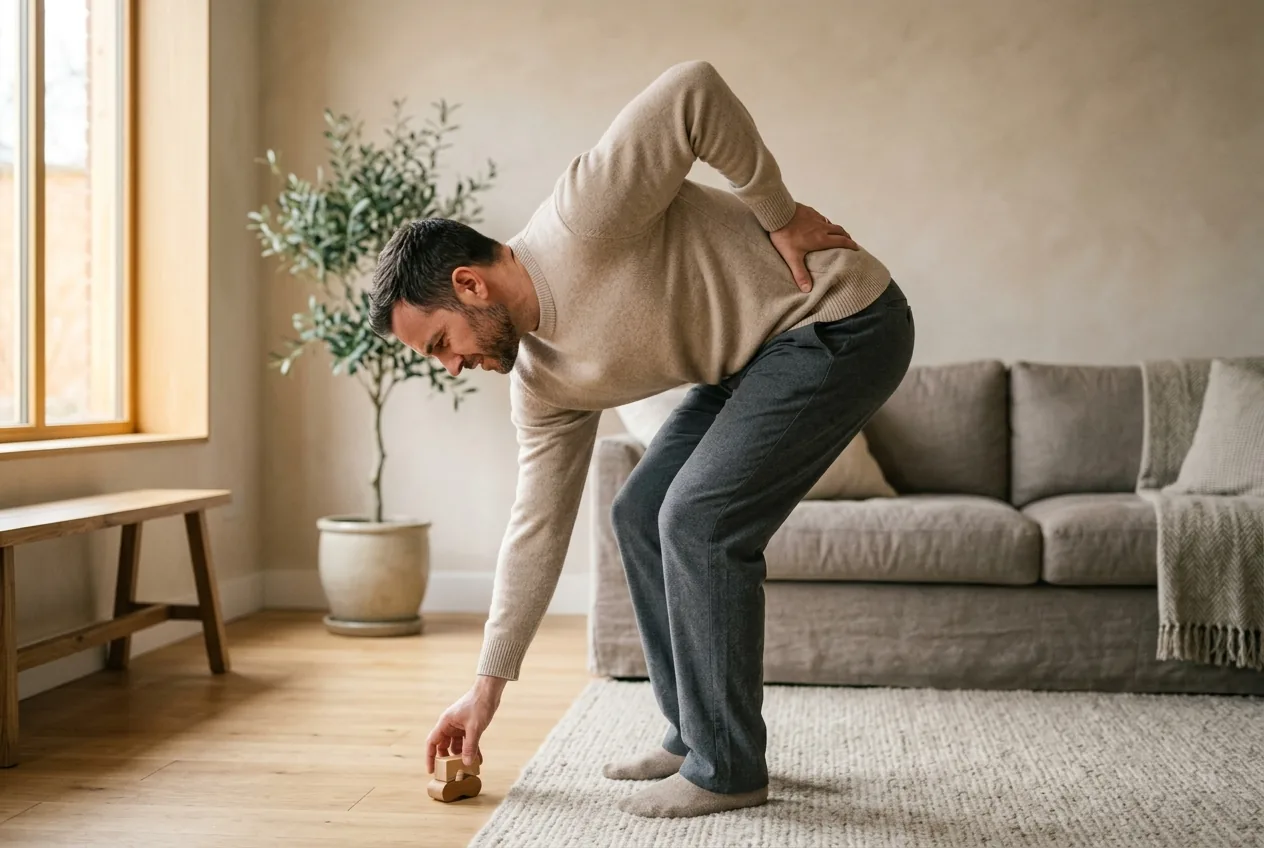

You reach for a coffee mug, twist slightly, and the left side of your lower back catches. The right side feels fine. That lopsided ache — sharp on one side, quiet on the other — is the thing keeping you reading.
Pain that sits on one side feels like it should have an obvious cause. Most of the time it doesn't come from an injury you can name. It comes from the way your body has been loading itself, day after day, a little heavier on one side than the other.
Why pain picks a side
Your spine sits in the middle, but your habits rarely are. You carry a kid on the same hip. You sleep curled toward the same edge of the bed. You sit with your wallet under one buttock, or you drive with your right foot working the pedals while your trunk leans a few degrees left for an hour each way.
Over months, the muscles on one side of your lower back and pelvis start doing more than their share. Some get short and tight from holding the load. Others, on the opposite side, switch off and go quiet because they're not being asked to work. The result is an uneven pull across your pelvis and lumbar spine. One side gets compressed and irritated; that's the side that talks to you.
This is the core of how chronic, non-traumatic back pain works. It's a compensation pattern, not a single broken part. The pain shows up where the load piles up.
One-sided pain is usually a story about how you've been standing, sitting, and sleeping — written into your muscles over time.
The usual suspects behind one-sided lower back pain
A few patterns come up again and again.
- Uneven hips and a tilted pelvis. If one side of your pelvis sits higher or rotates forward, the muscles around it pull unevenly and one side of your lower back takes the strain.
- Tight hip and glute muscles on one side. When the deep hip muscles on one side stay clenched, they tug on the lower back and can refer pain into the buttock and outer hip.
- The SI joint. The joint where your pelvis meets your sacrum can get irritated when load crosses it unevenly, producing a deep ache low on one side. More on that in our piece on SI joint pain.
- A sedentary day. Hours in a chair shorten the hip flexors and let the glutes go to sleep, which often shows up worse on your dominant side. If sitting is your trigger, the mechanics are spelled out in lower back pain when sitting.
Notice none of these is a dramatic event. They're slow, ordinary loading habits that quietly build a left-right imbalance.
What to do about it
The goal isn't to attack the painful side. It's to even out the load so the overworked side gets a break and the lazy side starts pulling its weight again.
Stop feeding the imbalance
Before any exercise, change the inputs.
- Switch which hip you carry bags and kids on. Consciously alternate.
- Take the wallet out of your back pocket when you sit.
- Set your chair so both feet are flat and your weight is even on both sit bones. If you always cross the same leg, stop crossing.
- In bed, notice which way you curl and try the other side or a more neutral position.
Loosen the side that's locked
Two safe moves that tend to help one-sided lower back tightness:
- Single-knee-to-chest. Lie on your back. Draw the knee on the tight side gently toward your chest, hold 20–30 seconds, breathe, and lower it. Repeat three to four times. You should feel a mild stretch in the lower back and buttock, never a pinch.
- Standing figure-four against a wall. Cross the ankle of the tight side over the opposite knee and sit back slightly, hand on the wall for balance. This opens the deep hip muscles that often drive one-sided ache. Hold 20–30 seconds per side.
Stretch both sides even though one feels worse — you want symmetry, not a new imbalance in the other direction.
Wake the quiet side up
Tightness on one side usually pairs with weakness on the other. Gentle glute work helps the pelvis level out.
- Glute bridges. Lie on your back, knees bent, feet flat. Press through both heels and lift your hips, squeezing your glutes at the top. Lower slowly. Do 8–12, and pay attention to whether one side is doing all the work — try to share it evenly.
- Side-lying leg raises on the weaker side rebuild the muscle that keeps your pelvis level when you walk.
Do a short version of this daily rather than a long session once a week. Posture patterns respond to repetition.
When to see a doctor
Most one-sided lower back pain is muscular and mechanical. A few signs mean you should get checked rather than stretch it out.
See a clinician promptly if you have numbness or weakness spreading down a leg, any loss of bladder or bowel control, pain after a fall or accident, fever alongside back pain, or unexplained weight loss. One more specific flag: pain set high and to one side, near your flank, with burning urination, blood in the urine, or fever can point to a kidney issue rather than a muscle problem — that's worth a same-week call to your doctor. Pain that's severe or steadily getting worse also deserves a professional look.
Why the pattern keeps coming back
Here's the part most stretching routines miss. If your left side hurts because your pelvis has been tilted and rotated for years, a generic stretch you found online might help the symptom for an afternoon and do nothing for the cause. Worse, a move that helps one posture can aggravate another — which is why the same YouTube routine works for your coworker and not for you.
Lasting relief comes from knowing your own pattern: which side is tight, which is weak, how your pelvis actually sits. That's the whole idea behind a posture assessment that measures your real deviations and builds the routine around them, rather than guessing. If you've cycled through generic fixes without it sticking, that's the gap worth closing — see how a posture-based method approaches chronic back pain.
One-sided pain is your body pointing at the side that's been carrying too much. Even out the load, and the pointing usually stops.
Common questions
Why does only one side of my lower back hurt?
Pain usually picks the side that's been carrying more load. Habits like always carrying a bag on the same hip, crossing the same leg, or a tilted pelvis leave one side's muscles overworked and the other quiet, so the strain collects on one side.
Should I stretch only the side that hurts?
Stretch both sides even though one feels worse. The goal is balance, and over-loosening only the sore side can create a new imbalance in the other direction.
Can sleeping on one side cause one-sided back pain?
It can contribute. Always curling toward the same edge of the bed loads one side overnight. Trying the other side, or a more neutral position with a pillow between your knees, helps keep the pelvis level.
When is one-sided back pain something to get checked?
See a clinician promptly if you have numbness or weakness spreading down a leg, loss of bladder or bowel control, pain after a fall, fever, or unexplained weight loss. Pain high near your flank with burning urination or blood in the urine can point to a kidney issue rather than a muscle problem.