
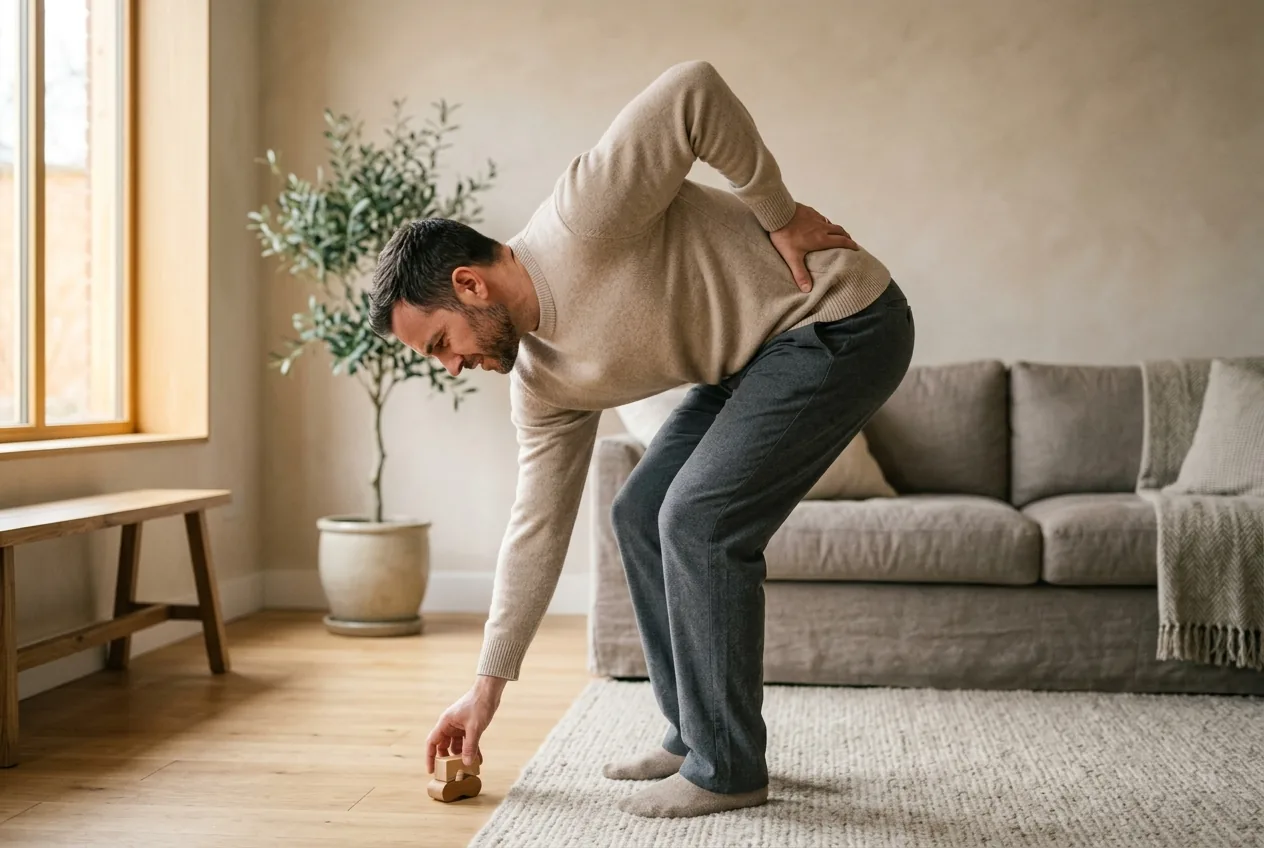
You can deadlift, haul groceries, carry a kid on your shoulders. But lean over the bathroom sink to spit out toothpaste, or bend to grab a sock off the floor, and your lower back catches like a drawer that's off its runners. It's a weirdly specific thing, and it confuses people because the heavy stuff feels fine.
There's a reason for the split, and it points straight at how you bend rather than how strong you are.
Why light bending hurts when heavy lifting doesn't
When you brace for something heavy, your body knows. You tighten your core, set your hips, keep the load close. The whole system locks in and the spine stays protected.
When you casually bend for something light, none of that happens. You fold from the waist, round the lower back, let the spine do the hinging instead of the hips. The muscles aren't switched on because your brain decided this was no big deal. So the small soft tissues at the back of the spine take the strain in a stretched, unsupported position — and that's exactly where it tweaks.
The load isn't the problem. The unguarded, rounded hinge is.
The hip hinge you've stopped using
A healthy bend comes mostly from the hips. You push your backside back, keep a long spine, and let the hips fold while the lower back stays neutral. Most chronic sitters lose this. The hips get stiff, the glutes go quiet, and the body starts hinging from the lower back instead because that's the path of least resistance.
So bending to brush your teeth becomes a deep, repeated lower-back round — dozens of times a day — in a position with no muscular support. Add a stiff morning back, when discs are most swollen with overnight fluid, and the bathroom sink becomes the classic flare-up spot.
This often travels with anterior pelvic tilt and tight hips, the same setup behind a lot of lower back pain when standing too long.
There's also a timing factor people miss. The bathroom-sink bend usually happens first thing in the morning, which is the worst possible moment for it. Overnight your discs absorb fluid and swell slightly, so a back that's only mildly cranky during the day is at its stiffest and most pressurized right when you lean over to spit out toothpaste. Stack a deep, rounded, unsupported hinge on top of a stiff morning back and you've found the exact recipe for the catch. The same bend at 4pm might not bother you at all — which is why people assume the sink is haunted rather than realizing it's the time of day.
How to bend without flaring it
The fix is relearning the hinge so it becomes automatic, even for trivial things.
- Push your hips back, not your back down. Imagine closing a car door with your backside. The movement starts behind you.
- Keep your chest tall and spine long. A long, neutral back through the bend, not a rounded one.
- Soft bend in the knees. Locked knees force the lower back to do the folding.
- For very low or repeated reaching, take a half step into a mini-lunge — one foot forward, drop the back knee toward the floor. This saves your back when you're picking up toys for the tenth time.
Practise it slowly a few times a day at the sink until it stops feeling like a technique and starts feeling like how you bend.
Two exercises that rebuild the hinge
Hip hinge drill. Stand with a broomstick along your spine, touching your head, upper back, and tailbone. Push your hips back and bend forward, keeping all three contact points. This trains your body to feel a neutral spine while hinging. Ten slow reps.
Glute bridge. On your back, knees bent, drive through the heels and lift the hips, squeezing the glutes hard at the top. Lower slowly. Strong glutes are what let your hips take over the bend from your lower back. Two sets of twelve. To build the bracing that protects light bends too, add core exercises for lower back pain.
Wall hip hinge. Stand a foot or so from a wall, facing away. Push your hips back to lightly tap the wall with your backside, keeping your spine long, then stand up by squeezing the glutes. The wall gives you a target so you learn to send the hips back instead of folding the spine down. Ten reps. This is the same movement you want to become automatic at the sink, the dishwasher, and the toy-strewn floor — done enough times, your body reaches for the hinge before you have to think about it.
Your back doesn't lack strength. It lacks the habit of hinging from the hips when no one's watching.
What to stop doing
- Stop folding straight from the waist with stiff legs to grab low things. That's the move that catches you.
- Stop bending first thing in the morning without a gentle warm-up — your back is at its stiffest right after waking.
- Stop holding a long forward bend (loading the dishwasher, leaning over a crib) with a rounded back. Hinge, or get a knee down.
When to see a doctor
Pain that's purely about the position of a light bend, with no leg symptoms, is usually mechanical and responds to better movement. See a clinician promptly if bending sends pain, numbness, or tingling down a leg; if you have weakness in a foot or leg; any loss of bladder or bowel control; back pain after a fall or accident; fever, unexplained weight loss, or pain that's severe or steadily getting worse. Repeated sharp catches that won't settle over a couple of weeks also deserve a proper assessment.
Why the same advice doesn't work for everyone
Relearning the hip hinge helps almost everyone who bends from the waist. But whether your hips are stiff because of a forward-tilted pelvis, a flat back, or one-sided tightness changes which stretches and which strengthening you actually need. The move that frees one pattern can aggravate another. A posture assessment shows which deviations you're carrying so the daily routine fits your body instead of a generic checklist — that's the idea behind this posture therapy method.
One more thing worth saying, because it trips people up: the fact that heavy lifting feels fine is not proof your back is strong enough. It's proof that you brace well when you decide something is heavy. The gap is entirely in the unguarded, automatic bends — and those are the ones you do hundreds of times a day without a thought. So the goal of the drills above isn't more strength. It's to make the hip hinge so habitual that your body reaches for it even when your brain has filed the task as trivial.
The win here is simple and daily: bend over to tie a shoe without bracing for a catch.
Common questions
Why does my lower back hurt bending over but not when I lift something heavy?
When you brace for something heavy, your core switches on and the spine stays protected. A casual bend for something light skips all that, so you fold from the waist and round the lower back without support, which is exactly where it tweaks.
Why does my back catch most when I lean over the bathroom sink?
That bend usually happens first thing in the morning, when your discs are swollen with overnight fluid and your back is at its stiffest. A deep, rounded, unsupported hinge on top of a stiff morning back is a common recipe for the catch.
How should I bend to avoid hurting my lower back?
Push your hips back rather than folding your back down, keep your chest tall and spine long, and soften your knees. For very low or repeated reaching, drop into a mini-lunge with one foot forward instead of bending from the waist.
Is bending-over back pain a sign of a disc problem?
Not on its own. Pain that's purely about the position of a light bend, with no leg symptoms, is usually mechanical. Pain, numbness, or tingling that travels down a leg is different and worth getting checked.