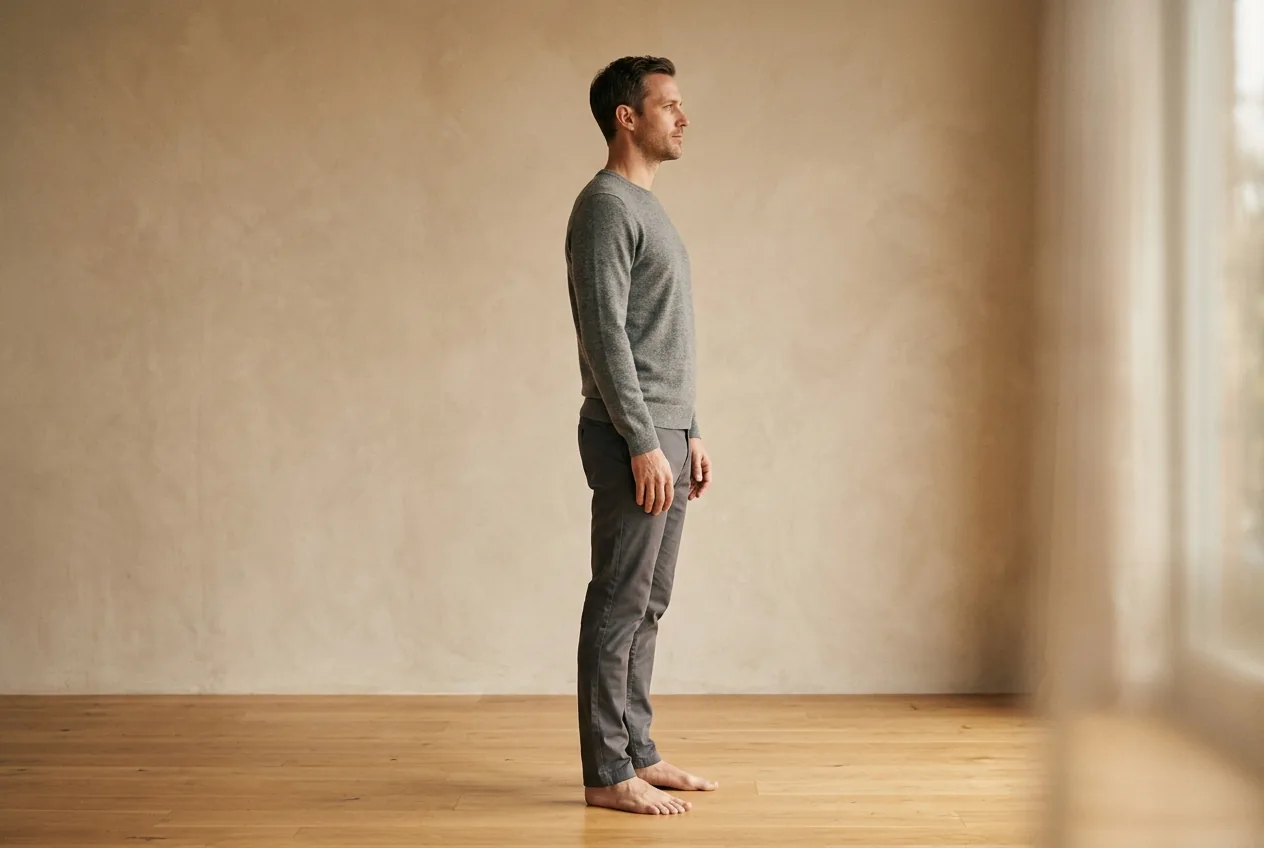

Someone tells you to "sit up straight" and you snap your shoulders back, jut your chest out, and hold it — for about ninety seconds, until it gets tiring and you collapse back into the slump. If that's your experience of good posture, you've been sold a bad version of it. Proper back alignment isn't a rigid, military brace you grit your teeth to maintain. If it takes effort to hold, it isn't alignment — it's a different kind of strain.
Real spinal alignment is the opposite of effortful. It's the position where your bones stack so your skeleton does the work of holding you up, and your muscles get to relax. It should feel light, balanced, almost like floating up out of your hips. This is what people mean by a neutral spine, and learning what it actually feels like is the first step to making good posture something you can keep rather than perform.
Your spine has curves, and that's the point
A common misunderstanding is that a straight back means a straight spine. It doesn't. A healthy spine has three gentle curves: an inward curve at the neck, an outward curve through the upper back, and an inward curve at the lower back. Viewed from the side, it's a soft S, not a line.
Those curves are load-bearing engineering. They let the spine absorb and distribute the weight of your head and trunk like a spring, rather than a rigid pole that takes every force straight down. Proper alignment means keeping those natural curves in their balanced positions — not flattening them, not exaggerating them. When people hold themselves "ramrod straight," they often flatten the lower-back curve, which is its own problem, not a fix. When they slump, they round the upper curve and poke the head forward. Neutral lives between those extremes.
Good alignment isn't a straight spine. It's your spine's natural curves, balanced and stacked.
What neutral actually feels like
This is the part worth slowing down for, because alignment is something you feel from the inside more than you check in a mirror. Try this standing.
- Stack from the ground up. Feet hip-width, weight even across both feet — not back on your heels, not forward on your toes. Knees soft, not locked.
- Find pelvis neutral. Roll your pelvis forward (tail sticking out) and back (tail tucked under) a few times, then settle in the middle. That middle is where your lower-back curve sits naturally.
- Let the ribcage settle. Don't thrust your chest out. Let your ribs stack over your pelvis, lowering them gently if they're flared up.
- Float the head up. Imagine a string lifting the crown of your head toward the ceiling. Your chin levels, your ears settle over your shoulders.
Now notice the feeling. Done right, the dominant sensation is ease — tall and supported, without any muscle screaming to hold it. If you feel like you're bracing, you've overshot into the rigid version. Back off until it feels light. That lightness is the signal you're actually aligned, with the skeleton bearing the load.
Why it feels hard if you've been misaligned for years
Here's the catch that frustrates people. If your posture has been off for a long time, neutral can feel wrong at first — even uncomfortable — while the slump feels normal. That's not a sign you're doing it incorrectly. It's a sign your body has adapted to the misalignment.
When you've held a deviation for years, some muscles have shortened and tightened, others have lengthened and switched off, and your brain has reset its sense of "upright" to match the deviation. So when you stack into true neutral, the short muscles complain and the unfamiliar position feels effortful. The fix isn't to force the position harder; it's to gradually retrain the muscles and your sense of upright so neutral becomes the new default. This is exactly why a generic "stand up straight" rarely sticks — it asks you to hold a position your body isn't yet built to keep. The mechanics of how a slump turns into pain are covered in where bad posture causes pain.
Aligning the common trouble spots
A few specifics, since these are where alignment most often goes wrong:
- The head. It should balance over your shoulders, not lead the way. A forward head is the most common misalignment and the hardest to feel, because it creeps. A gentle chin tuck — drawing the chin straight back — finds the neutral spot.
- The shoulders. Down and slightly back, relaxed. Not yanked back and held, and not rounded forward. Think "set them on a shelf and let go."
- The lower back. A gentle inward curve, not flattened and not over-arched. The pelvic-neutral step above sets this.
Holding all three at once, lightly, is the whole skill. Building it is less about willpower and more about consistent practice, which is the core of how to improve posture.
When to see a doctor
Working on alignment is education and posture practice, not treatment for a specific condition. If you have pain that's more than ordinary stiffness — numbness, tingling, or weakness in your limbs, pain after a fall or injury, pain with fever or unexplained weight loss, or pain that's severe or steadily worsening — see a clinician rather than assuming alignment work alone is the answer. Posture practice helps a great deal, but persistent or worsening symptoms deserve a professional look first.
Why "neutral" is personal
Everything above describes neutral in general. But your particular spine has its own starting point — maybe your pelvis tilts forward, maybe your upper back rounds more than most, maybe one shoulder sits higher. The neutral you're aiming for, and the muscles you'll need to retrain to reach it comfortably, depend on those specific deviations.
That's why generic posture cues only get you so far. Lasting alignment comes from knowing your own pattern and training it directly. A short posture assessment measures where your body actually sits out of neutral and builds a daily routine to bring it back — so good alignment stops being something you hold and becomes something you have. If you want a quick first look, try a check at home.
Common questions
What does a neutral spine feel like?
Light and supported, not held. Your bones stack so the skeleton carries your weight and your muscles relax. You feel tall, balanced over your feet, with your head floating up and your ribs settled over your pelvis. If you feel like you're bracing or working to hold it, you've overshot into rigidity — ease off until it feels effortless.
Is sitting up straight bad for you?
The rigid, chest-thrust version is — it flattens your lower-back curve and tires you out fast, so you collapse back into a slump. Real alignment keeps your spine's natural curves and feels easy, not held. Aim for relaxed and stacked rather than stiff and straight.
Why does good posture feel uncomfortable?
If you've been misaligned for years, your muscles and your sense of "upright" have adapted to the deviation, so true neutral feels unfamiliar and effortful at first. That's normal. The discomfort eases as you retrain the tight and weak muscles and your body resets its default toward neutral.
How long does it take to fix my back alignment?
It varies with how long the misalignment has been there and how consistently you train it, but most people start to feel neutral come more naturally within a few weeks of daily practice. Lasting change usually takes longer and works best with a routine matched to your specific deviations rather than generic cues.