If you finish the workday with sore shoulders, a stiff neck, or wrists that ache, there's a decent chance your desk is the wrong height for you. Most desks are built to a single standard number, and most bodies aren't that number. So you spend eight hours quietly compensating — hunching your shoulders to reach a high desk, or slumping down to a low one — and the body sends the bill in the evening.
Proper desk height isn't a fixed figure you can look up. It depends on your height, your chair, and how your arms sit. The good news is that measuring it for your own body takes about five minutes and a tape measure, and getting it right removes one of the most common, most fixable sources of desk pain.
Why desk height matters more than people think
Your desk height sets the position of your arms, and your arm position drags everything above it along for the ride. Too high, and you lift your shoulders all day to reach the keyboard — the upper traps stay clenched, and that's the band of tension you feel across your shoulders by mid-afternoon. Too low, and you slump down or round forward to reach it, dropping your head toward the screen.
There's a cascade. A wrong desk height pulls your shoulders out of neutral, which pulls your head forward, which loads the back of your neck. The ache you feel in your neck might actually start at your wrists. That's why getting the height right is high-leverage — one correct number fixes a chain of compensations. It's also why this works hand in hand with a full ergonomic desk setup rather than in isolation.
Set the chair first, then the desk
The order matters. Your chair sets where your body sits; the desk has to meet your arms from there. Set the chair wrong and you'll measure the desk to the wrong reference.
Step 1 — chair height. Sit fully back. Adjust the seat so your feet are flat on the floor and your thighs are roughly parallel to the ground, or your knees sit just slightly below your hips. If your feet dangle, the chair's too high — lower it, or if you can't (because the desk forces it), add a footrest. Dangling feet throw your whole sitting posture off.
Step 2 — find your forearm line. Sit tall with your shoulders relaxed down, upper arms hanging by your sides, and bend your elbows to about a right angle so your forearms are level. The height of your forearms and hands in this position is your target desk height. When you type, your forearms should stay roughly level and your wrists straight.
Step 3 — measure it. With your forearms level, have someone measure (or measure yourself against a wall) from the floor to the underside of your relaxed forearms. That measurement is the keyboard height your desk should provide. For many adults it lands somewhere around 65–75 cm, but yours is yours — don't assume the average.
What to do when the desk won't match
Most desks are a fixed height, so you'll often need to adjust around it rather than change it. Here's how to reconcile the two.
- Desk too high? Raise your chair until your forearms are level, then add a footrest so your feet are supported and your knees aren't jammed up. The footrest is non-negotiable here — without it, raising the chair just trades shoulder strain for hip strain.
- Desk too low? Raise the desk on sturdy risers or blocks under the legs until it meets your forearm line. Slumping down to a low desk is the more damaging error, so fix this one rather than living with it.
- Keyboard tray. A tray that sits below the desktop can lower your keyboard to the right height without touching the desk itself — useful when the desk is slightly too high for typing.
- Monitor is separate. Don't confuse keyboard height with screen height. Set the keyboard to your forearms, then raise the monitor independently so the top of the screen is at or just below eye level, about an arm's length away. Getting the screen right is what keeps your head from poking forward — a major piece of avoiding forward head posture.
Set the chair to your body, the keyboard to your forearms, and the screen to your eyes. Three independent heights, not one.
The standing-desk question
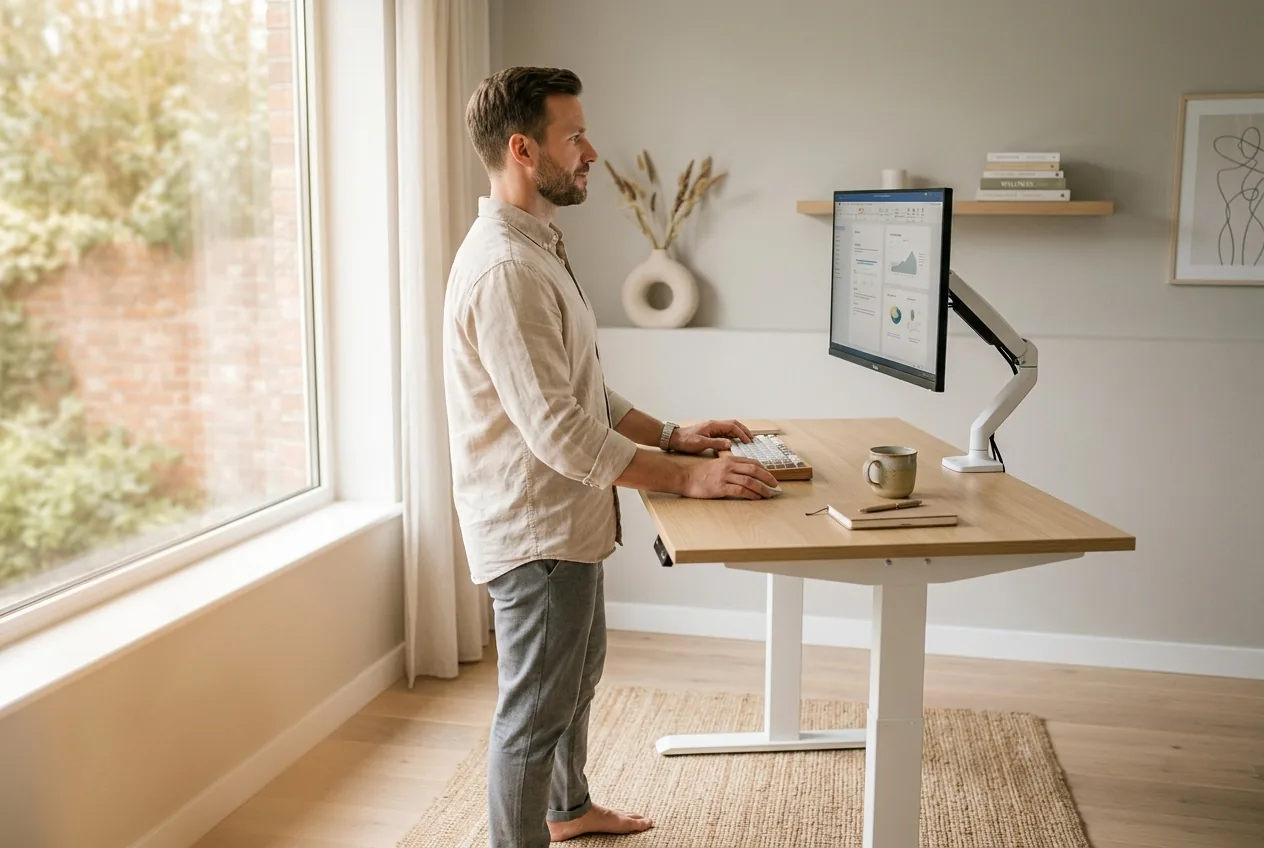
If you have a standing desk, the same logic applies — your forearms should be level when standing too, which means the standing height is different from your sitting height. Set both, and switch between them through the day rather than committing to one. Standing all day causes its own problems, just as sitting all day does, which is covered in standing desk setup. The win is the variety, not the standing itself.
When to see a doctor
Desk height is comfort and prevention, not treatment. If you have pain that goes beyond ordinary stiffness — numbness, tingling, or weakness in your hands, arms, or legs, pain after a fall, pain with fever or unexplained weight loss, or pain that's severe or steadily worsening — see a clinician rather than assuming the desk explains it. Correcting your setup helps almost everyone, but persistent or worsening symptoms deserve a professional look.
From the right desk to your own pattern
Getting your desk and chair height right removes a clear, mechanical source of strain, and for a lot of people that quietly takes the edge off the daily ache. But the height is only part of it. You also bring your own posture into the chair — the head that already lives forward, the shoulders that already round — built over years.
That underlying pattern is individual, which is why two people at identically measured desks can still hurt differently. A short posture assessment measures where your body actually sits out of neutral and builds a routine for it, so the time at your correctly set desk works with your body rather than against the deviations you carry into it.
Common questions
What is the correct desk height for my body?
The right desk height is the one where your forearms stay level and your wrists straight while typing, with your shoulders relaxed and feet supported. Measure from the floor to the underside of your relaxed, level forearms while seated properly — that number is your target keyboard height. For many adults it's roughly 65–75 cm, but it varies with your height.
How do I know if my desk is too high or too low?
Too high: you have to lift or hunch your shoulders to reach the keyboard, and they ache by afternoon. Too low: you slump or round forward to reach it, and your head drops toward the screen. With the right height, your forearms rest level and your shoulders stay relaxed down.
Should desk height be set for sitting or standing?
Both, separately, if you have a height-adjustable desk. Your forearms should be level in either position, but the desk height that achieves that is higher when standing than sitting. Set each and switch between them through the day rather than picking one.
Does desk height affect neck pain?
Yes, indirectly. A desk at the wrong height pulls your shoulders out of neutral, which pulls your head forward, which loads the back of your neck. Setting the keyboard to your forearms and the monitor to eye level keeps your head stacked over your shoulders and takes that strain off the neck.