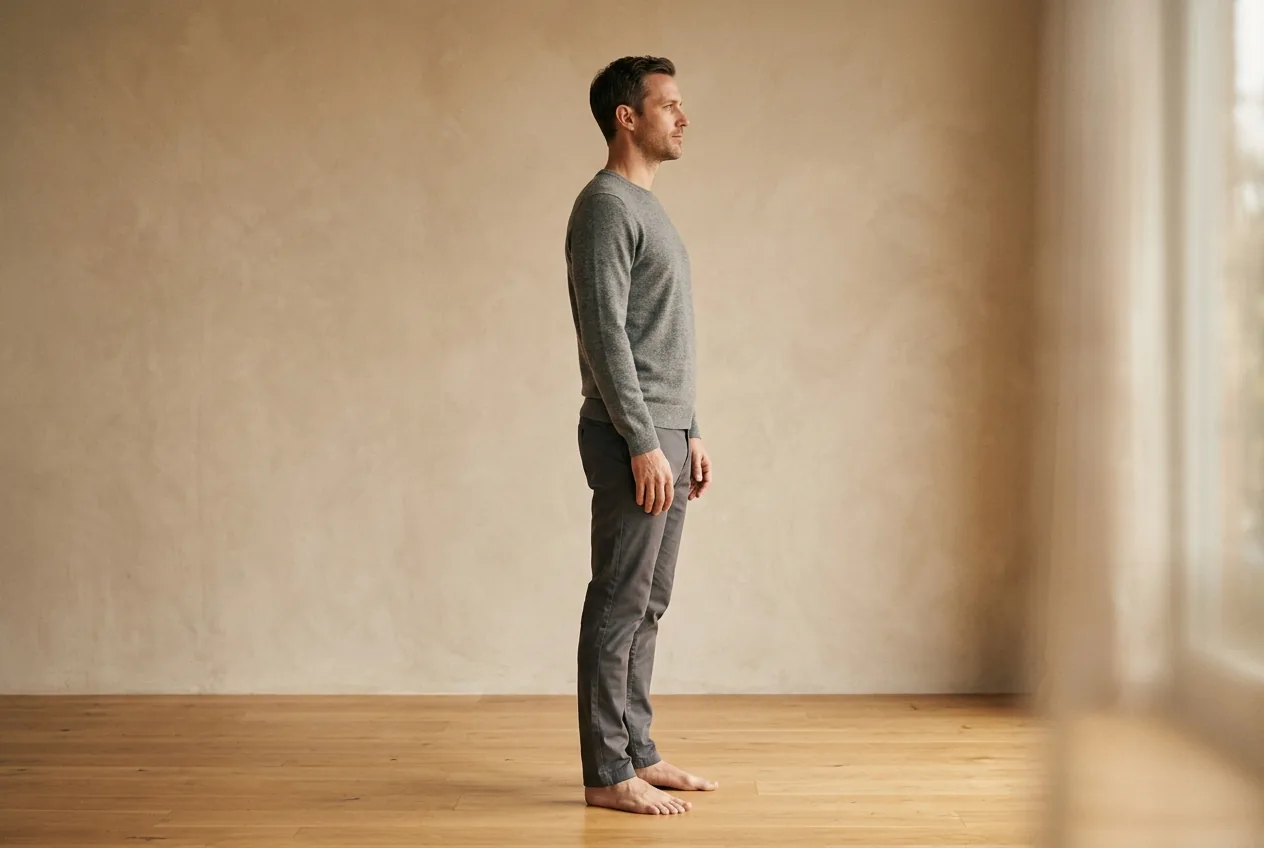

Someone tells you to sit up straight. You pull your shoulders back, hold it for about ninety seconds, and then — the moment you start typing again — they roll right back forward. By the afternoon you've forgotten the whole thing, and your upper back is tight in the same spot it's been tight for years.
That's the frustrating truth about rounded shoulders. The advice everyone gives you is the one thing that can't fix it. If you've been wondering how to fix rounded shoulders and "just sit straighter" keeps failing, it's not a discipline problem. It's a muscle problem, and willpower was never going to win.
Why your shoulders round in the first place
Rounded shoulders — shoulders that sit forward of your ears, with the upper back curved and the chest collapsed — are what your body builds when you spend most of your hours reaching forward. Typing, driving, scrolling, holding a baby, pushing a stroller. The arms live out in front, so the shoulders follow them and stay there.
Over time the muscles take sides. The chest muscles at the front (the pecs) get short and tight from being held in a closed position all day. The muscles between your shoulder blades get long, weak, and quiet. Your shoulders aren't rounded because you're slouching on purpose — they're rounded because the front is pulling and the back has stopped pulling back.
This is why "sit up straight" fails. For the two minutes you remember, you're asking weak, switched-off back muscles to overpower tight, switched-on chest muscles. They lose. The instant your attention moves, the stronger side wins again.
You can't hold yourself in a posture your muscles aren't built to hold. The shape follows the strength, not the other way around.
How rounded shoulders connect to the rest of you
Rounded shoulders rarely show up alone. When the upper back curves forward, the head usually drifts forward to balance it — the nerd neck or tech neck pattern. Higher up, that often becomes a more pronounced upper-back hump if it's left for years, which is the kyphosis or hunchback territory.
It runs both ways. Fixing rounded shoulders usually eases neck tension too, because you stop forcing the muscles at the base of your skull to compensate for a collapsed upper back. That's why treating the shoulders in isolation, with one stretch, tends to underwhelm — you're working on one link of a connected chain.
How to fix rounded shoulders: the actual routine
The fix is a trade. You open and release the tight front, you switch the back on and strengthen it, and you do it often enough that holding yourself upright stops feeling like work. Here's a routine that needs no equipment.
Open the chest — doorway stretch
Stand in a doorway. Put your forearms on the frame with your elbows at about shoulder height. Step one foot through and lean gently forward until you feel a stretch across the front of your chest and shoulders. Hold for 30 seconds, breathe, repeat twice. This releases the pecs that have been pulling your shoulders forward.
Wake up the back — wall angels
Stand with your back to a wall, lower back lightly flattened. Bring your arms into a goalpost shape against the wall, then slide them up and down, keeping the backs of your hands and elbows on the wall as much as you can. Ten slow reps. You'll feel the muscles between your shoulder blades doing the work — those are the ones that quit on you. The wall angels exercise walks through the details if your arms keep peeling off the wall.
Strengthen the squeeze — scapular retractions
Sit or stand tall. Draw your shoulder blades down and back, like you're tucking them into your back pockets. Hold five seconds, release. Do 10 to 12. No shrugging — the movement is back and down, not up toward your ears.
Pair it with chin tucks
Because rounded shoulders and forward head travel together, add a set of chin tucks: glide your head straight back over your shoulders, hold five seconds, release, repeat 8 to 10 times. It keeps the whole upper body honest.
How long it takes, and what progress feels like
People want a date on the calendar. There isn't a clean one, because you're changing a balance your body built over years, not stretching a single muscle once. What you can expect is a sequence. In the first week or two the tight chest starts to release, and standing tall feels less like fighting yourself. Over the next month the muscles between your shoulder blades begin to hold without you thinking about it, so you catch yourself sitting upright at the desk for longer stretches before you slump. Past that, the new shape starts to become the default rather than a pose you adopt for photos.
The thing that makes or breaks it is frequency. Five focused minutes most days beats a thirty-minute session once a week, because you're rehearsing a habit, and habits answer to repetition. The day you skip isn't a disaster; the week you skip is where the old pattern quietly wins back ground.
What to stop doing
- Stop relying on the "shoulders back" snap-correction. It lasts seconds and teaches nothing.
- Stop wearing a posture brace and expecting it to retrain you — it holds the position so your muscles don't have to, which keeps them switched off.
- Stop doing all your pulling-forward (typing, driving) without ever doing any pulling-back. Balance the day.
- Stop sleeping curled tight on your side with both arms reaching forward, which keeps the chest closed all night.
When to see a doctor
This is posture education, not medical advice, and rounded shoulders are a postural pattern rather than a diagnosis. Still, check with a clinician if you have shoulder or arm pain that radiates, numbness, tingling, or weakness in an arm or hand, pain that began after a fall or injury, or pain that's severe or steadily getting worse. Those aren't posture issues to stretch through.
Why a generic routine only takes you so far
The moves above help most people with rounded shoulders, because the underlying pattern — tight front, weak back — is so common. But how rounded your shoulders are, whether your head and upper back are pulling into it, and what to prioritize first will be specific to you. A stretch that helps one person's pattern can do little for another's.
That's the reasoning behind a real posture assessment: instead of guessing, you measure your own deviations and build the routine around them. If you want a quick read first, you can check your posture at home with a few photos and a mirror.
Rounded shoulders are a balance problem, not a willpower problem. Shift the balance and the posture comes along for free.
Common questions
Why do my shoulders round forward even when I try to sit straight?
Because the front of your body is tight and the back is weak. Holding yourself back for a few seconds asks switched-off muscles to overpower switched-on ones, so the moment your attention drifts, the stronger side wins and the shoulders roll forward again.
Do posture correctors fix rounded shoulders?
A brace holds the position for you, which keeps the muscles that should hold it switched off. It can give short-term relief, but it doesn't teach your back to do the work, so the shoulders tend to drift back once it comes off.
How long does it take to fix rounded shoulders?
Most people feel the tight chest release in the first week or two, then notice the mid-back holding them upright for longer over the following month. It's a balance you built over years, so steady daily practice matters more than intensity.
Can rounded shoulders cause neck pain?
They often travel together. When the upper back collapses forward, the head usually drifts forward to balance it, which makes the muscles at the base of the skull work harder — so easing the shoulders frequently calms neck tension too.