
It usually starts late morning — a band of pressure across your forehead, or a dull ache that wraps from the base of your skull around the sides of your head. It's not the throb of a migraine. It's a steady, gripping tightness that gets worse the longer you sit at your desk. By evening you've taken something for it, again.
If your headaches arrive on workdays, build through the afternoon, and ease on weekends, there's a good chance they're starting in your neck — not your head. A tension headache from posture is one of the most common and most overlooked patterns there is.
How a neck problem becomes a headache
The muscles at the base of your skull and the back of your neck connect directly to the tissue that wraps your head. When those muscles are tense and overworked, the strain refers up and over your skull. You feel it as a headache, but the source is lower down.
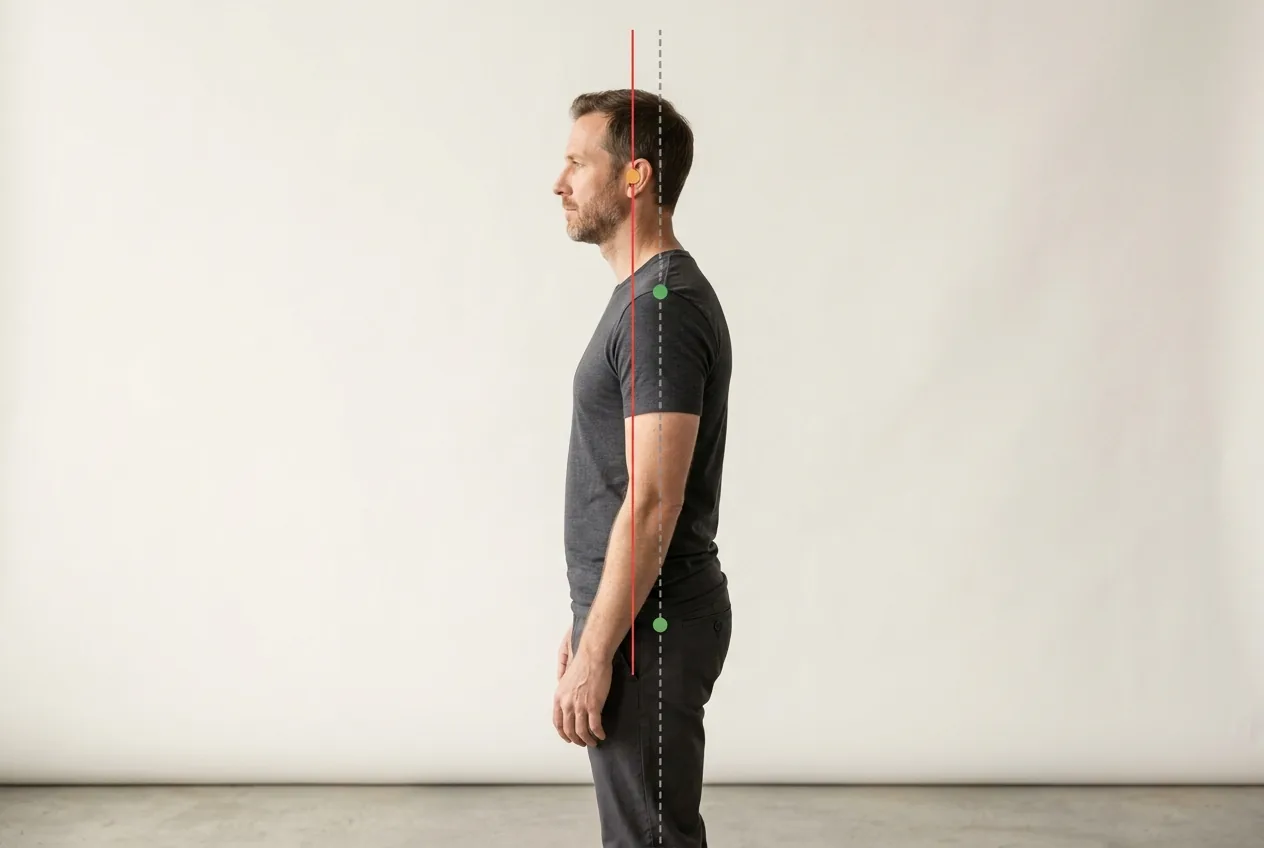
What makes those muscles tense? Position. When your head sits forward of your shoulders — leaning toward a screen, looking down at a phone — the muscles at the back of your neck have to pull constantly to stop your head dropping. They never get to rest. A muscle held in a contraction for hours becomes a source of pain, and the small muscles at the base of the skull refer that pain straight into a headache.
This is why posture and tension headaches are tied together. The forward head is the load; the headache is the bill. You can read the lever mechanism in detail in forward head posture, but the short version is: the further forward your head, the harder those muscles work, and the more likely they are to set off a headache.
The headache feels like it's in your head. The work that caused it is happening in your neck.
How to tell if posture is behind yours
A few clues point toward a postural, cervicogenic pattern rather than another headache type:
- The pain often starts at the base of the skull or one side of the neck, then spreads forward.
- It's worse after long stretches at a desk or on a phone, and better when you move.
- Pressing on the tight muscles at the base of your skull reproduces or eases the ache.
- It tracks with your workdays and screen time.
That base-of-skull tenderness is worth understanding on its own — the neck pain at the base of your skull piece covers exactly the spot most posture headaches start from.
What to do about it
The goal is to take the constant load off the neck muscles that are referring pain upward, release them when they tighten, and stop feeding the forward-head position that keeps them loaded.
Release the base of the skull
Lie on your back. Place two fingers, or a small rolled towel, where your skull meets your neck. Let your head's weight rest into the pressure, tuck your chin a few millimetres to lengthen the muscles, and relax for two minutes. Done early, when the pressure is just starting, this often heads a building headache off entirely.
Chin tucks to change the load
Pulling your head back over your shoulders takes the constant strain off the back of your neck. The chin tucks exercise guide shows the technique. Several short sets through the day matter more than one long one, because the point is to interrupt hours of forward loading.
Move and reset every half hour
A headache pattern feeds on stillness in one position. Stand, roll your shoulders, look at something across the room, and reset your head back over your shoulders. Brief and frequent beats one big stretch.
Loosen the jaw and shoulders too
Posture headaches rarely come from the neck alone. People who get them often clench the jaw and hike the shoulders without noticing, which adds to the tension feeding the head. A few times an hour, check in: let your teeth part, drop your shoulders away from your ears, and take one slow breath out. It sounds minor. Over a workday it removes a surprising amount of the load that builds into the afternoon ache.
Watch the screen and phone angle
Raise your monitor toward eye level and lift your phone toward your face. You can't out-stretch the angle that's causing the problem if you keep returning to it all day. The same goes for reading in bed with your chin tucked hard into your chest, or working from the couch with a laptop on your knees — both put your neck in exactly the loaded position that triggers the headache.
What to stop doing
- Stop reaching for the painkiller as the first and only move. It masks a position problem.
- Stop powering through two-hour stretches hunched at the screen. That's the headache being built.
- Stop clenching your jaw and shoulders when you concentrate. Notice it, drop them.
- Stop ignoring the weekend clue. If the headache eases when you're away from your desk, your desk is involved.
When to see a doctor
Posture work is education, not medical care, and it can't diagnose a headache. See a clinician promptly if a headache comes on suddenly and severely — the worst of your life — if it comes with a fever and stiff neck, with confusion, vision changes, weakness, or numbness, or if it follows a head injury. A headache pattern that's new, changing, or steadily worsening also needs a proper look before you assume it's postural.
Why your pattern matters more than the average
Releasing the base of the skull, chin tucks, and movement breaks help most people whose headaches come from the neck, because the forward-head pattern behind them is so common. But how far forward your head sits and which muscles have taken on the strain differ from person to person. Generic advice is a fine starting point — lasting relief comes from working your actual pattern.
A proper posture assessment measures where your head and neck actually sit and builds a daily routine around it. Take the load off the neck, and the headache loses its source.
Treat the neck that's working too hard, and the head it's pulling on often quiets down.
Common questions
How do I know if my headache is coming from my posture?
A few clues point that way: it tends to build through a desk day rather than hit suddenly, it eases on weekends or when you're away from your screen, and it sits like a band or pressure around the head with a tight, tender neck underneath. A new, severe, or changing headache needs a clinician's eye instead.
Where do posture headaches usually hurt?
Often at the back of the head and base of the skull, sometimes wrapping forward to the temples or behind the eyes like a tightening band. The starting point is usually the tense muscles at the base of the skull.
Can fixing my desk setup actually stop the headaches?
For many people, yes, because the headache is fed by hours in a head-forward position. Raising the screen, lifting the phone, and taking movement breaks remove the load that builds the ache. It won't happen overnight, but the pattern usually eases over a few weeks.
Should I take painkillers for a posture headache?
The occasional one is fine, but leaning on them daily masks the position problem and can sometimes make headaches worse over time. Use them as a bridge while you change the setup, not as the whole plan.