You've heard yoga is good for backs, you tried a class, and somewhere around the deep forward fold your lower back said absolutely not. Now you're not sure whether yoga is the answer or the problem. The truth sits in between. Yoga for lower back pain genuinely helps a lot of people — but only the gentle, spine-friendly half of it. A general class full of deep folds and big twists can stir up a sore back faster than almost anything.
The win from yoga isn't the impressive shapes. It's the slow, controlled movement through a comfortable range, the breathing that lets tense muscles let go, and the body awareness that helps you stop bracing all day. Used that way, a short daily practice of a few well-chosen poses does more for an ordinary sore back than the occasional ambitious class.
What yoga actually does for a sore back
A stiff, guarded lower back tends to lock into one shape and stay there. Gentle yoga coaxes it through small ranges of motion, which eases stiffness and reminds the surrounding muscles they're allowed to relax. The breathing matters as much as the movement — slow exhales calm the nervous system that's been keeping everything clenched.
It also builds the quiet kind of strength and control that supports the spine through the day. None of that requires bending yourself in half. The poses below are chosen because they move the spine kindly rather than forcing it.
Beginner poses that help
Move into each one slowly, stop short of any pinch, and breathe. If a pose increases pain or sends symptoms down a leg, skip it.
Cat-cow
On hands and knees, you slowly alternate between gently rounding your back toward the ceiling and letting it sag into a mild arch, following your breath. It's the gentlest way to wake up a stiff spine through its full range. There's a full how-to in the cat-cow stretch for your back.
Child's pose
From hands and knees, you sit your hips back toward your heels and reach your arms forward, letting your lower back lengthen and decompress. It's a resting pose you can return to any time things feel tight, and it eases many sore lower backs. The walkthrough is in child's pose for back pain.
Knees-to-chest
Lying on your back, you draw both knees gently toward your chest and hold, which lengthens the lower-back muscles and feels like a release valve. Rock side to side slightly for a light massage along the spine.
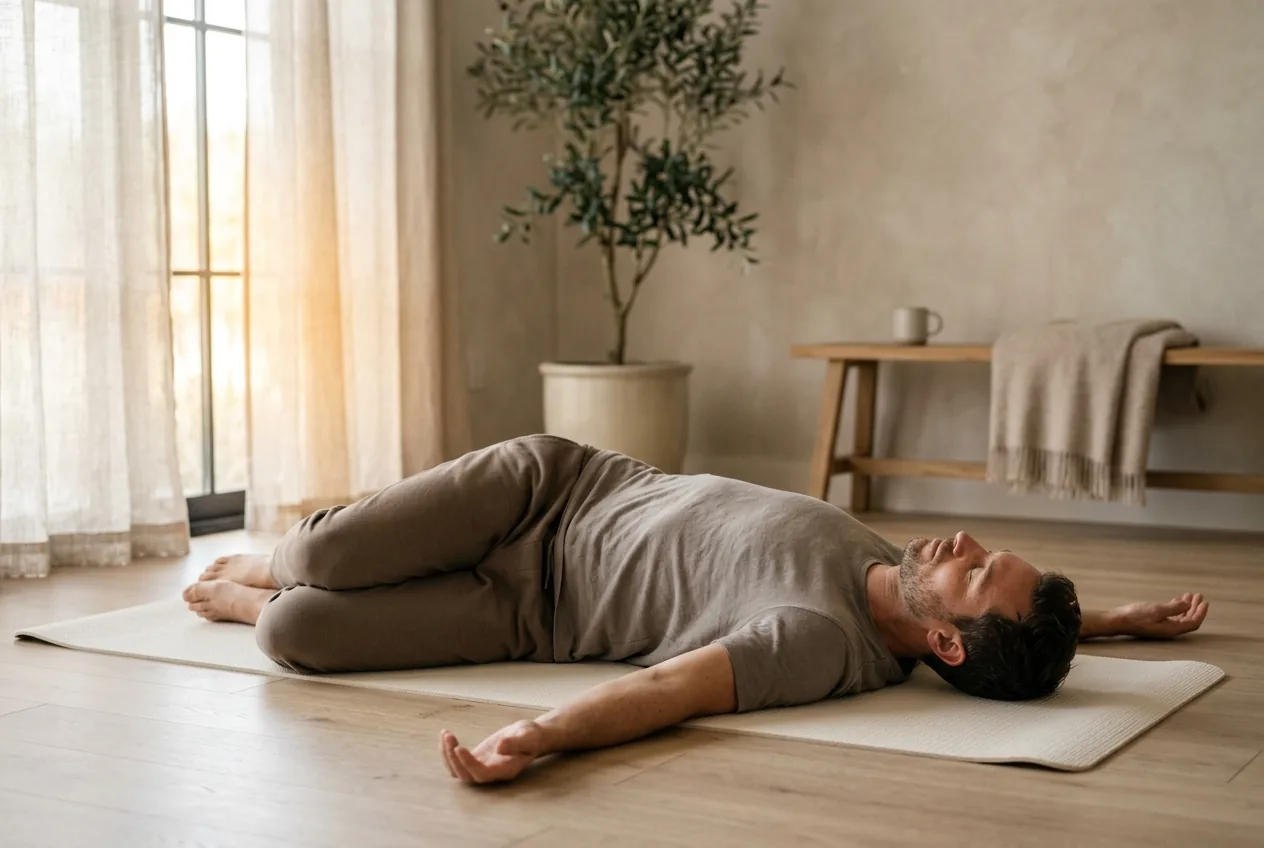
Gentle supine twist
Lying on your back with knees bent, you let both knees drop slowly to one side while your shoulders stay down, then switch. Keep it gentle and within an easy range — this is a mobility twist, not a wrench.
Bridge
Lying on your back with knees bent and feet flat, you lift your hips by squeezing your glutes, then lower slowly. It strengthens the glutes and the back of the body, which takes load off the lower back over time.
The yoga that helps a sore back is slow, small, and breathed-through — not deep, fast, or impressive.
Poses to approach carefully or skip
Some popular poses load a sore lower back the wrong way, especially early on.
- Deep seated forward folds (reaching for your toes with straight legs) load the front of the discs and pull on tight hamstrings, which can flare a sore back. If tight hamstrings are part of your back pain, address them gently rather than forcing the fold.
- Big deep twists taken to the end of the range can aggravate an irritated back. Keep twists gentle.
- Heavy backbends like full wheel or deep cobra are too much for most sore backs at first; a mild prop-on-the-forearms version is plenty.
How to practise without flaring up
- Short and daily beats long and occasional. Ten gentle minutes most days does more than a ninety-minute class once a week.
- Stop short of pain. A stretch should feel like a comfortable lengthening, never a pinch.
- Tell the instructor. In a class, say you have a sore back so they can offer modifications and you can sit out the deep stuff.
- Don't chase the full pose. The benefit is in the controlled movement, not the depth.
Yoga also helps your standing and sitting posture over time, which feeds back into the back. There's more on that link in yoga for posture.
When to see a doctor
Yoga is for ordinary, mechanical lower-back stiffness and ache. See a clinician before leaning on stretching if you have numbness, tingling, or weakness running down a leg, a foot that catches when you walk, or back pain after a fall or accident. Seek urgent care for any loss of bladder or bowel control, or numbness in the saddle area between the legs — uncommon, but an emergency. Also get assessed for pain that's severe, steadily worsening, or paired with fever or unexplained weight loss. Yoga is movement and relaxation, not a treatment for those signs.
Why the same poses don't help everyone
Here's the catch with any list of "good for your back" poses. Whether a pose helps or hurts depends on what your spine is doing to begin with. A back that's over-arched from a forward-tipped pelvis wants different work than one that's flat and stiff — and a forward fold that relieves one can flare the other. That's exactly why a general yoga class, aimed at the average body, can stir up a sore back: it isn't matched to your pattern.
Knowing your own pattern is what lets you pick the poses that actually help and skip the ones that don't. Understanding which muscles have switched off and which are overworking turns yoga from a gamble into a targeted tool. A posture-based approach to chronic back pain measures those specific deviations and builds a daily routine around them, so the movement you do is the movement your back needs.
Start with cat-cow, child's pose, and knees-to-chest, keep it gentle and daily, and skip the deep folds for now. Nothing here cures back pain or replaces your doctor's guidance — but a short, well-chosen practice is one of the kinder things you can do for a sore lower back.
Common questions
Is yoga good for lower back pain?
Gentle yoga generally helps. The slow controlled movement eases stiffness, the breathing relaxes clenched muscles, and the body awareness reduces all-day bracing. The catch is that the deep folds and big twists in a general class can flare a sore back, so beginners should stick to spine-friendly poses and stop short of pain.
What yoga poses are best for a beginner with back pain?
Cat-cow, child's pose, knees-to-chest, a gentle supine twist, and bridge are good starting points. They move the spine kindly and build supportive strength without forcing deep ranges. Move slowly, breathe, and skip any pose that pinches or sends symptoms down a leg.
What yoga poses should I avoid with lower back pain?
Approach deep seated forward folds, big end-range twists, and heavy backbends carefully or skip them early on. Deep folds load the front of the discs and pull on tight hamstrings, while aggressive twists and backbends can aggravate an irritated back. Gentler versions give most of the benefit with less risk.
How often should I do yoga for back pain?
Short and daily beats long and occasional. Around ten gentle minutes most days does more for a sore back than a single long class each week, because the benefit comes from regular, controlled movement rather than depth or intensity.