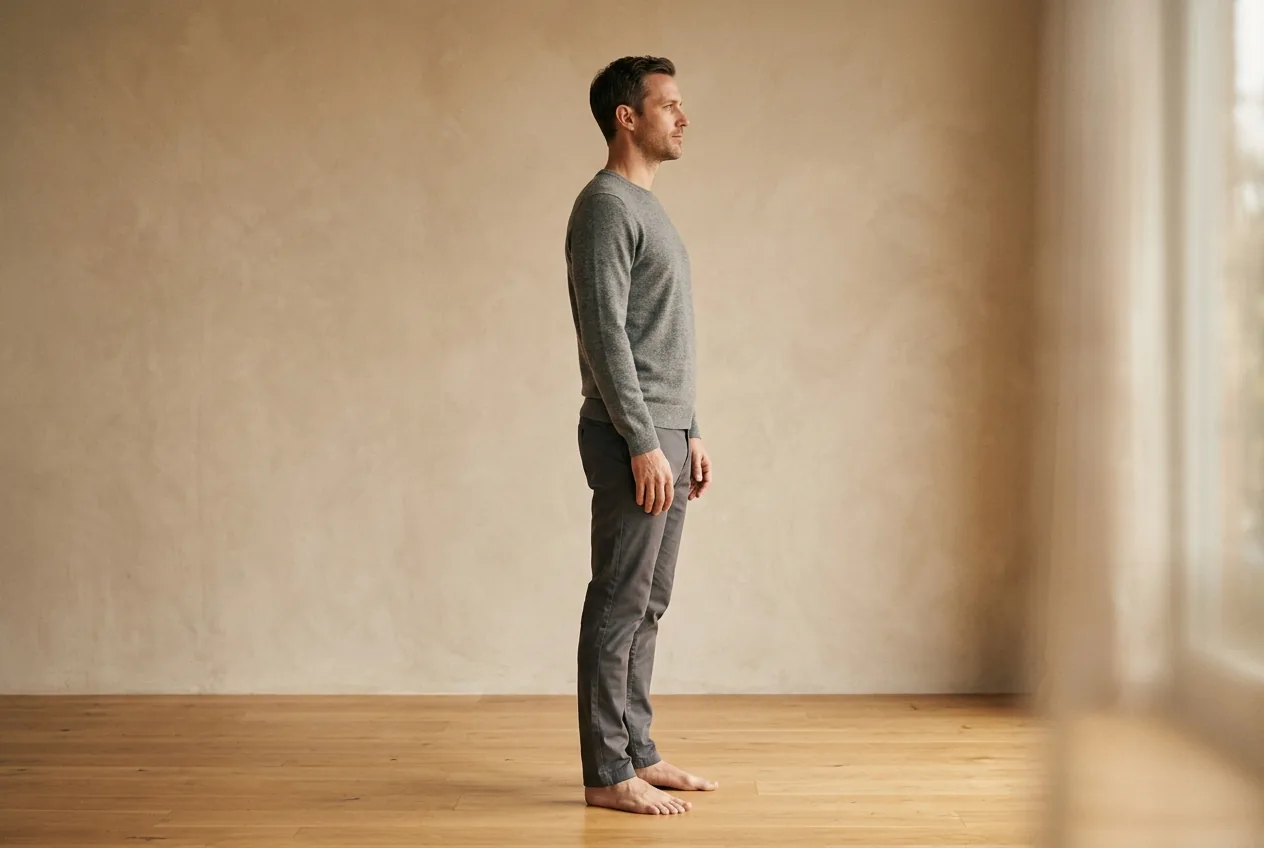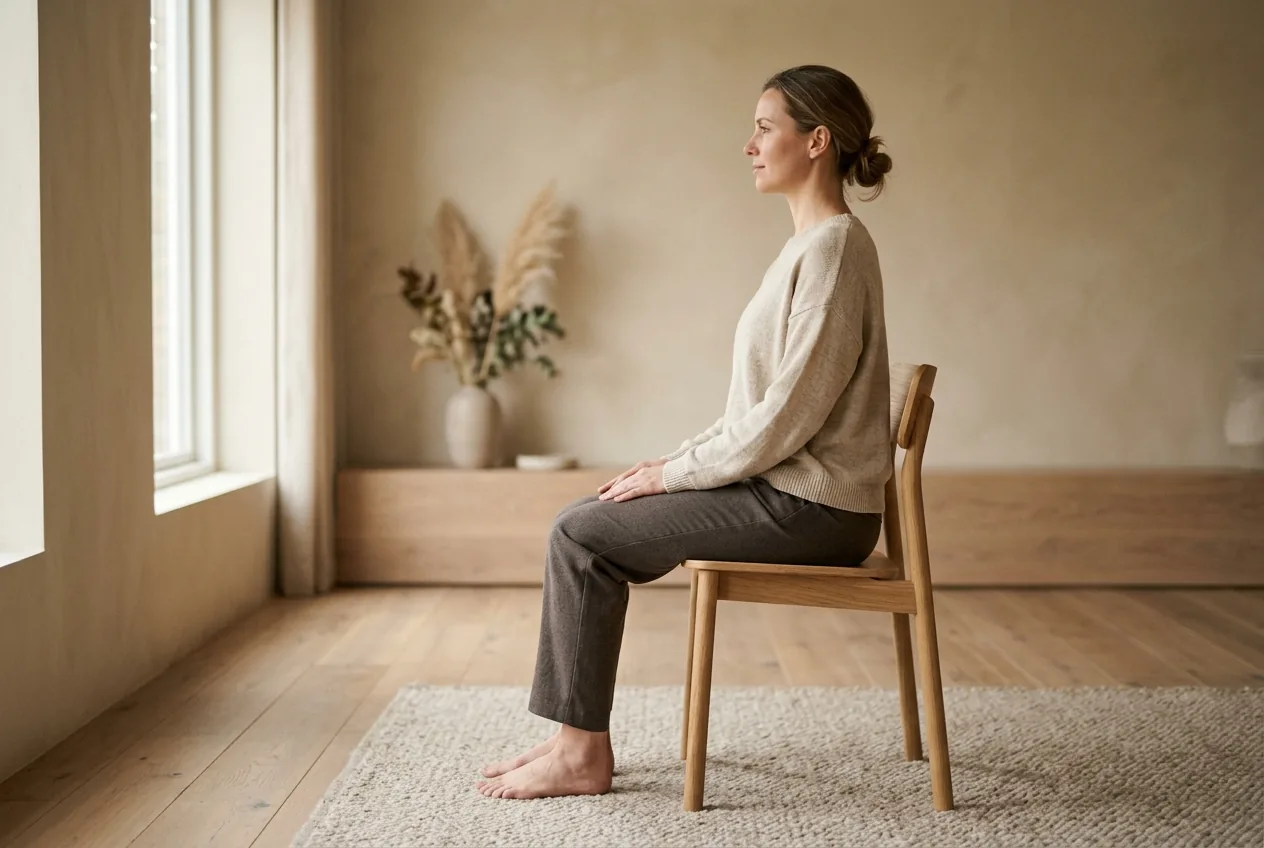
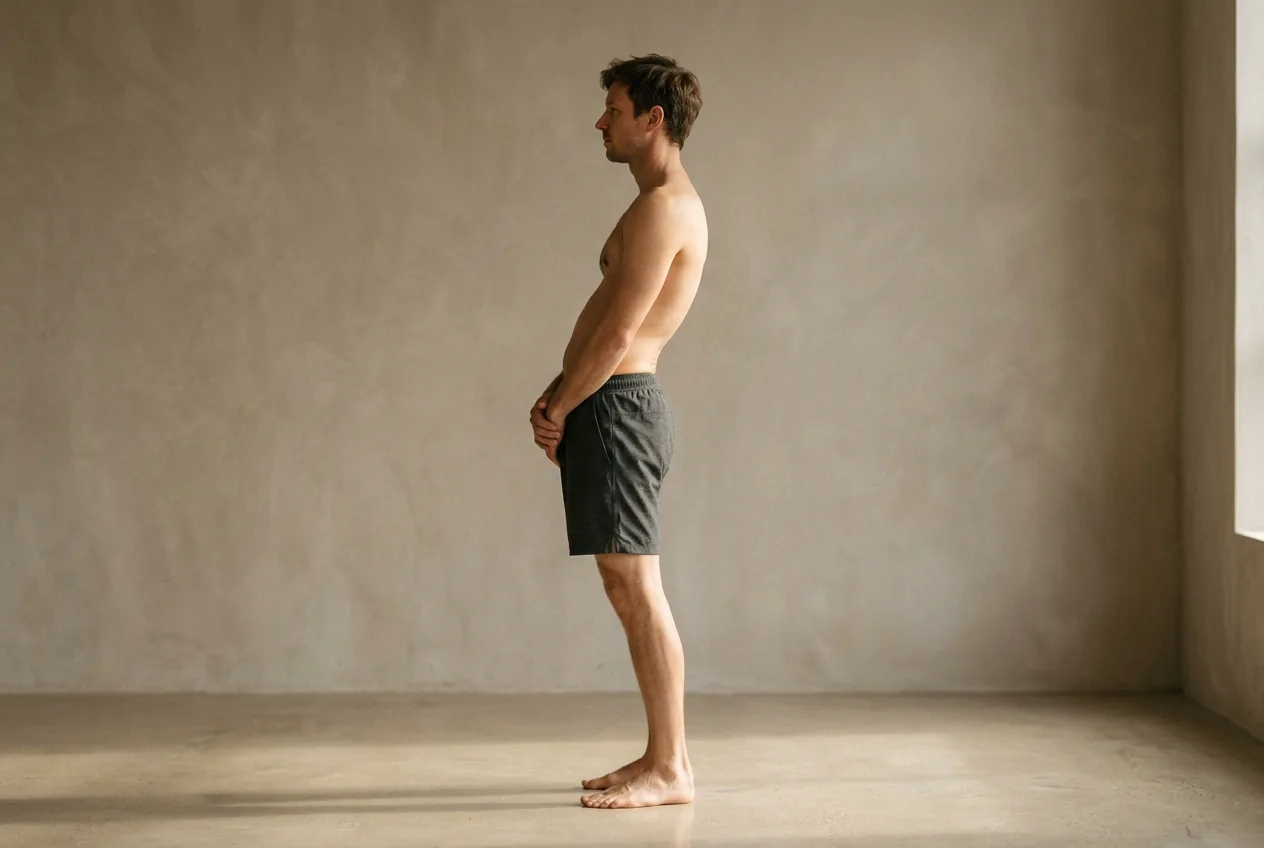
You stand sideways in the mirror and notice your belly pushes forward and your backside sticks out, even though you're not heavy. Your lower back has a deep curve, and it aches if you stand in the kitchen for more than a few minutes. That sway-backed, "Donald Duck" look is the classic sign of anterior pelvic tilt, and the right anterior pelvic tilt exercises can level it out — once you're sure that's what you've got.
It's one of the most common postural patterns in people who sit all day, and one of the most misunderstood. Most folks pile on core work and stretching at random and wonder why nothing changes. The fix is more specific than that.
What anterior pelvic tilt is
Picture your pelvis as a bowl of water. In a neutral position the water sits level. In anterior pelvic tilt, the bowl tips forward — the front drops down and the back lifts up — so the water would pour out the front. That forward tilt drags your lower spine into an exaggerated arch and pushes your stomach out ahead of you.
It's a tug-of-war between four muscle groups. The hip flexors at the front of your hips and the muscles of your lower back get short and tight, pulling the front of the pelvis down. Meanwhile your glutes and deep abdominals get long and weak, so they can't pull the back of the pelvis down to balance things out. Sit for years and the front wins. That's the tilt.
How to tell if you have it
You don't need a clinic. Two quick checks at home get you most of the way.
The wall check: stand with your back, head, and heels against a wall, feet a few inches out. Slide a hand into the gap behind your lower back. A small gap — about a flat hand's thickness — is normal. If your whole forearm slides through easily and your back feels far off the wall, that points toward an excess arch.
The side-photo check: have someone take a photo of you standing relaxed, side on. Look at the front of your hip bones versus the back. If the pelvis is clearly tipped so the front points down and your backside juts out behind you, that's the anterior tilt look. The check your posture at home guide walks through doing this properly. It's worth knowing this isn't the only tilt — its mirror image is posterior pelvic tilt, the flat-back pattern, and the fixes are nearly opposite, which is exactly why guessing is risky.
Two people with "lower back pain" can have opposite pelvises. The same stretch that helps one makes the other worse.
Anterior pelvic tilt exercises that work
The goal is to release the tight front, strengthen the weak back and underside, and teach the pelvis to sit level. Do these most days — short and frequent beats long and occasional.
Hip flexor stretch — release the front
Kneel on one knee in a lunge, back knee on the floor, front foot flat ahead of you. Tuck your tailbone under and squeeze the glute on the kneeling-leg side, then push your hips gently forward until you feel a stretch across the front of the back hip. Hold 30 seconds each side. The tuck is what makes it work — without it you just arch more. See the hip flexor stretch for back pain for the full breakdown.
Glute bridge — strengthen the back
Lie on your back, knees bent, feet flat. Before you lift, flatten your lower back gently into the floor. Then drive through your heels and lift your hips until your body makes a straight line from knees to shoulders. Squeeze your glutes hard at the top, hold two seconds, lower slowly. Do 10 to 12. This wakes up the glutes that stopped pulling their weight. The glute bridge for back pain covers the cues.
Dead bug — wake up the deep core
Lie on your back, arms reaching at the ceiling, knees bent at 90 degrees over your hips. Press your lower back into the floor and keep it there. Slowly lower one arm overhead and the opposite leg toward the floor, then return. Alternate. The whole point is keeping that back flat — if it arches up off the floor, you've gone too far. Do 8 per side.
How it shows up in daily life
The tilt isn't just a look in the mirror. It changes how ordinary things feel. Standing still — at the stove, in a queue, washing dishes — gets uncomfortable fast, because your overarched lower back is taking load instead of sharing it, and the muscles there fatigue. Lying flat on your back can feel like there's a gap your spine wants to fill, so you bend your knees to settle. Getting up from a low chair, or lifting a toddler off the floor, you lead with your back rather than your hips, and the back complains.
Spotting these patterns is useful, because they tell you the tilt is doing real work in your day, not just sitting there cosmetically. They also give you honest checkpoints: when standing in the kitchen stops being a countdown to an ache, you're making progress, regardless of what the mirror says on any given morning. Change here is gradual and stacks up over weeks, which is exactly why a daily habit beats an occasional blitz.
What to stop doing
- Stop hammering endless sit-ups and crunches. They can pull you into more arch, not less.
- Stop doing big arching back stretches like cobra over and over — you're stretching a back that's already overarched.
- Stop standing with your weight dumped forward into your lower back. Stack your ribs over your hips.
- Stop sitting for three-hour blocks. Tight hip flexors are mostly a sitting injury. The link between tight hip flexors from sitting and this tilt is direct.
When to see a doctor
This is posture education, not medical advice. See a clinician promptly if your back pain came after a fall or accident, if you have numbness, tingling, or weakness spreading into the legs, any loss of bladder or bowel control, fever with back pain, unexplained weight loss, or pain that's severe or steadily worsening. Those need a proper assessment first.
Why your routine should be yours
The moves above target the standard anterior-tilt pattern, and for many people that's enough to start. But the degree of your tilt, whether one hip sits higher than the other, and how your upper body has compensated are specific to you — and the wrong emphasis can stall your progress or nudge you toward the opposite problem.
That's the case for a proper posture assessment rather than a one-size routine: measure your actual deviations, then build the program around them, repeated daily until level becomes normal.
Anterior pelvic tilt is a balance you lost from sitting. You get it back by retraining the muscles that quit — not by stretching harder.
Common questions
How do I know if I have anterior pelvic tilt?
Two home checks help. Stand against a wall and slide a hand behind your lower back — a forearm slipping through easily points to an excess arch. A side-on photo showing the front of your pelvis tipped down and your backside jutting out is the other tell.
What causes anterior pelvic tilt?
It's a tug-of-war from sitting. The hip flexors and lower-back muscles get short and tight while the glutes and deep core get long and weak, so the front of the pelvis drops and the back lifts.
Do sit-ups and crunches help anterior pelvic tilt?
Not usually — they can pull you into more arch rather than less. The deep-core work that helps is the kind that keeps the lower back flat, like dead bugs, paired with glute strengthening and hip-flexor release.
Can anterior pelvic tilt be corrected at home?
For the common, sitting-driven kind, the routine here needs no equipment and is done at home. How much it changes depends on the degree of your tilt and what's compensating above it, which is why matching the work to your own pattern helps.