
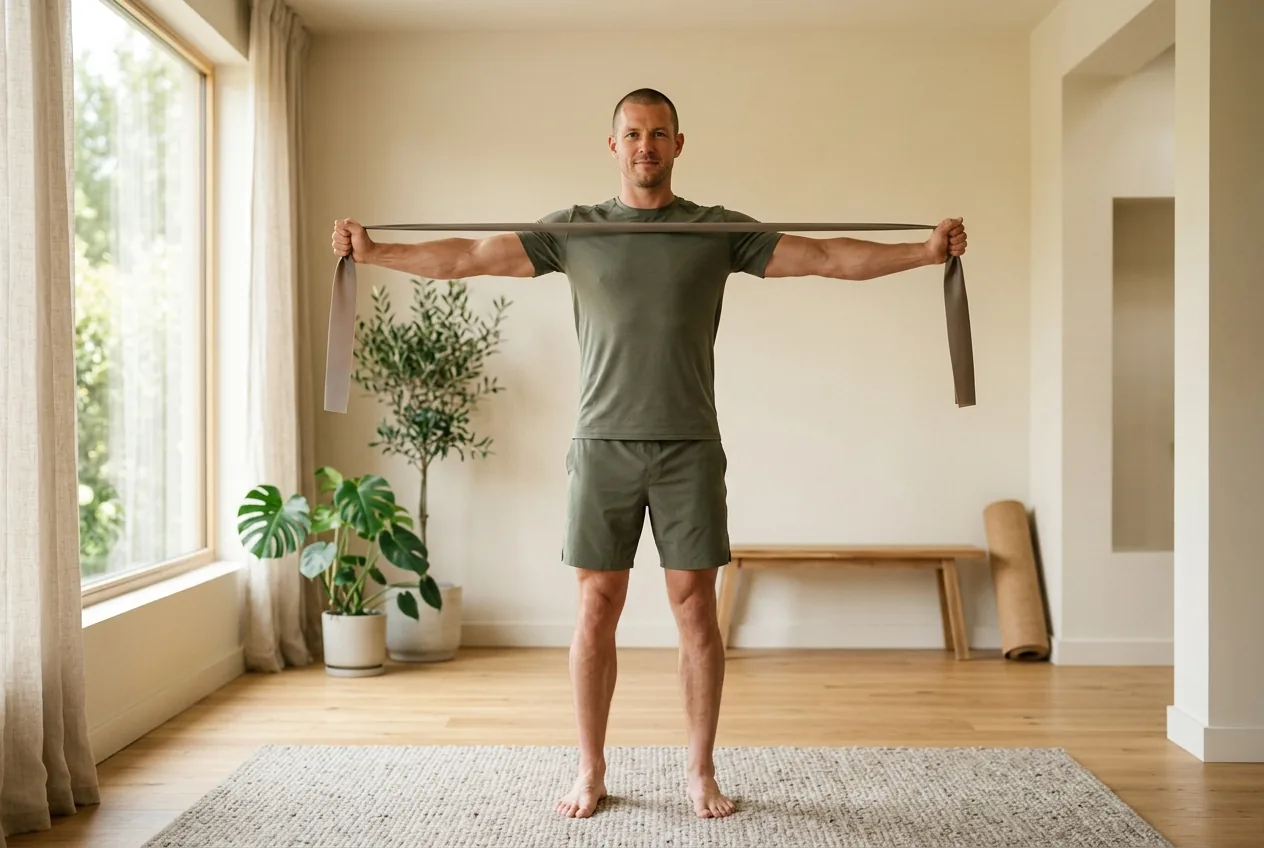
If your shoulders round forward by default and pulling them back feels like it lasts about thirty seconds before they cave again, the muscles meant to hold them there have simply gone quiet. Band pull aparts for posture are one of the most direct ways to wake those muscles up. You hold a resistance band out in front of you and pull it apart, squeezing your shoulder blades together — and that squeeze is exactly the action your upper back forgets after years at a desk. It's a small move with a big payoff for anyone whose shoulders live in a forward slump.
This single-move guide covers what band pull-aparts train, how to do them with clean form, the mistakes that waste the effort, sets and reps, and a few progressions.
What band pull-aparts train
When your shoulders round forward, two things are usually true at once: the chest and front shoulders are tight and short, and the muscles between your shoulder blades — the mid and lower traps and the rhomboids — are weak and stretched out. Those mid-back muscles are supposed to pull your shoulder blades back and down, holding your shoulders open. After enough hours hunched toward a keyboard or phone, they stop firing, and your shoulders default to rolled-forward.
Band pull-aparts hit those muscles directly. The pulling-apart action forces your shoulder blades to retract — to squeeze together — against resistance, which is precisely the job they've stopped doing. Train that motion regularly and the muscles relearn how to hold your shoulders back without you having to think about it.
That's why pull-aparts are a staple fix for rounded shoulders and a useful counter to the slump that drives forward head posture, since a rounded upper back drags the head forward with it.
How to do band pull-aparts, step by step
- Hold a light resistance band with both hands, arms straight out in front of you at about chest height, hands roughly shoulder-width apart. There should be slight tension in the band already.
- Stand tall — feet about hip-width, ribs down, a gentle brace through your core. Don't lean back.
- Keeping your arms straight (a soft, unlocked elbow is fine), pull the band apart by drawing your hands out to the sides.
- As your hands move apart, squeeze your shoulder blades together, like you're trying to pinch a pencil between them. The movement comes from your upper back, not your arms.
- Bring the band toward your chest in a wide arc until your arms are out to the sides, pausing for a second at the squeeze.
- Return slowly to the start with control, resisting the band the whole way back. That's one rep.
What you want to feel: the muscles between your shoulder blades working. What you don't want: your shoulders creeping up toward your ears, or your lower back arching to help.
The form errors that waste it
Shrugging the shoulders up. The most common mistake. As you pull, keep your shoulders down away from your ears so the work stays in the mid-back, not the upper traps.
Bending the elbows to cheat. Letting your elbows bend turns it into an arm exercise. Keep your arms long so the shoulder blades do the work.
Arching the lower back. Leaning back to yank the band harder takes the focus off your upper back. Keep your ribs down and core gently braced, body still.
Rushing the return. Letting the band snap your hands back wastes half the rep. Control the band on the way in — that lengthening part builds strength too.
Using too heavy a band. A band you can't pull apart with clean form makes you compensate. Lighter and cleaner beats heavy and sloppy.
The squeeze between your shoulder blades is the whole exercise. If you can't feel it there, lighten the band and slow down.
Sets, reps, and progressions
Band pull-aparts respond well to higher reps because you're building endurance in muscles that need to hold a posture all day, not lift something heavy once. A good starting point is two to three sets of 12 to 20 reps, a few times a week — even daily is fine with a light band, since the load is low. They're a great desk break: keep a band by your workspace and do a set every couple of hours.
To progress as it gets easier:
- Use a heavier band or shorten your grip for more tension.
- Slow the tempo, taking three seconds to return each rep.
- Add a pause at the full squeeze for two to three seconds.
Pull-aparts also stack well with other upper-back work. Pair them with wall angels to groove the same shoulder-blade motion against a wall, and with a doorway chest stretch to release the tight chest that's pulling your shoulders forward in the first place. Loosen the front, strengthen the back — that combination is what actually changes rounded shoulders.
Who should be cautious
Band pull-aparts are low-risk for most people, but:
- If you have a shoulder injury or recent shoulder surgery, clear it with your clinician first.
- If a movement sharply pinches your shoulder, reduce the range or lighten the band rather than pushing through.
- Keep the load light if you're new to resistance work — there's no rush to a heavy band.
When to see a doctor
This is a gentle exercise, but symptoms have limits. See a clinician promptly if you have numbness, tingling, or weakness spreading into an arm or hand, neck or upper-back pain after a fall or accident, fever with the pain, unexplained weight loss, or pain that's severe or steadily worsening. This article is education and posture therapy, not medical advice. Stop any move that reliably sends pain or tingling down your arm.
Why one exercise won't fix the slump
Band pull-aparts are excellent at what they do — waking up the mid-back muscles that hold your shoulders open. But rounded shoulders are rarely just a mid-back problem. They sit on top of a chain: a tight chest, often a forward head, sometimes a slumped lower back or tipped pelvis pulling the whole posture down. Strengthen one link and ignore the rest, and the shoulders keep rounding because the forces dragging them forward are still there.
That's the limit of any single move. Which links in your chain are tight, which are weak, and the order to fix them depend on your specific posture. A posture assessment measures where your shoulders, head, and spine actually deviate and builds a routine that targets your pattern — so pull-aparts become one well-placed piece instead of a guess. A quick posture check at home will show you where your shoulders are starting from.
Do the pull-aparts. Then make sure the rest of the chain isn't quietly pulling your shoulders back into the slump.
Common questions
Do band pull-aparts improve posture?
Yes, for the rounded-shoulder part of poor posture. They directly strengthen the mid-back muscles that retract your shoulder blades and hold your shoulders open — the muscles that go weak from sitting. Paired with chest stretching to release the front, they're one of the most effective fixes for rounded shoulders.
How many band pull-aparts should I do?
Because they build postural endurance, higher reps work well: two to three sets of 12 to 20, several times a week or even daily with a light band. Keeping a band at your desk and doing a set every couple of hours is a simple way to stay consistent.
What muscles do band pull-aparts work?
Mainly the muscles between and around your shoulder blades — the rhomboids and the mid and lower trapezius — plus the rear shoulders. These are the muscles that retract and stabilise the shoulder blades, which is why pull-aparts help counter a rounded, forward-shoulder posture.
Why don't I feel band pull-aparts in my upper back?
Usually because you're shrugging your shoulders up, bending your elbows, or using too heavy a band, which shifts the work to your arms and upper traps. Lighten the band, keep your shoulders down and arms long, slow down, and focus on squeezing your shoulder blades together.