You step off a curb and your hip dips, or one side of your lower back nags after a walk, or your knees drift inward when you climb stairs. These are small signs of the same thing: the muscles on the side of your hip that are supposed to keep your pelvis level have gone quiet. The clamshell exercise is the simplest, most reliable way to wake them back up, and it does more for your hips and lower back than its lazy-looking shape suggests.
The clamshell targets a specific muscle most people can't even feel working at first — the gluteus medius on the side of the hip. Get it firing and a lot of downstream aches start to settle.
Why the side glutes matter for your back
Your glutes aren't one muscle. The big one you sit on extends your hip. But on the side, the gluteus medius and minimus do a quieter job: they hold your pelvis level when you stand on one leg, which is every single step you take. Walk across a room and your weight shifts to one leg dozens of times — the side glutes are what stop your pelvis from dropping on the unsupported side each time.
When these muscles are weak — and sitting all day leaves them weak — your pelvis sways and tilts with every step, your knees fall inward, and your lower back and the band down the outside of your thigh end up compensating. That compensation is behind a lot of one-sided lower back ache, hip pain, and knee trouble. The body covers for the sleeping side glute, and the cover charge is pain somewhere else.
This is the same disuse story behind weak glutes and back pain, just focused on the side muscles. Waking the gluteus medius is a piece of broader hip mobility exercises, because a stable hip moves better.
The side glute does its job a hundred times on a short walk. When it sleeps, your back and knees pick up the bill.
How to do a clamshell with good form
The whole game is feeling it in the side of your hip, not the front of your thigh or your lower back. Form is everything here.
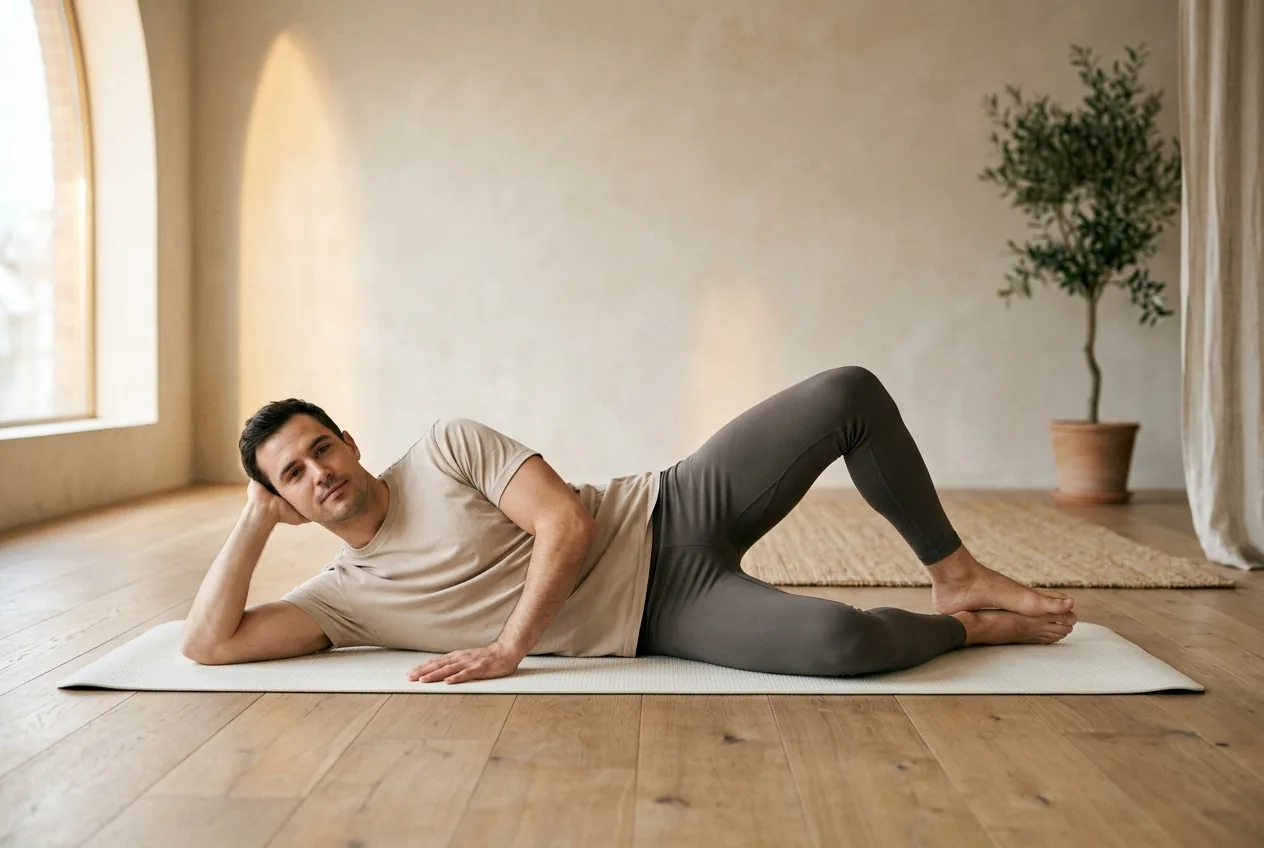
- Lie on your side, hips and knees stacked, knees bent to about ninety degrees, feet in line with your backside.
- Rest your head on your lower arm and put your top hand on your top hip — you'll use it to make sure your hip doesn't roll backward.
- Keep your feet together and your top hip stacked directly over the bottom one. Don't let the pelvis roll back.
- Slowly lift your top knee like a clam opening, keeping your feet touching, opening only as far as you can without your pelvis rotating.
- Pause at the top, feel the muscle on the side of your hip working, then lower slowly.
If you feel it in the front of your thigh or your lower back instead of the side of your hip, you're probably rolling your pelvis open to get more range. Open the knee less and keep the hip stacked. A smaller, honest range beats a big, cheated one.
Reps and sets
Two or three sets of twelve to fifteen per side is a good target. Go for control and that burn on the side of the hip rather than speed or range. Two or three sessions a week wakes the muscle up; once it's firing well, it slots into a warm-up before walks or workouts. To make it harder, loop a resistance band just above your knees.
Variations once the basic clamshell is easy
- Banded clamshell. A light loop band above the knees adds resistance and makes the side glute work harder through the same range.
- Feet-elevated clamshell. Lift your feet a few inches while keeping the knees together as you open, which increases the demand.
- Reverse clamshell. Keep the knees together and lift the top foot instead, opening at the ankle — a different angle on the same muscle.
- Side-lying leg raise. Once clamshells are easy, straighten the top leg and lift it directly out to the side, leading with the heel. This loads the side glute through a bigger range.
Common mistakes
- Rolling the pelvis backward. The classic error. It lets bigger muscles take over and hides the side glute. Keep your top hip stacked and use your hand to feel for any roll.
- Opening too far. Range past where the hip can hold steady comes from the pelvis rotating, not the glute working. Smaller and honest wins.
- Feeling it in the lower back. That means your spine is moving to help. Brace your core gently and keep the movement at the hip only.
- Rushing. Fast clamshells use momentum. Slow down, pause at the top, and lower under control.
- Feet drifting apart. Keep your heels together so the movement stays at the hip rotation, not the legs scissoring.
When to see a doctor
The clamshell is exercise, not medical treatment. Stop and see a clinician promptly if it brings on numbness, tingling, or weakness down a leg, sharp hip or back pain, any loss of bladder or bowel control, or back or hip pain after a fall, with fever, or that's severe or steadily worsening. New, sharp one-sided pain is worth getting assessed before you keep loading it.
Why glute activation isn't one-size-fits-all
Clamshells help most people whose side glutes have switched off from sitting. But the catch is that the same exercise lands differently depending on how your pelvis actually sits — a pelvis tilted or rotated one way loads the side glute differently than one tilted the other, so two people doing identical clamshells get different results. General activation is a fair starting point. The version that holds is matched to how your hips and pelvis are positioned, which is what a posture assessment built around your own pattern is for, instead of guessing from how the move feels on day one.
Common questions
What muscle does the clamshell work?
Mainly the gluteus medius on the side of your hip, with the smaller gluteus minimus helping. These are the muscles that keep your pelvis level when you stand on one leg, which happens with every step. You should feel a clamshell in the side of your hip, not the front of your thigh or your lower back.
How do clamshells help back pain?
Weak side glutes let your pelvis tilt and sway with every step, and your lower back compensates for that instability — a common source of one-sided ache. Strengthening the side glutes with clamshells steadies the pelvis so your back stops covering for them.
Where should I feel a clamshell?
In the side of your hip, just below the bony point, where the gluteus medius sits. If you feel it in the front of your thigh or your lower back, you're rolling your pelvis to cheat the range. Keep your top hip stacked over the bottom and open the knee less.
How many clamshells should I do?
Two or three sets of twelve to fifteen per side, two or three times a week, focusing on control and feeling the side glute work rather than speed or range. Add a light resistance band above the knees once the bodyweight version feels easy.