
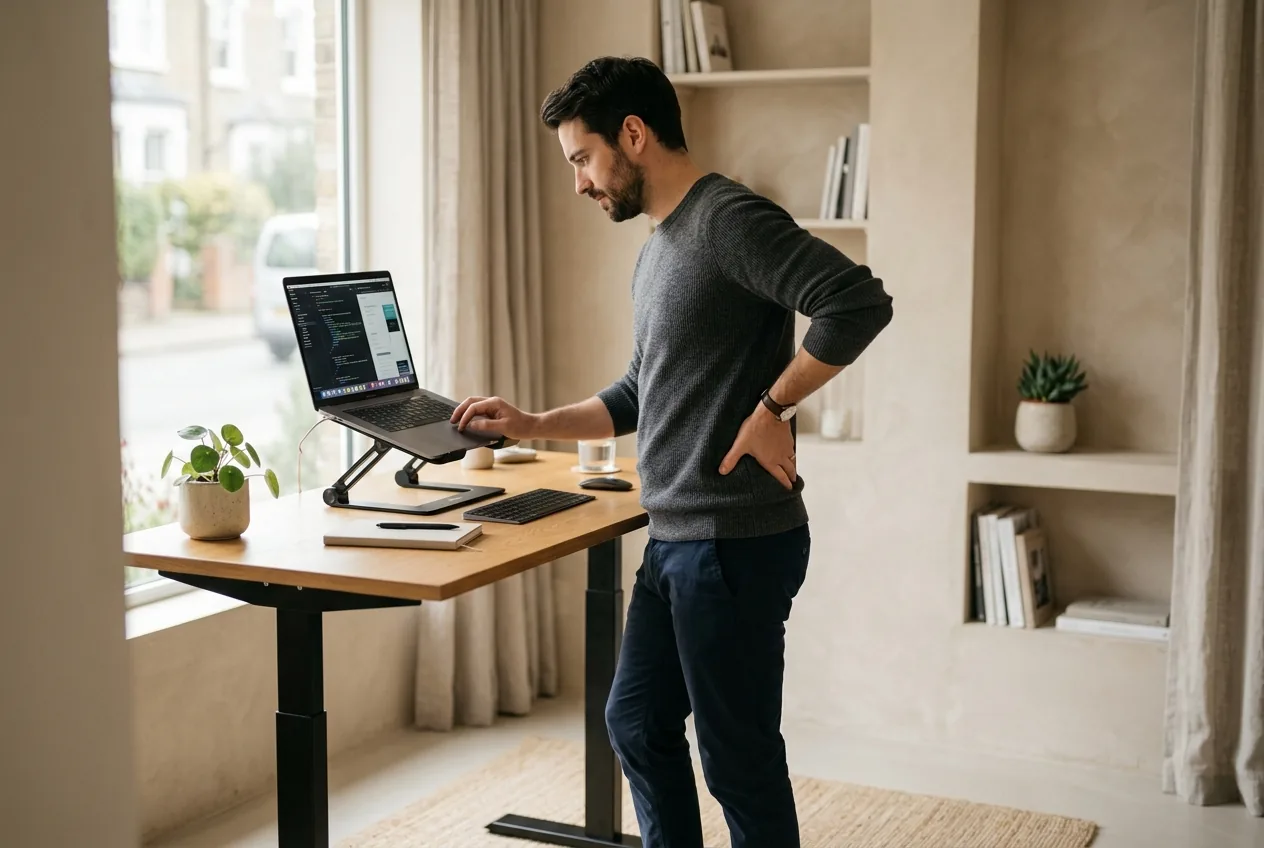
You bought the standing desk because everyone said sitting was wrecking your back. Now you're standing, and the ache has just moved into your lower back instead of leaving. If that's where you are, you're not doing it wrong on purpose. Standing desk lower back pain is real, common, and rarely mentioned in the brochures.
The standing desk isn't a villain. It solves some problems and creates others, and the lower back is often where the new problems land. Understanding why turns it from a frustration into something you can adjust.
Why standing can hurt as much as sitting
Sitting and standing fail your back in different ways, but they share a root cause: holding one position too long. Muscles aren't designed for hours of static load. Sit too long and your hip flexors shorten and your glutes switch off. Stand too long and a different set of muscles fatigues, particularly the ones running along your lower back.
When you stand for hours, it's tempting to settle into a slumped, hips-pushed-forward stance to take the effort off your legs. That posture jams the lower back into an exaggerated curve and parks your weight on the joints rather than the muscles. The muscles get a rest. The joints take the strain. By afternoon, the lower back is the part that complains.
There's also the surface. Standing on a hard floor with no cushioning sends a steady, low-grade load up through your feet, knees, hips, and into your back. Hours of that adds up even with decent posture.
So the standing desk didn't fail. It swapped one static position for another, and your body found a new way to compensate.
The posture traps of standing all day
Three habits turn a standing desk into a back-ache machine:
Locking into a sway. When legs tire, people push the hips forward and let the lower back arch to prop themselves up. This is the standing version of slumping, and it's the most common cause of standing desk lower back pain. The same exaggerated-arch pattern shows up in anterior pelvic tilt, where the pelvis tips forward and the lower back over-curves.
Shifting onto one hip. Standing with weight dumped onto one leg, hip cocked out to the side, feels restful but loads one side of the back and pelvis unevenly. Do it for months and you build an asymmetry. If one side already bothers you, the guide on lower back pain on one side goes deeper.
Never moving. A standing desk used as a place to stand perfectly still for six hours is just a different chair. Stillness is the problem, not the height of the surface. The early warning sign is usually the same for everyone: you stop noticing your feet, settle your weight somewhere, and only realize an hour later that you haven't shifted at all.
How to set up a standing desk that helps
A few adjustments make the difference between relief and a new ache.
- Get the height right. Elbows at roughly a right angle, forearms parallel to the floor, screen top at eye level. Too low and you'll hunch forward; too high and your shoulders shrug. The same screen-height rule from any ergonomic desk setup applies standing or sitting.
- Stand tall, not swayed. Stack your ribs over your pelvis, tuck your tailbone slightly so you're not arching, and keep a soft bend in the knees. Weight spread evenly across both feet, not parked on one hip.
- Use an anti-fatigue mat. A cushioned mat takes the edge off the hard-floor load and gently encourages small shifts in weight, which is exactly what you want.
- Try a footrest bar or a low box. Resting one foot up for a while, then swapping, lets you ease the lower-back arch without slumping. It's an old bartender trick for a reason.
- Don't stand all day. This is the big one. Alternate sit and stand. Aim to change position before discomfort starts, not after.
The fix for a standing desk is the same as the fix for a chair: stop holding still.
Sit-stand is the real win
The benefit of a standing desk isn't standing. It's the option to change. The healthiest pattern for most people is shifting between sitting and standing through the day, with neither held long enough to settle into a slump or a sway.
A rough rhythm that works for many: sit for a stretch, stand for a stretch, and break both up with a short walk or a few movements every half hour or so. When you are seated, set up the chair properly, because a bad seated position between standing bouts undoes the benefit. The breakdown in how to sit with lower back pain covers that side. Don't get hung up on hitting an exact sit-to-stand ratio either. The number that matters is how often you change, not the split.
Movement beats posture. A perfectly aligned position held for hours still fatigues the muscles holding it. Small, frequent changes keep any single set of muscles from carrying the load too long. The same logic applies whether you work in an office or from your kitchen, which is why back pain working from home lands on the same answer.
When to see a doctor
Postural lower-back ache from standing eases when you change the setup and move more. Some signs point elsewhere. See a clinician promptly if you have numbness or weakness spreading into a leg, any loss of bladder or bowel control, back pain after a fall, fever with back pain, unexplained weight loss, or pain that's severe or steadily getting worse rather than easing with movement.
Why your standing posture defaults the way it does
If you keep drifting back into a sway or onto one hip, that's not laziness. It's your body taking the path of least resistance around an underlying imbalance. A pelvis that tips forward, glutes that don't fire, a back that over-arches to compensate, those patterns decide what "comfortable standing" feels like for you. That's why two coworkers at identical desks settle into different shapes.
Generic advice about standing tall only sticks when the muscles can actually hold the position without a fight. A short posture assessment that measures your specific deviations shows which pattern you're working around, then matches a daily routine to it so a neutral standing position stops being effortful.
Adjust the desk this week, add a mat, and treat the standing desk as a tool for changing position rather than a place to stand still. The ache that moved into your lower back will have less to feed on.
Common questions
Can a standing desk cause lower back pain?
It can, especially if you stand still for long stretches or drift into a sway. Standing isn't automatically better than sitting; the gain comes from changing position often.
How long should I stand at a standing desk?
Alternate rather than commit to either extreme. Many people do well switching every 30 to 60 minutes, using the desk as a way to move rather than a place to stand frozen.
Why does my lower back hurt more when I stand?
Often because the pelvis tips forward and the lower back over-arches to compensate, especially when the glutes aren't firing. That sway loads the spine and shows up as an ache.
Does an anti-fatigue mat help with standing desk back pain?
For many people it does, by encouraging small shifts in weight and easing the load on the legs and lower back. It's a cheap thing to try before changing anything bigger.