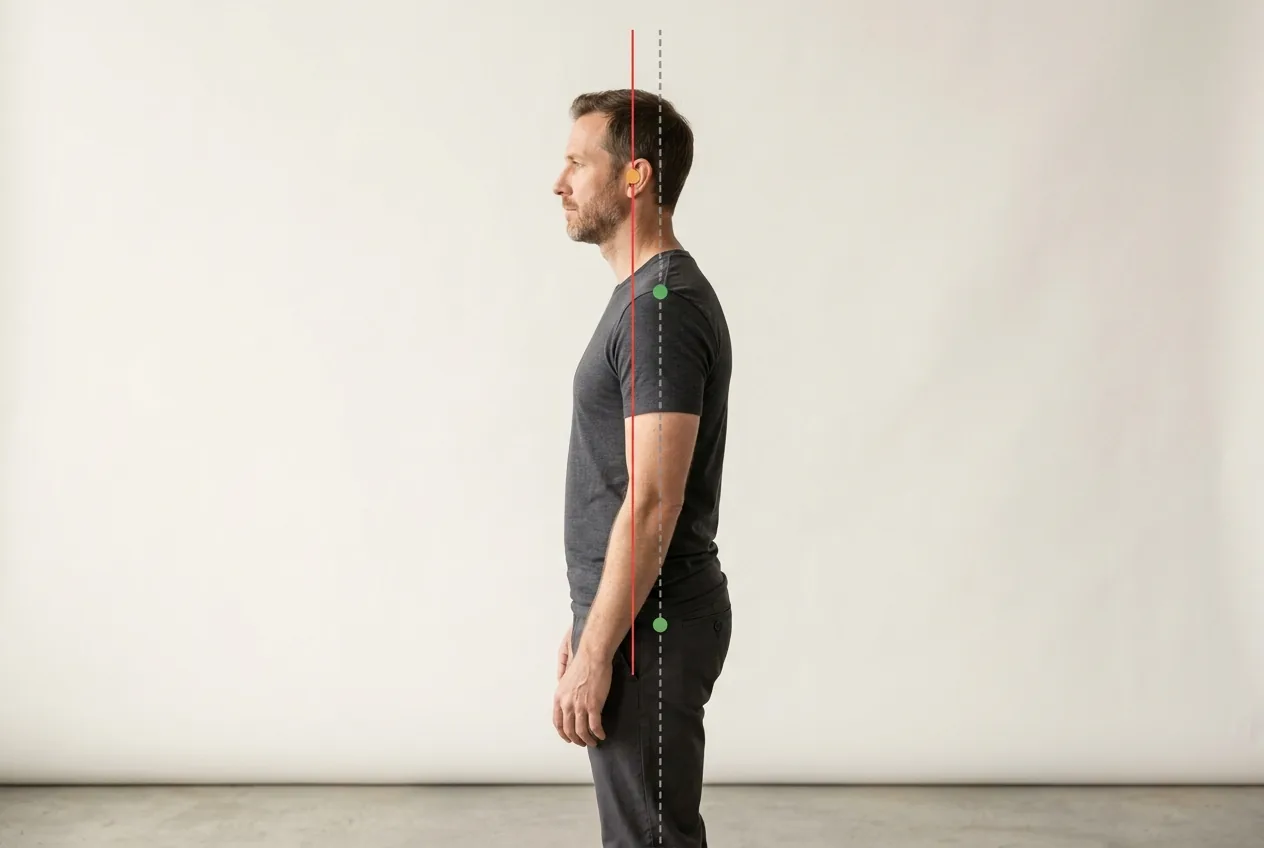

The front of your shoulder starts to ache partway through a set, and reaching overhead — in the pool or just grabbing something off a high shelf — has a catch or pinch to it. You've cut your yardage, iced it, maybe rested a week, and the moment you build back up it returns. Swimmer's shoulder gets blamed on mileage, and volume does play a part. But the deeper reason the same shoulder keeps flaring is usually the posture you carry into every stroke: rounded shoulders and a forward head that quietly steal the space your rotator cuff needs to work.
The shoulder is the most mobile joint in the body, which means it depends on good positioning to stay healthy. When your posture rounds it forward, the mechanics change before you take a single stroke. Add thousands of overhead pulls on top of a compromised position and the tissue gets irritated. Fix the position and you give the cuff room to do its job.
What's actually getting pinched
Your rotator cuff is a group of small muscles that hold the ball of your shoulder centered in its socket and let the arm rotate. The cuff tendons pass through a narrow space beneath the top of the shoulder blade. As long as that space stays open, the tendons glide freely overhead.
When your shoulders round forward and your upper back slumps — the everyday result of desk work and phones — the shoulder blade tips forward and the space underneath narrows. Now every overhead reach drags the cuff tendons through a tighter gap, and they get pinched and irritated. That's the catch you feel. Swimming just repeats the motion enough to turn an occasional pinch into a steady ache.
There's a postural chain behind it. Rounded shoulders tip the shoulder blade forward, and a forward head posture drags the whole upper body into the same slump. The shoulder is downstream of both.
The rotator cuff isn't failing from effort alone. It's working overhead through a space your posture keeps squeezing shut.
Why volume isn't the whole story
Two swimmers can do the same yardage and only one develops the ache. The difference is usually how the shoulder is positioned when the load arrives. A swimmer with an open chest, a stable shoulder blade, and a tall upper back has room to spare overhead. A swimmer who sits hunched at a desk all day brings a forward-tipped shoulder blade to the pool, so the same yardage lands on a joint that's already short on space.
That's why rest alone tends to give only temporary relief. Resting calms the irritated tissue, but the moment you return to training the posture is unchanged, the space is still tight, and the cuff gets pinched all over again. The fix has to change the position, not just wait out the inflammation.
The fix: open the space and stabilize the blade
The goal is to open the chest, mobilize the upper back, and wake up the muscles that hold the shoulder blade in a good position. Then the cuff has both room and support.
Open the front
- Doorway pec stretch. Stand in a doorway, forearm on the frame, and gently lean through to open the chest. Hold 30 seconds, two or three rounds. Tight chest muscles are a big part of what rounds the shoulder forward.
- Foam roller chest opener. Lie lengthwise along a roller and let your arms fall open to the sides for two minutes, letting gravity open the front.
Mobilize the upper back
A stiff mid-back forces the shoulder forward. Thoracic extension over a foam roller and cat-cow restore the upright posture the shoulder needs underneath it.
Wake the muscles that hold the blade back
This is the part that holds the change. The muscles between and below the shoulder blades pull it back and down into a good position, opening the space.
- Wall angels train exactly this. The full how-to is in wall angels.
- Scapular rows and band pull-aparts strengthen the mid-back so the blade stops tipping forward. If your blade wings out from the ribs, the targeted approach in winged scapula pairs well.
- External rotation with a band strengthens the cuff itself in a safe range, so it can hold the ball centered.
Strengthen, then return to volume
Build the position and the support first, then rebuild yardage gradually. Returning to full volume on an unstabilized shoulder is what restarts the cycle.
In and around the pool
- Roll your body more. A flat stroke makes the arm reach across and overhead in the worst position; rotating your torso with each stroke opens the shoulder's path.
- Fix your catch. Dropping the elbow or crossing the midline on entry pinches the joint. A coach's eye on your stroke is worth it.
- Mind the dry-land hours. The eight hours you sit hunched shape the shoulder you bring to the water. Sitting tall and taking screen breaks isn't separate from your swimming — it's part of it.
What to stop doing
- Stop relying on rest alone. It calms the tissue but leaves the tight position that caused the pinch.
- Stop pushing through sharp overhead pain. Mechanical irritation that worsens within a set is a signal, not a warm-up.
- Stop training only the front. Endless pushing and pressing rounds the shoulder further — balance it with pulling and mid-back work.
When to see a doctor
Swimmer's shoulder from a postural pattern is mechanical and usually responds to mobility and strengthening. See a clinician promptly if you have sharp pain with weakness or an inability to lift the arm, pain that followed a specific injury or fall, numbness or tingling down the arm, night pain that wakes you, or pain that's severe or steadily worsening. Posture and strength work is for ordinary mechanical shoulder pain, not for a diagnosed tear or instability.
Why a generic plan only goes so far
Pec stretches and wall angels help most swimmers, because the rounded-shoulder pattern is so common. But how far forward your shoulder sits, how stiff your mid-back is, which side aches, and whether your blade wings out — that's specific to you, and swimming is repetitive enough to expose any imbalance. Two swimmers with the same ache can need different work.
Lasting relief comes from knowing your own setup: where your body deviates, which muscles switched off, which are overworking to cover. A posture-based approach measures your real deviations first, then builds the routine around them — so you're opening and strengthening exactly what your shoulder needs. Give the cuff its space back, and the same set stops ending in a pinch.
Common questions
What causes swimmer's shoulder?
It's a combination of overhead volume and shoulder position. The rotator cuff tendons pass through a narrow space under the shoulder blade, and when rounded posture tips the blade forward that space narrows. Each overhead pull then drags the tendons through a tighter gap, and the repetition of swimming turns the occasional pinch into a steady ache.
Is swimmer's shoulder a rotator cuff injury?
It's irritation of the rotator cuff tendons from being repeatedly pinched in a narrowed space, rather than a tear in most cases. Because the cause is often postural — a forward-tipped shoulder blade and rounded upper back — opening that space and stabilizing the blade tends to settle it. Sharp pain with weakness or inability to lift the arm needs a clinician's assessment.
How do I fix swimmer's shoulder?
Open the front of the chest with doorway stretches, mobilize a stiff upper back, and strengthen the muscles that hold the shoulder blade back and down with wall angels, rows, and band work, plus gentle cuff strengthening. Then rebuild yardage gradually. Fixing the dry-land posture and stroke mechanics matters as much as the pool work.
Will rest cure swimmer's shoulder?
Rest calms the irritated tissue and eases the pain for a while, but on its own it doesn't change the rounded posture that narrowed the space in the first place. Without addressing the position, the pinch tends to return when you build volume back up. Pairing a sensible reduction in load with mobility and strengthening is what lasts.