By two in the afternoon your neck is doing that thing again. The base of your skull is tight, your shoulders have crept up toward your ears, and your upper back feels like someone parked a small weight between your shoulder blades. You roll your shoulders, you stretch, it eases for a minute, and then you go back to typing and it all settles right back in.
If that's your day, most days, there's a name for the pattern you've drifted into. Upper crossed syndrome is the muscle imbalance that builds in people who spend their hours reaching forward at a desk — and once you see how it's wired, the stubbornness of it makes sense.
What upper crossed syndrome actually is
Upper crossed syndrome describes a predictable trade-off in the muscles of your neck, chest, and upper back. Some get short and tight from being held in one position all day. Their opposites get long, weak, and quiet because nothing asks them to work. Draw lines connecting the tight muscles and the weak ones and they form an X across your upper body — which is where the name comes from.
On the tight side: the muscles at the front of the chest (the pecs) and the ones running up the back of the neck into the top of the shoulders. On the weak side: the deep neck muscles at the front of your throat that should hold your head balanced, and the muscles between and below your shoulder blades that should hold your upper back upright.
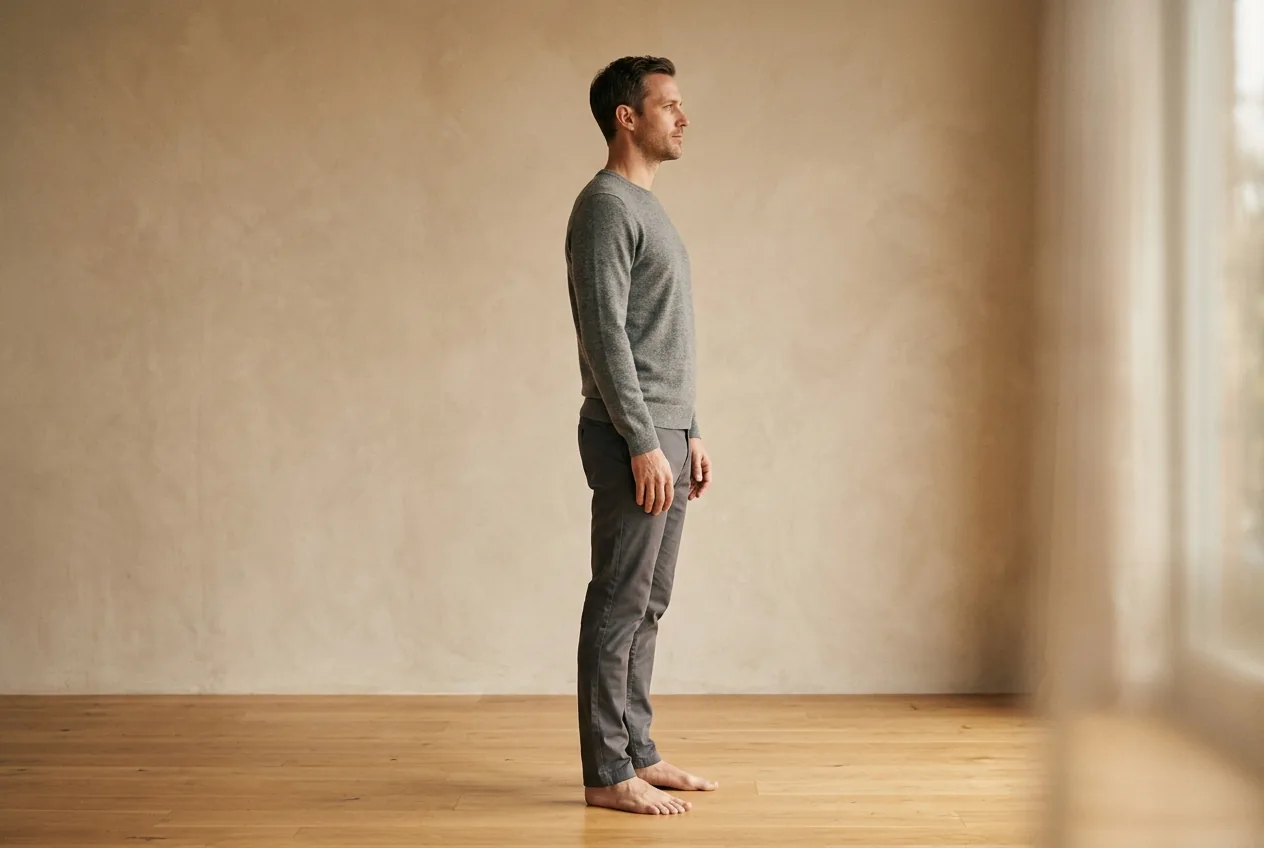
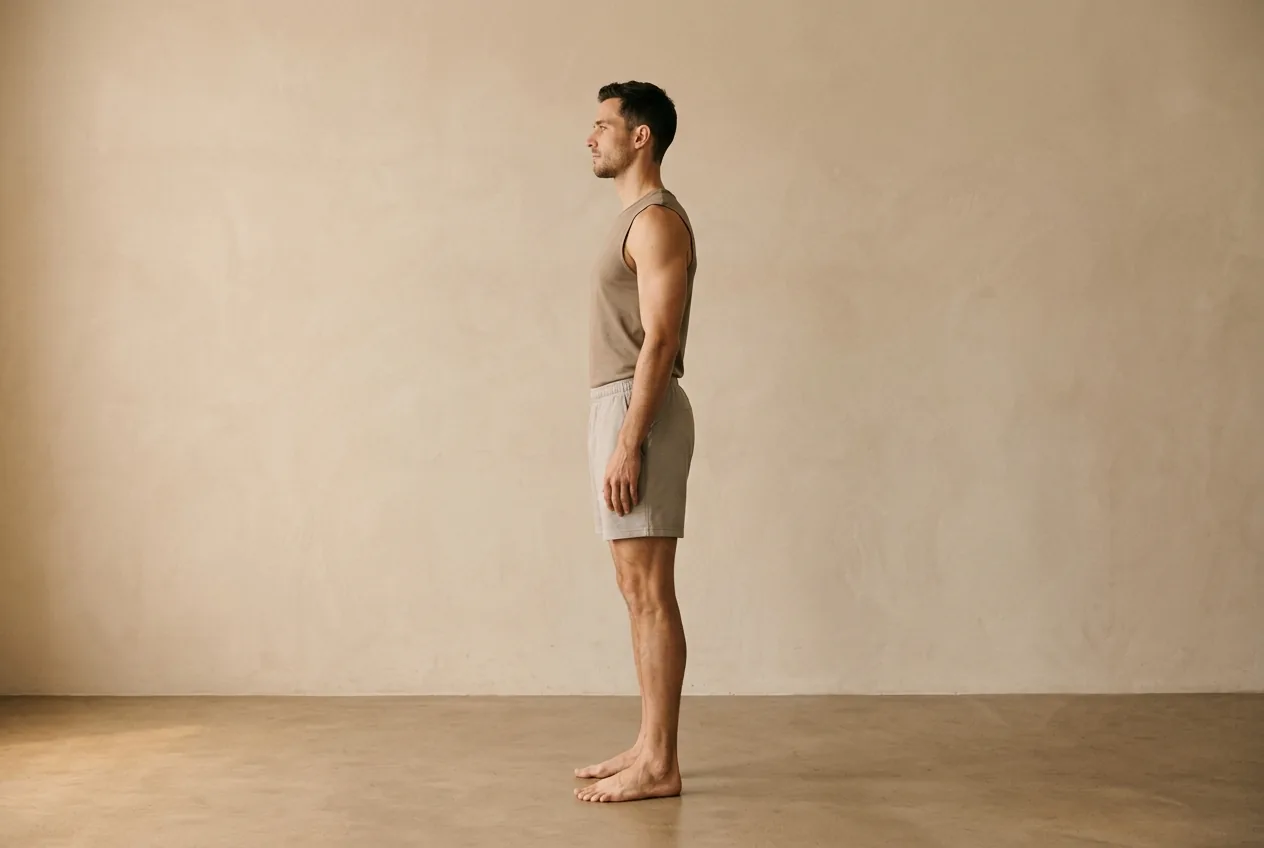
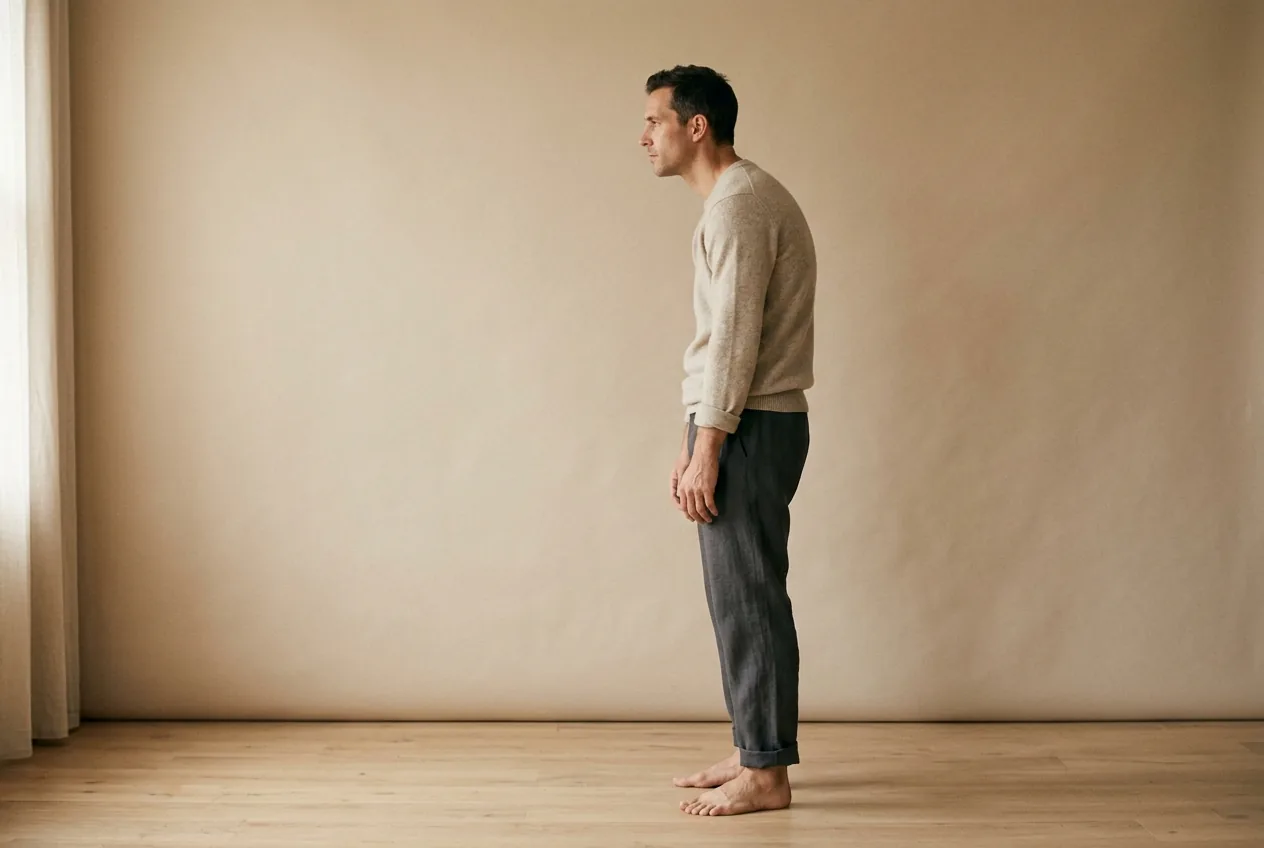
The result is a visible shape. The head drifts forward of the shoulders, the upper back rounds, the shoulders roll in, and the chest collapses. You've seen it in every coffee-shop window full of laptops.
The pattern isn't slouching out of laziness. It's the shape your body builds when the front is always pulling and the back has stopped pulling back.
Why it builds, and why it sticks
Think about what your arms do for eight hours. They reach forward to a keyboard, a mouse, a steering wheel, a phone. The chest stays in a closed, shortened position the entire time. Muscles that sit short all day adapt by getting shorter. Meanwhile the muscles between your shoulder blades never get a reason to fire, so they go slack.
The neck follows. As the upper back rounds forward, the head has to poke forward to keep your eyes level — the forward head posture pattern. Because the head is heavy, every inch it travels forward makes the muscles at the back of the neck work harder to hold it up. That's the afternoon ache. It's not weakness in the sense of being unfit; it's a muscle that's been on overtime since nine a.m.
This is also why "sit up straight" never holds. For the few seconds you remember, you're asking weak, switched-off back muscles to overpower tight, switched-on chest muscles. They lose the moment your attention moves. The shape follows the strength, not your good intentions.
The four moves that change the balance
Fixing upper crossed syndrome is a trade. You release the tight front and the overworked neck, you switch the weak back and deep neck muscles on, and you do it often enough that holding yourself upright stops feeling like effort. None of this needs equipment.
Open the chest — doorway stretch
Stand in a doorway, forearms on the frame, elbows about shoulder height. Step one foot through and lean gently forward until you feel a stretch across the front of your chest. Hold 30 seconds, breathe, repeat twice. This lengthens the pecs that have been pulling your shoulders forward.
Reset the head — chin tucks
Glide your head straight back over your shoulders, like you're making a double chin, without tipping it up or down. Hold five seconds, release, repeat 8 to 10 times. This wakes up the deep neck muscles that have gone quiet. The chin tucks exercise covers the details if it feels awkward at first.
Wake the upper back — wall angels
Stand with your back to a wall, lower back lightly flattened. Make a goalpost shape with your arms against the wall, then slide them up and down, keeping the backs of your hands and elbows in contact as much as you can. Ten slow reps. You'll feel the muscles between your shoulder blades doing the work. Wall angels walk through it if your arms keep peeling off.
Strengthen the squeeze — scapular retractions
Sit or stand tall. Draw your shoulder blades down and back, like tucking them into your back pockets. Hold five seconds, release, do 10 to 12. The movement is back and down, never up toward your ears.
What to stop doing
- Stop relying on the shoulders-back snap-correction. It lasts seconds and teaches nothing.
- Stop wearing a posture brace and expecting it to retrain you. It holds the position so your muscles don't have to, which keeps the weak ones switched off.
- Stop doing all your forward work — typing, driving, scrolling — without ever balancing it with something that pulls back.
- Stop letting your monitor sit low. A screen below eye level pulls your head down and feeds the whole pattern.
Upper crossed syndrome shares a lot of wiring with rounded shoulders, and the two usually travel together, so the same routine tends to help both.
When to see a doctor
This is posture education, not medical advice, and upper crossed syndrome describes a muscle pattern, not a disease. Check with a clinician if you have numbness, tingling, or weakness running into an arm or hand, pain that radiates down the arm, headaches that are new or severe, pain that began after a fall or accident, or pain that's severe or steadily getting worse. Those aren't postural aches to stretch through.
Why a matched routine beats a generic one
The four moves above help most people with this pattern, because the tight-front, weak-back wiring is so common. But how far your head has drifted, how rounded your upper back is, and whether something lower down is feeding into it will be specific to you. A move that suits your stack can do little for someone else's.
That's the thinking behind a real posture assessment: instead of guessing, you measure your own deviations and build the routine around them, in the right order. If you want a quick read first, you can check your posture at home with a side-on photo and a wall.
Upper crossed syndrome is a balance problem. Shift the balance and the upright posture comes along on its own.
Common questions
What causes upper crossed syndrome?
It builds from hours spent reaching forward — typing, driving, looking at phones. The chest and the back of the neck shorten and tighten while the deep neck muscles and the muscles between the shoulder blades go weak and quiet. That imbalance pulls the head forward and rounds the upper back.
Can you fix upper crossed syndrome at home?
For most people the everyday version responds well to home work: opening the tight chest, resetting the head with chin tucks, and waking the upper back with wall angels and scapular squeezes. The key is doing it most days, since you're retraining a balance your body built over years rather than stretching once.
How long does it take to correct?
There's no fixed date, but a sequence is common. The tight chest usually starts to release in the first week or two, and over the following month the upper back begins to hold you upright without conscious effort. Steady daily practice matters more than long, occasional sessions.
Is upper crossed syndrome the same as bad posture?
It's one specific, common form of it. "Bad posture" is a catch-all; upper crossed syndrome names a particular muscle imbalance in the neck, chest, and upper back. People often carry it stacked with other patterns lower down, which is why a matched routine works better than generic advice.