If raising your arms straight overhead feels stiff, or your shoulders creep up toward your ears the moment you try, the wall angels exercise will show you exactly how much your upper back has tightened. It looks like a slow snow-angel against a wall. What it's really doing is restoring the shoulder and upper-back movement that years of hunching over a keyboard quietly took away.
This guide covers the setup, the rep, the cheats almost everyone falls into, and how to scale the move when your shoulders won't cooperate yet.
What wall angels are fixing
Spend your days reaching forward — to a keyboard, a steering wheel, a phone — and your body adapts to that shape. The chest muscles shorten and pull your shoulders forward. The muscles between your shoulder blades lengthen and switch off. Your upper back rounds, your shoulders roll in, and your head drifts forward to follow.
This rounded-shoulder pattern doesn't just look slumped. It limits how freely your shoulder blades can glide, which is why reaching overhead feels tight and why knots build between the shoulder blades. It usually travels with forward head posture — the two reinforce each other.
Wall angels work both ends of that imbalance at once. Pressing your back flat to the wall stretches the tight chest, while sliding your arms up and down wakes up the mid-back muscles that pull your shoulder blades down and together. You're stretching what's short and switching on what's switched off — in one move.
If you can't get your arms flat against the wall, that's not failure. That's the wall measuring exactly how much movement you've lost.
How to do a wall angel
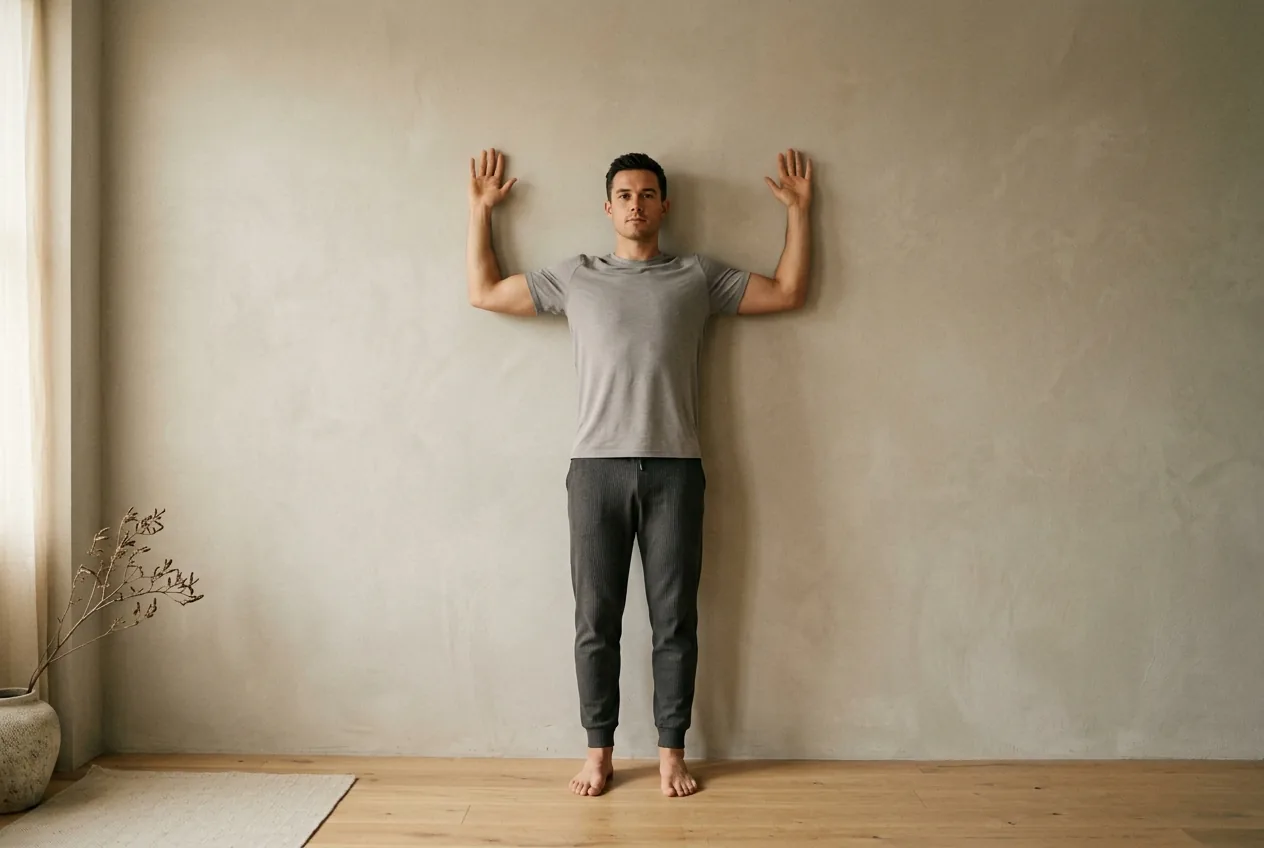
- Stand with your back against a wall, feet about six inches out from the base, knees soft.
- Press your lower back, upper back, and the back of your head into the wall. There'll be a small natural gap at your lower back — don't force it flat.
- Raise your arms and put the backs of your hands and elbows against the wall, elbows bent at about ninety degrees, like a goalpost or a "W."
- Keeping arms, hands, and head in contact with the wall as much as you can, slide your arms slowly up overhead toward a "Y."
- Slide back down to the start, drawing your elbows toward your ribs and squeezing your shoulder blades together at the bottom.
- Move slowly — three or four seconds each direction. That's one rep.
The work should be felt between and below your shoulder blades, with a gentle stretch across the chest. Keep your ribs down — don't let your lower back arch off the wall to fake the range.
The cheats almost everyone makes
Arching the lower back. When the shoulders won't move freely, people let the lower back hump off the wall to get the arms up. That borrows movement from the wrong place. Keep your ribs anchored; let your arms only go as high as they can while your back stays put.
Shrugging. Shoulders rising toward the ears means the overworking upper-trap muscles are taking over. Consciously draw your shoulders down away from your ears throughout the move.
Losing wall contact. If your hands or elbows peel off the wall, you've hit your current range. Don't chase the full motion by leaving the wall — work at the edge where you can stay in contact.
Rushing. Speed lets momentum do the job and skips the muscles you're trying to wake up. Slow is the point.
Flaring the ribs. As the arms go up, it's tempting to let the front of the ribcage pop forward off the wall. That's the lower back arching in disguise. Keep the front of your ribs gently knitted down toward your hips so the movement comes from the shoulders, not the spine.
Reps, sets, and scaling
Start with 2 sets of 8–10 slow reps, once or twice a day. Daily practice is what moves the range.
If full wall angels are too tight right now, scale down:
- Reduce the range: only slide up as far as you can keep elbows and hands on the wall, even if that's a few inches.
- Step the feet further out: more distance from the wall reduces how much your lower back has to stay flat.
- Floor version: lie on your back and do the same motion against the floor for more support.
As mobility improves, slow the tempo further and pause for two seconds at the top. Pair wall angels with chin tucks to address the head-forward half of the same pattern, and with core exercises for lower back pain if your rounded upper back sits over a cranky lower back.
What to expect over a few weeks
The first thing most people notice is the gap — how far their hands and elbows start out from the wall. That gap is your before picture. Over a couple of weeks of daily practice, the chest loosens and the mid-back muscles wake up, and the same arms that wouldn't touch the wall start sliding closer to it. Reaching overhead to a high shelf gets easier, and the low-grade tightness between the shoulder blades tends to settle. The change is gradual because you're undoing a shape your body adopted over years — but the wall gives you honest, visible feedback every single session, which makes it one of the more motivating moves to keep up.
When to see a doctor
Wall angels are low-risk, but shoulders and necks can hide nerve issues. Stop and see a clinician promptly if you get numbness, tingling, or weakness down an arm, sharp shoulder pain that catches on certain movements, dizziness during the exercise, or pain that's clearly worsening rather than easing. New pain after a fall or injury also deserves a proper look before you train through it.
Why the same move helps unevenly
Wall angels reliably open a rounded upper back. But whether a rounded upper back is the main driver of your discomfort — or a side effect of something lower down, like a tipped pelvis pulling your whole posture out of stack — is specific to you. The same move that frees one person's shoulders barely touches another's, because their imbalance lives somewhere else.
That's the limit of any single exercise pulled off a list. Knowing where your own posture actually deviates is what turns wall angels from a nice-feeling stretch into part of a routine that holds. A posture assessment measures your alignment head to hip and builds the sequence around what it finds.
Do wall angels slowly, stay honest about your range, and practise them daily. They'll give your upper back its movement back — and then you can fit them into the routine your body actually needs.
Common questions
What are wall angels good for?
They open a chest and upper back that desk work has rounded shut. Pressing your back to the wall stretches the tight chest while sliding your arms wakes up the mid-back muscles that pull your shoulder blades down and together.
Why can't I get my arms flat against the wall?
That gap is the wall measuring how much shoulder and upper-back movement you've lost to hunching. It's not failure — work at the edge where your hands and elbows stay in contact, and the range improves with daily practice.
How often should I do wall angels?
Start with 2 sets of 8 to 10 slow reps, once or twice a day. Daily practice is what moves the range. Slow tempo matters more than the number of reps.
Can I do wall angels if my shoulders are too tight?
Yes, scale them. Reduce how far you slide up, step your feet further from the wall, or do the same motion lying on the floor for more support. Work within the range where you can keep contact.