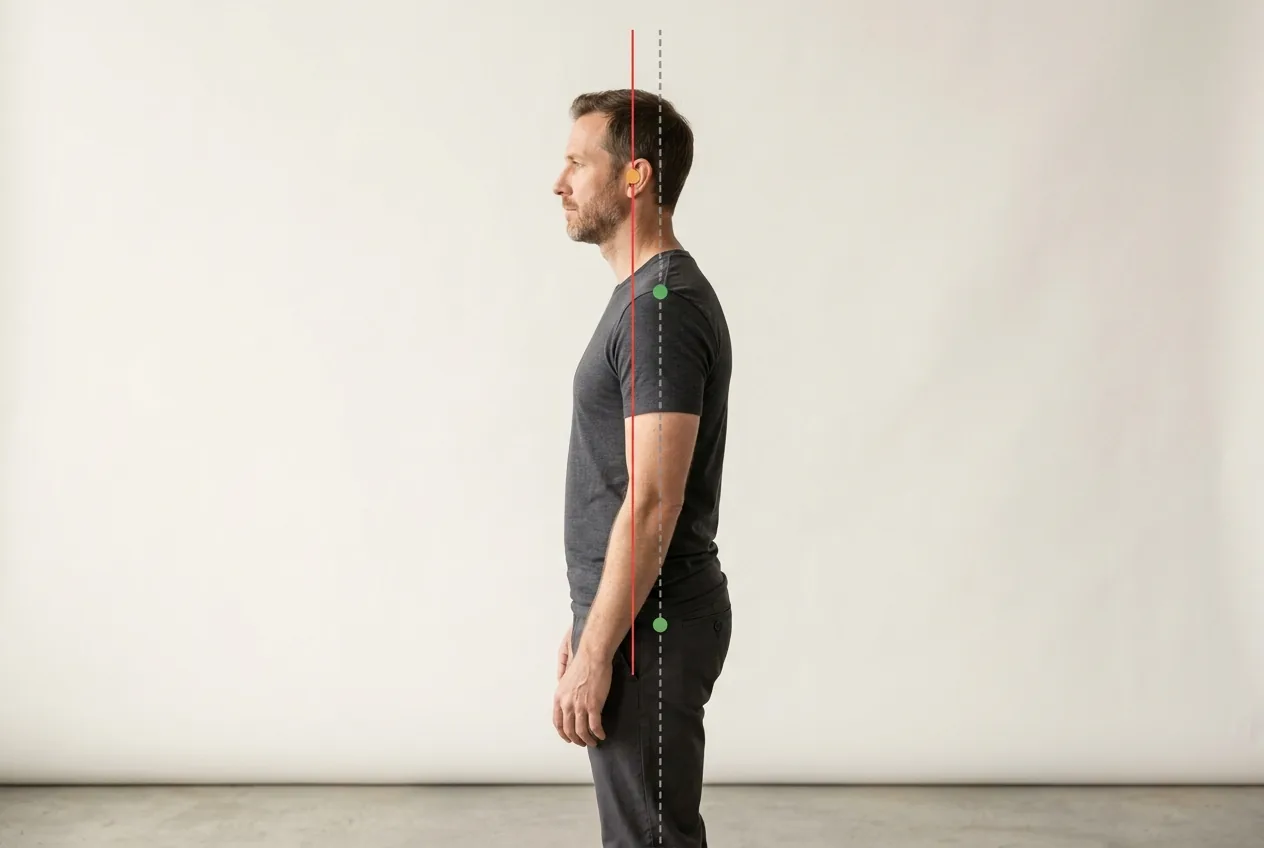

You reach up to a high shelf, or back to put your arm through a jacket sleeve, and a pinch flares in the front of your shoulder. You've rubbed it, iced it, maybe done a few rotator-cuff exercises off the internet. It quiets down, then comes right back. The shoulder feels like the problem, so the shoulder is where you keep looking.
Here's the part that usually gets missed. A lot of shoulder pain from posture isn't really coming from the shoulder joint at all. It's coming from the foundation the shoulder sits on — the upper back and the shoulder blade. When that foundation is rounded forward and stuck, the joint at the top of your arm gets squeezed into positions it was never meant to work in, and the ache that follows is the downstream complaint.
The shoulder doesn't move alone
Your arm bone doesn't hang off your spine directly. It connects to the shoulder blade, a flat bone that floats on the back of the rib cage and slides as you move. When you lift your arm overhead, the shoulder blade is supposed to rotate and tilt to clear space for the arm bone to glide cleanly. Roughly a third of the total motion of "raising your arm" actually comes from the shoulder blade moving, not the shoulder joint itself.
So the shoulder blade has to be in a good position and free to move for the joint above it to work. When your upper back is rounded and your shoulders sit forward — the default after years at a desk — the shoulder blade gets pulled out of place. It tips forward and rides up toward your ears. From there it can't rotate properly when you lift your arm.
The result is a pinch. With the blade stuck, the space the arm bone needs gets narrowed, and the tendons running through that space get compressed every time you reach overhead or behind you. That repeated squeezing is what most people feel as shoulder pain, and it's why the joint can be irritated even when nothing inside it is torn.
The shoulder is usually the place that hurts, not the place that's broken. The fix tends to live one level down.
Why posture sets it up
The pattern behind it is familiar if you've read about rounded shoulders. Hours hunched over a keyboard or a phone shorten the chest muscles at the front and let the muscles between the shoulder blades go long and weak. The chest pulls the shoulders forward; the back can't pull them home. The blade settles into a tipped-forward, hiked-up position and stays there.
Pile a forward head on top of that — which usually comes with the same slump — and the muscles around the neck and upper shoulders stay clenched all day. Now the blade isn't just out of position, it's anchored there by tight tissue. This is the same chain behind forward head posture and the knot between the shoulder blades so many desk workers describe.
The shoulder, sitting on top of all this, just inherits the problem. Strengthen the rotator cuff all you like — if the blade underneath it is stuck forward, you're loading a joint that's still pinched.
What to do about it
The aim is to free the upper back, wake up the muscles that pull the shoulder blade back and down, and stop feeding the forward slump all day. Move gently. Nothing here should reproduce a sharp pinch.
Open the front, free the back
- Doorway chest stretch. Stand in a doorway, forearm on the frame with the elbow at about shoulder height, and step gently through until you feel a stretch across the front of the chest and shoulder. Hold 20–30 seconds each side. This eases the tight chest that drags the shoulders forward.
- Thoracic extension over a chair. Sit, lace your hands behind your head, and gently arch your upper back over the chair's backrest, looking slightly up. A few slow reps. This restores the upper-back extension that the rounded posture takes away.
Wake up the shoulder blade
- Wall angels. Stand with your back to a wall, arms in a goalpost shape touching the wall, and slide them up and down while keeping contact. This trains the blades to move and the mid-back muscles to fire. The full how-to is in our wall angels guide.
- Scapular setting. With arms at your sides, gently draw both shoulder blades down and slightly together, as if tucking them into your back pockets. Hold five seconds, release, repeat ten times. This teaches the blade to find its home position instead of hiking up.
Change the daily input
- Raise your screen so your head isn't drifting forward and your shoulders aren't curling in.
- Every hour, do one slow set of scapular settings or a doorway stretch. The habit matters more than the single session.
- Carry bags on both sides, not always the same one — a heavy bag on one shoulder keeps that blade hiked.
When to see a doctor
Most posture-related shoulder pain eases as the upper back opens and the blade starts moving. But some shoulder pain needs a clinician. See one promptly for shoulder pain after a fall or impact, pain with significant weakness or an inability to lift the arm at all, a shoulder that looks deformed or out of place, or pain with redness, swelling, and fever.
One flag worth knowing: shoulder pain — especially on the left side — that comes with chest pressure, shortness of breath, sweating, or pain spreading to the jaw or arm can signal a heart problem and needs urgent care, not posture work. When shoulder pain arrives with those symptoms rather than with movement, treat it as urgent.
Why it keeps coming back
If your shoulder keeps flaring no matter how many cuff exercises you do, it's usually because the foundation hasn't changed. The upper back is still rounded, the blade is still stuck forward, and every overhead reach re-pinches the same tissue. You can calm a flare, but the setup that caused it is still there the next morning.
Lasting relief comes from changing the posture underneath the shoulder, and that depends on your own pattern — how rounded your upper back is, how far your head sits forward, which muscles are short and which are switched off. The right work for one posture can be wrong for another, which is why a generic shoulder routine often does nothing. A posture assessment measures your actual deviations and builds the routine around them. If your shoulder keeps catching despite the exercises, see how a posture-based method addresses chronic pain by starting from your real alignment.
Free the upper back, give the shoulder blade somewhere to move, and the joint on top of it usually stops complaining.
Common questions
Can bad posture really cause shoulder pain?
Yes. A rounded upper back and forward shoulders pull the shoulder blade out of position, which narrows the space the arm bone needs to move. Reaching overhead then pinches the tendons running through that space, and that repeated squeezing is what most people feel as shoulder pain.
Why does my shoulder hurt when the scans look fine?
A lot of postural shoulder pain is mechanical, not structural. The joint is being pinched because the shoulder blade underneath it is stuck forward, so the tissue gets irritated even when nothing is torn. Freeing the upper back and the blade often settles it.
Will strengthening my rotator cuff fix it?
Not on its own if the shoulder blade is stuck. Strengthening the cuff while the blade sits tipped forward just loads a joint that's still pinched. Freeing the upper back and retraining the blade's position usually has to come first.
When should shoulder pain be checked by a doctor?
See a clinician for pain after a fall, marked weakness or inability to lift the arm, a deformed-looking shoulder, or pain with fever and swelling. Seek urgent care if shoulder pain comes with chest pressure, shortness of breath, sweating, or pain spreading to the jaw, which can signal a heart problem.