
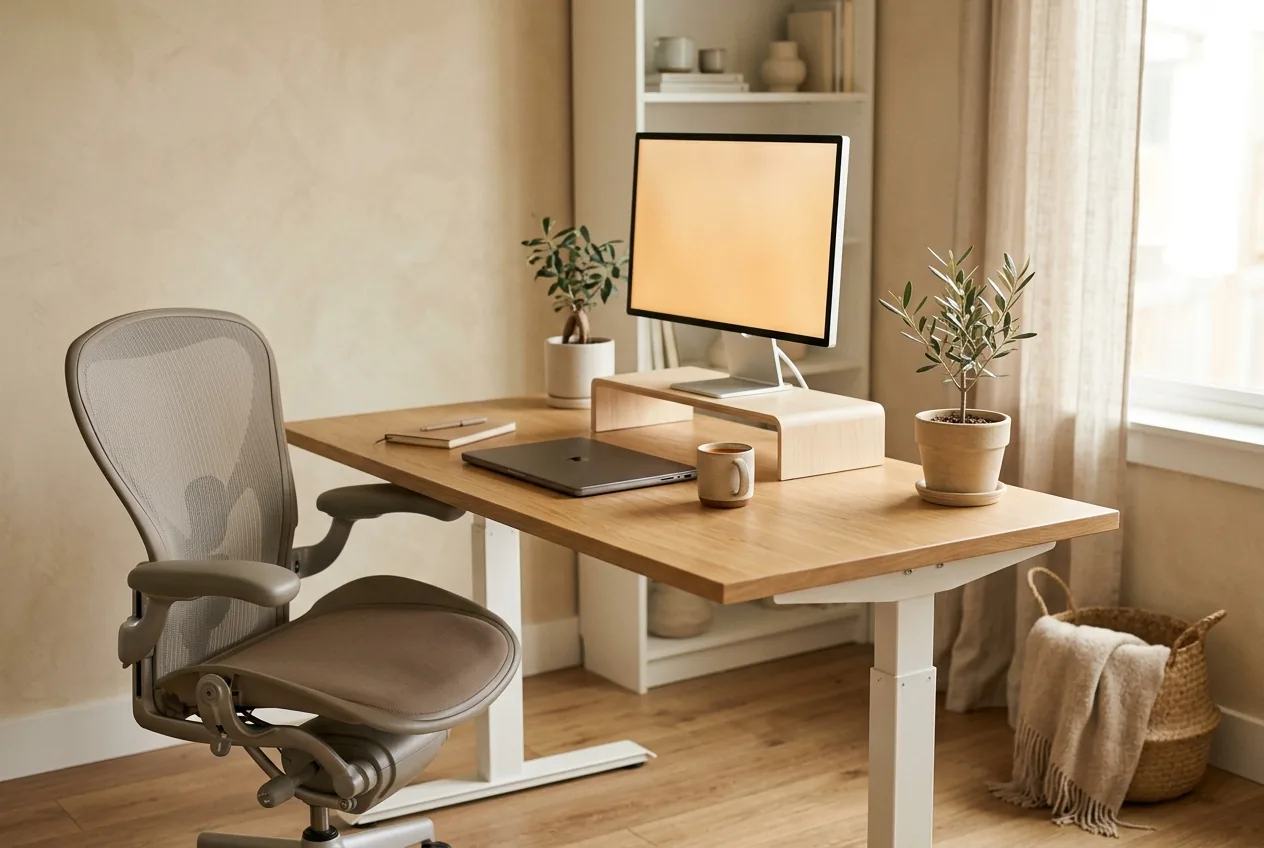
You've seen the word stamped on chairs, keyboards, mouse pads, even footrests, usually next to a price tag that's noticeably higher than the version without the label. "Ergonomic." It sounds like a promise — buy this and your back will stop hurting. So you wonder whether the expensive chair is actually worth it, or whether you're paying for a word.
Here's the plain truth. "Ergonomic" isn't a regulated term. Anyone can print it on anything. But there's a real idea underneath it, and a handful of features that genuinely matter. Once you know what those are, you can tell a chair that supports your body from one that just wears the badge — and you stop overpaying for marketing.
What "ergonomic" actually means
Ergonomics is the study of fitting the work to the person, rather than forcing the person to fit the work. Applied to furniture, ergonomic means designed to support your body in a neutral, comfortable position while you use it — so your skeleton holds you up and your muscles aren't straining to compensate.
That's the whole concept. A genuinely ergonomic chair lets you sit with your spine's natural curves supported, your feet flat, and your arms relaxed. A genuinely ergonomic desk lets your forearms stay level. The label only means something if the object actually achieves that fit for your body. A "ergonomic" chair that doesn't adjust to your size is just a chair with a sticker.
Ergonomic isn't a feature you buy. It's whether the thing fits you — and fit means adjustable.
The features that genuinely matter in a chair
Strip away the marketing and a supportive chair comes down to a short list. These are the things that do real work.
- Adjustable seat height. So you can get your feet flat and your hips level with or slightly above your knees. Without this, the chair can't fit different bodies — and you are a specific body.
- Lumbar support that meets your lower back. Your lower spine curves inward, and a good chair fills that gap so the curve doesn't collapse. Adjustable lumbar support is better than fixed, because backs sit at different heights.
- Seat depth. You should be able to fit a few fingers between the seat's front edge and the back of your knees. Too deep and you can't use the backrest; too shallow and your thighs aren't supported.
- A seat that isn't too soft. Deep cushioning feels nice in the showroom and lets your pelvis sink and roll backward over hours. Firm-but-comfortable holds a neutral pelvis far better.
- Adjustable armrests. So your shoulders can relax down instead of hunching or bracing.
- A backrest that supports the spine's curves and, ideally, reclines slightly so you're not locked bolt upright.
Notice the theme: nearly every real feature is about adjustability. That's the tell. The more a piece of furniture can be adjusted to your body, the more genuinely ergonomic it is. This is exactly what makes an ergonomic chair for back and hip pain worth the attention — not the brand, the adjustment range.
What about ergonomic desks and accessories?
The same logic extends past chairs.
Desks. A genuinely ergonomic desk is one whose height lets your forearms stay level when you type — which usually means it's height-adjustable, or paired with a chair and footrest that get you there. Height-adjustable (sit-stand) desks earn the label because they fit more bodies and let you change position. A fixed desk at the wrong height isn't ergonomic no matter what the listing says. Getting that number right is its own small task, covered in the right desk and chair height.
Keyboards and mice. "Ergonomic" keyboards aim to keep your wrists straight and forearms neutral; vertical mice aim to reduce forearm twist. These can help if you have wrist or forearm strain, but they're secondary to getting your chair and desk height right first.
Footrests, monitor stands, lumbar cushions. These are the cheap heroes. A footrest under a too-high desk, a stand that raises your monitor to eye level, a lumbar cushion in a chair that lacks support — each fixes a real problem for a fraction of the price of premium furniture. Often they do more than the badge-bearing chair. They're a key part of a complete ergonomic desk setup.
The marketing to ignore
Some "ergonomic" claims are mostly decoration. Be skeptical of:
- Vague comfort language — "contoured," "premium support," "ergonomic design" — with no actual adjustments. If you can't adjust it to you, it can't fit you.
- One-size chairs. Bodies vary enormously. A chair with no height or lumbar adjustment can't be ergonomic for everyone, by definition.
- Gadgets that promise to "fix posture" passively while you do nothing. No piece of furniture corrects posture on its own; it can only make a good position easier to hold.
- Gel and memory-foam everything. Plush isn't the same as supportive. Often the opposite.
When to see a doctor
Furniture is comfort and prevention. It isn't a treatment for pain, and the word "ergonomic" definitely isn't a medical claim. If you have pain beyond ordinary stiffness — numbness, tingling, or weakness in your limbs, pain after a fall, pain with fever or unexplained weight loss, or pain that's severe or steadily worsening — see a clinician rather than shopping for a chair to fix it. Good furniture supports recovery; it doesn't replace assessment of persistent or worsening symptoms.
Why even the best chair is only half the answer
A genuinely ergonomic, well-adjusted chair makes a good sitting position easier to hold. That helps. But the chair can only support the posture you bring to it — and most chronic back and neck pain traces to a posture pattern you carry everywhere, built over years, not just to the furniture under you.
Two people in the same excellent chair can still ache for different reasons, because their underlying deviations differ. A short posture assessment measures where your body actually sits out of neutral and builds a routine for it — so the chair becomes a support for a posture you're actively training, rather than the whole plan.
Common questions
Is ergonomic furniture worth the money?
It's worth it when the price buys real adjustability — seat height, lumbar support, seat depth, armrests — that lets the furniture fit your specific body. It's not worth it when you're paying for the word "ergonomic" on a one-size piece with no adjustments. Judge by what it can adjust, not by the label or the price.
What's the difference between an ergonomic chair and a regular chair?
A genuinely ergonomic chair adjusts to support your body in a neutral position — feet flat, lumbar curve held, arms relaxed — while a regular chair holds one fixed shape that fits some bodies and not others. The defining feature is adjustability, not styling or cushioning.
Can ergonomic furniture fix my back pain?
It can remove the obvious provocations and make a supportive position easier to hold, which helps a lot of people. But it can't fix pain on its own if the cause is a posture pattern you carry everywhere. Pair good furniture with regular movement and, where pain persists, a routine matched to your own deviations.
Do I need ergonomic furniture or just good habits?
Both help, and habits often matter more. The cheapest, highest-impact moves are raising your monitor to eye level, supporting your lower back, and getting up to move every half hour — none of which require premium furniture. Good furniture makes good habits easier, but it doesn't replace them.