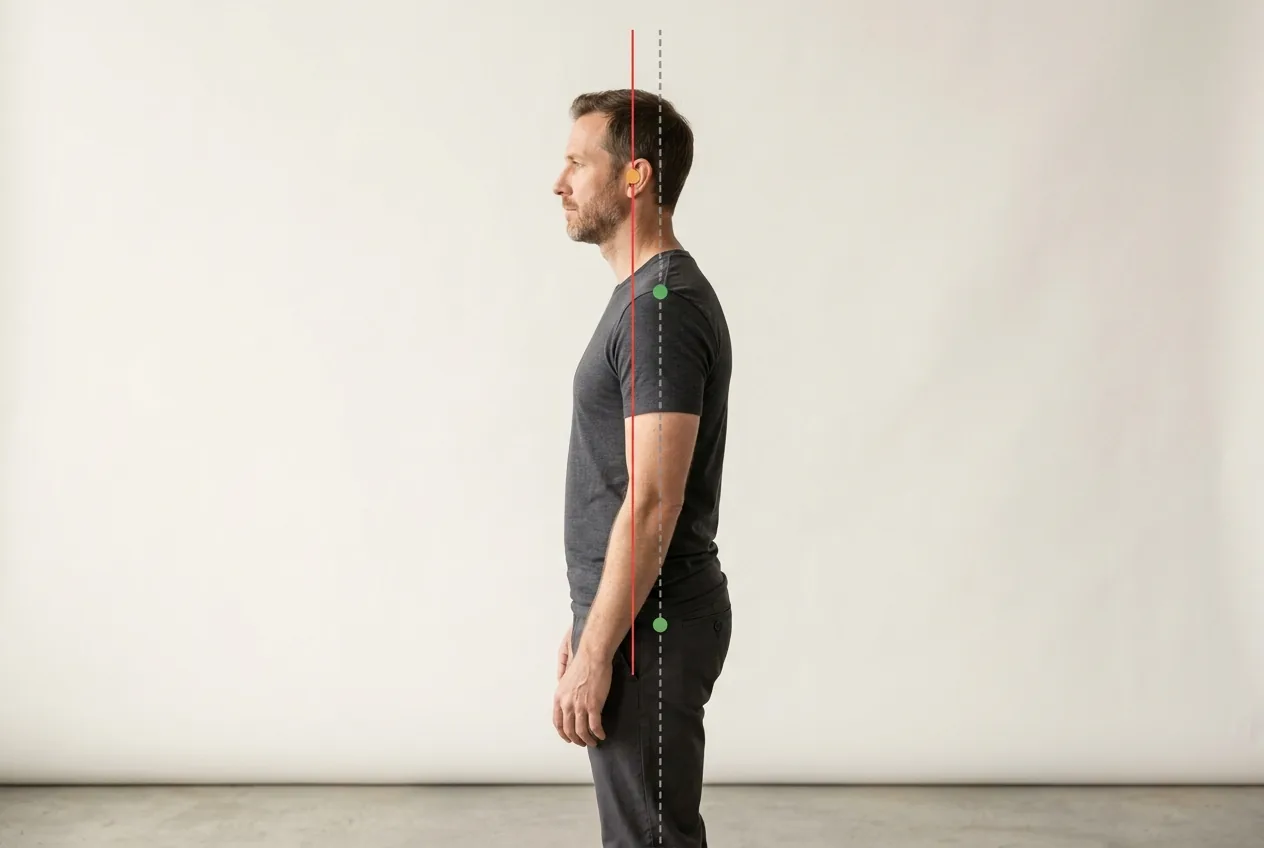

It starts somewhere around the middle of a long workday — a hot, raw, burning line between your shoulder blades, right along the spine. Not a sharp stab, not a dull ache, but a burn, like the muscle there has been switched on too long and is starting to protest. You arch back, you roll your shoulders, and it eases for a minute before settling back in. Burning pain between the shoulder blades is one of the most common desk complaints, and it almost always has the same root.
The location is the giveaway. That strip of muscle is doing a job it can't sustain, and the burn is it telling you so.
Why the burn shows up there
The muscles between your shoulder blades — the rhomboids and the middle part of the trapezius — have one main job: to hold your shoulder blades back and steady against your spine. When you sit upright with your shoulders stacked over your hips, they barely have to work. When you slump forward over a keyboard or phone, everything changes.
In a slumped position the shoulders roll forward and the upper back rounds. That pulls the muscles between the shoulder blades into a long, stretched position — and then asks them to hold you there for hours. A muscle held stretched and working at the same time fatigues fast. As it tires, it produces that hot, burning quality. It's not damage. It's an endurance failure in muscles that were never meant to be on duty all day.
That's why the burn builds as the day goes on and eases the moment you stand, stretch, or pull your shoulders back. You've briefly given those muscles a break or changed their length. The relief is real but short, because the slumped position comes right back the moment you return to the screen.
The whole setup usually rides on a rounded upper back and forward-pulled shoulders. That pattern is described in rounded shoulders, and it's the same posture behind the tight, knotted feeling covered in the knot between your shoulder blades.
The burn between your shoulder blades is muscle fatigue, not injury — fatigue from holding a slumped position your body wasn't built to sit in for hours.
What to do about it
Lasting relief comes from two things at once: changing the position that overloads those muscles, and building enough strength there that they can do their job without burning out.
Reset the position often
The single most effective move is the cheapest. Every twenty to thirty minutes, sit or stand tall, pull your shoulder blades gently down and back, and lift the breastbone. Hold five seconds, relax. You're giving the overworked muscles a brief reset and reminding your body what neutral feels like. Done often, this alone takes the edge off most cases.
Open the front
Slumping shortens the chest muscles, which then pull the shoulders forward and keep the back muscles stretched. A doorway chest stretch counters it: stand in a doorway, forearms on the frame, and step gently through until you feel a stretch across the chest. Hold thirty seconds. The doorway chest stretch guide has the setup.
Strengthen the middle back
The deeper fix is making those muscles strong enough to hold you up without burning.
- Band pull-aparts. Hold a light band at chest height and pull it apart, squeezing the shoulder blades together. See band pull-aparts for posture.
- Wall angels. Slide your arms up and down a wall keeping contact, which trains the same muscles through a useful range — the wall angels exercise guide shows the form.
- Thoracic extension. Gently arching the upper back over a rolled towel or chair edge restores the mobility that slumping takes away.
Bring the head back too
A forward head drags the upper back into rounding, so stacking the head over the shoulders with chin tucks supports everything below it. The chin tucks exercise guide covers it.
What to stop doing
- Don't power through hours of slumping and rely on stretching at the end. The damage is the holding, not the lack of a stretch.
- Don't only stretch the burning area. It's already overstretched; piling on more stretch can leave it more irritated. It needs strength.
- Don't prop the laptop low on your lap, which forces the deepest slump of all. Raise the screen toward eye level.
When to see a doctor
Posture work is education, not medical advice. Most burning between the shoulder blades is muscular and eases with position changes and strengthening. But this is one area where it pays to be careful, because pain here can occasionally reflect something other than muscle. See a doctor promptly if the burning comes with chest pain, pressure, shortness of breath, sweating, or pain spreading to the jaw or arm — those need urgent assessment. Also see a clinician if you have numbness, tingling, or weakness, a fever, unexplained weight loss, pain after a fall, or pain that's severe, steadily worsening, or waking you at night. When in doubt, get it checked rather than assuming it's posture.
The pattern worth knowing
Position resets and strengthening settle most cases. But how rounded your upper back is, how far forward your shoulders pull, and which muscles have gone weak are specific to you — and a generic routine can leave the real driver in place.
A proper posture assessment measures how your upper back and shoulders actually sit and builds a daily routine around it, so the muscles between your shoulder blades stop being asked to do the impossible. Change the load, and the afternoon burn fades.
Common questions
What causes burning pain between the shoulder blades?
Most often it's fatigue in the muscles that hold your shoulder blades back. Slumping forward stretches those muscles and keeps them working for hours, and a muscle held stretched and active too long produces a burning feeling. It builds through the day and eases when you sit tall or stand.
Is burning between the shoulder blades serious?
Usually it's muscular and not dangerous. But pain in this area can occasionally signal something else, so get urgent care if it comes with chest pressure, shortness of breath, or pain spreading to the jaw or arm, and see a doctor for pain that's severe, worsening, or paired with fever, weight loss, or weakness.
How do I get rid of burning between my shoulder blades?
Reset your posture every twenty to thirty minutes by pulling the shoulder blades down and back, open the chest with a doorway stretch, and strengthen the mid-back with band pull-aparts and wall angels. Raising your screen toward eye level removes the slump that causes it.
Why does it burn more the longer I sit?
Because the muscles are working the whole time you're slumped. Fatigue accumulates the longer they stay stretched and active, so the burn intensifies as the day goes on. Standing or sitting tall briefly unloads them, which is why a quick reset gives temporary relief.